
Spring migration counts: Col de l'Escrinet, Pointe de Grave and Le Hucel
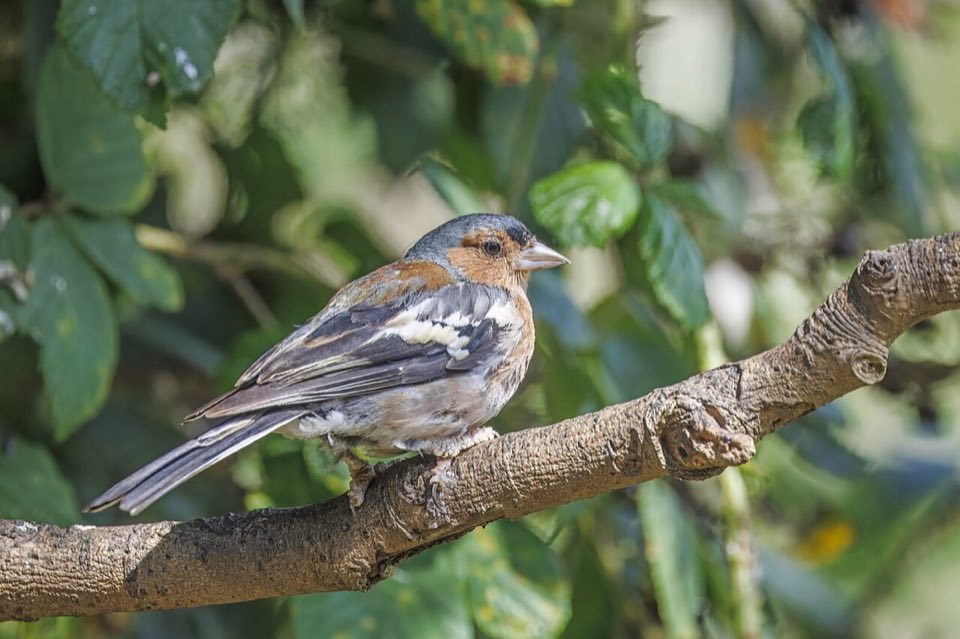
Chaffinch (150,000+ a spring at Escrinet), woodpigeon, meadow pipit, swallows and swifts, black kite, honey buzzard, common crane, white stork, turtle dove, bee-eater (Pointe de Grave). Ardèche (Escrinet), Gironde (Pointe de Grave), Haute-Savoie (Hucel), Drôme (Pierre-Aiguille), France.
Best time: 20 Feb – 15 Apr and 10 Apr – 25 May (February to May). Where: Col de l'Escrinet (789 m), Ardèche, Pointe de Grave, Le Verdon-sur-Mer, Le Hucel, Thollon-les-Mémises (France). Time of day: Passerines move from first light until late morning, loudest in the first 3 h.
- You can go on your own
- Free
- Binoculars helpful
- Sound 4/5
Open it in the interactive calendarSunrise and sunset listening times for the day you pick, and the map.
When is the best time?
- Peak 1: 20 Feb – 15 Apr — Escrinet, Pierre-Aiguille, Hucel: finches, pigeons, kites, cranes
- Peak 2: 10 Apr – 25 May — Pointe de Grave: swifts, swallows, turtle doves, bee-eaters, honey buzzards
Active from 15 Feb to 31 May (February to May) in a typical year.
Time of day
Passerines move from first light until late morning, loudest in the first 3 h; raptors and pigeons once the air warms, 10:00–15:00. The LPO counters are on site daily from dawn (Escrinet and Pierre-Aiguille mid February to mid April; Pointe de Grave mid March to end of May).
- Passerine passage: 15 min before sunrise → 3 h after sunrise
- Raptors and pigeons: 10:00 → 15:00
What will you hear?
A river of chaffinch flight calls over the col at dawn, meadow pipits, serins and linnets in the flocks, woodpigeon wing-clatter, cranes bugling northwards in March, and at Pointe de Grave the May sound of swifts screaming low over the dunes and bee-eaters calling in off the Gironde — one of the few places in France where spring migration is a sound you can stand under.
Binoculars?
Binoculars helpful. Finch flocks pass at head height over the cols — ears first; binoculars for kites and cranes, a scope for the high Pointe de Grave raptors.
Where to go
- Col de l'Escrinet (789 m), Ardèche — LPO Auvergne-Rhône-Alpes count point on the col between Privas and Aubenas (N104); land of the Fondation Franz Weber, counted since the 1980s; a counter welcomes the public daily mid Feb–mid April. Map
- Pointe de Grave, Le Verdon-sur-Mer — LPO Aquitaine's spring station: a wooden hut on a 10 m dune at the tip of the Médoc, birds funnelled between the Gironde and the ocean; 80,000–120,000 birds a spring. Map
- Le Hucel, Thollon-les-Mémises — Pre-nuptial count site above Lake Geneva (LPO Haute-Savoie); cranes, kites, finches over the Chablais. Map
- Pierre-Aiguille, Crozes-Hermitage (Drôme) — Escrinet's twin station on the Rhône; white storks from mid February. Map
How to go on your own, and what it costs
Escrinet: the N104 Privas–Aubenas crosses the col; park at the col and join the LPO counter at the marked point (free, daily mid February to mid April; launch day with public events in February). Pointe de Grave: drive the Médoc to Le Verdon-sur-Mer and walk to the dune hut beside the ferry terminal (free, mid March to end of May, mornings). Hucel: minor road above Thollon-les-Mémises to the col; Pierre-Aiguille: hamlet above Crozes-Hermitage.
Cost: Free.
Field-recording notes
Open cols and road verges: the N104 runs over Escrinet (lorries), the Pointe de Grave hut sits by the ferry terminal and the beach. Early mornings are quiet enough and the flight calls are overhead, not distant — a short shotgun or a parabola pointed up works. The counters need concentration; stand beside, not in front. No permits; stay off the Escrinet private land beyond the count point. Weather: southerly winds and clear skies bring the big days; after a rainy block the next clear morning is the one.
Sources
- LPO Auvergne-Rhône-Alpes – Migration Escrinet / Pierre-Aiguille
- LPO – Rapport Escrinet 2025 (22 Feb–21 Apr, 59 count days)
- Migraction.net – sites de suivi (Pointe de Grave, Escrinet, Hucel)
- LPO Aquitaine – Observatoire régional de la migration 2016 (Pointe de Grave)
Similar spectacles
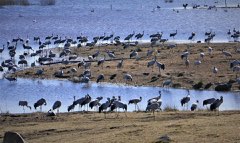 Spring crane staging: Hornborgasjön and PulkenThousands of cranes bugling in chorus — trumpeting that carries for kilometres, rising to a roar when a flock lifts; unison calls of pairs, wing noise of landing flocks, whooper swans and lapwings in the background.
 Cranes at Laguna de GallocantaUp to 100,000 cranes lifting off the salt lagoon at first light in a continuous trumpeting roar that lasts half an hour, then skeins bugling over the steppe villages.
 Breskens: spring migration over the Westerschelde dikeA river of flight calls — meadow pipit, yellow wagtail, finches, linnets — low over your head, with the Westerschelde ships behind; screaming swift flocks on a May top day; harriers silent overhead; a crowd of counters calling out species.
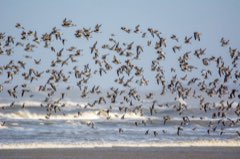 Wadden Sea high-tide wader roosts: Westhoek and the Frisian coastThe rising murmur of tens of thousands of dunlin and curlew sandpipers packed on the roost, then the rush of wings as the flock lifts and turns; curlew and grey plover calls; brent geese in autumn; wind over the flats.
 Neretva delta: the Adriatic flyway stopoverBittern booming from the reeds, whiskered and black terns over the lagoons, marsh frogs, great reed warblers, glossy ibis and egret flights at dusk, Cetti's warbler explosions; frog and cicada layers by June.
 Spring passage on small islandsIsland scrub full of freshly arrived, singing migrants after 'falls', with night flight calls overhead.
More: all spectacles in France · bird migration hotspots · France in February · France in March · France in April · France in May