
Cranes at Laguna de Gallocanta
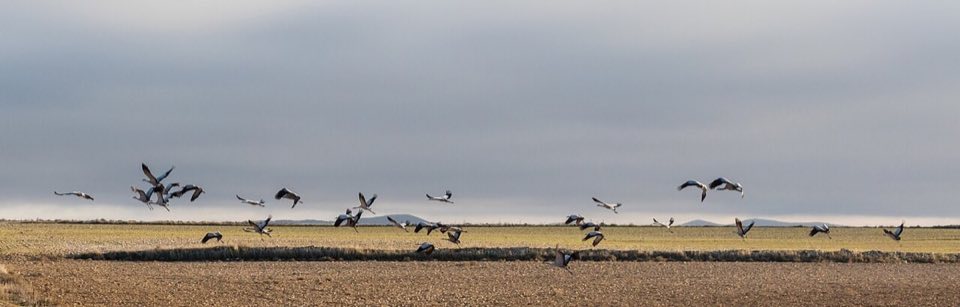
Common crane (Grus grus). Aragón (Zaragoza / Teruel), Spain.
Best time: 1 Nov – 30 Nov and 15 Feb – 10 Mar (February to March, November). Where: Centro de Interpretación de la Laguna de Gallocanta (Bello road), Ermita del Buen Acuerdo, Gallocanta village, Laguna de La Nava, Fuentes de Nava (Palencia) (Spain). Time of day: In place in the dark: the departure roar runs from about 45 min before sunrise for half an hour past it.
- You can go on your own
- Free
- Binoculars helpful
- Sound 5/5
Open it in the interactive calendarSunrise and sunset listening times for the day you pick, and the map.
When is the best time?
- Peak 1: 1 Nov – 30 Nov — November: autumn passage south, tens of thousands on the lagoon roost
- Peak 2: 15 Feb – 10 Mar — Mid February to early March: return passage north — the biggest days of all (114,000 on 24 Feb 2011, 135,000 on 27 Feb 2013)
Active from 15 Oct to 10 Mar (October to March) in a typical year.
Time of day
In place in the dark: the departure roar runs from about 45 min before sunrise for half an hour past it; the return from an hour before sunset until dusk. Perimeter tracks are open all hours.
- Dawn departure: 45 min before sunrise → 30 min after sunrise
- Evening return: 1 h before sunset → last light
What will you hear?
Up to 100,000 cranes lifting off the salt lagoon at first light in a continuous trumpeting roar that lasts half an hour, then skeins bugling over the steppe villages.
Binoculars?
Binoculars helpful. The lift-off roar is overhead in the half-dark; binoculars for the daytime skeins and the far shore.
Where to go
- Centro de Interpretación de la Laguna de Gallocanta (Bello road) — Reserve information and the main dawn viewpoint; the perimeter tracks are open at all hours. Map
- Ermita del Buen Acuerdo, Gallocanta village — Elevated viewpoint over the north shore for the evening return. Map
- Laguna de La Nava, Fuentes de Nava (Palencia) — Second Spanish crane roost on the return route; 10–20,000 birds in Feb–Mar. Map
How to go on your own, and what it costs
Drive the A-1507/A-2506 to the Centro de Interpretación on the Bello road (car park, free); the perimeter tracks around the lagoon are public and open at all hours — be on the north-east shore track in the dark for the dawn lift-off. Ermita del Buen Acuerdo: drive up from Gallocanta village. Stay off the lagoon bed.
Cost: Free.
Field-recording notes
Reserve rules: stay on the perimeter tracks, no entering the lagoon bed even when dry; the water level varies enormously between years and the roost moves with it. Hunting on the surrounding farmland (partridge, hare) in autumn. Cold, dry, often dead calm at dawn — a superb noise floor at 1,000 m altitude; the A-1507 carries a little farm traffic.
Sources
Similar spectacles
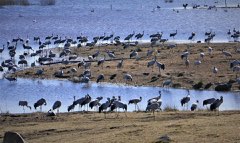 Spring crane staging: Hornborgasjön and PulkenThousands of cranes bugling in chorus — trumpeting that carries for kilometres, rising to a roar when a flock lifts; unison calls of pairs, wing noise of landing flocks, whooper swans and lapwings in the background.
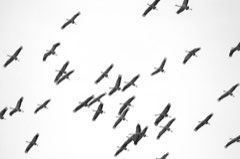 Cranes at Lac du DerTens of thousands of cranes bugling as they leave the lake at first light in wave after wave, then the evening return with the sky full of trumpeting skeins.
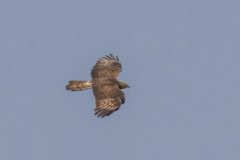 Pyrenean passes: raptor, stork, pigeon & crane migrationMostly visual, but woodpigeon flocks pass with a rush of wings, cranes bugle over the pass, and pre-dawn passerine flight calls stream through — with gunfire from the neighbouring hunting passes.
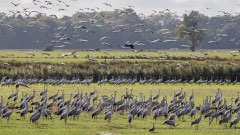 Crane autumn staging: Rügen-Bock, Linum, Diepholz, MüritzWaves of trumpeting families flying in at dusk, the roost's night-long murmur over shallow water, dawn's mass departure with tens of thousands calling at once; greylag and white-fronted geese in the same flights.
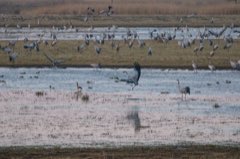 Cranes dancing on the dune heaths and bogsCrane pairs duetting and bugling across the wet dune slacks at first light, the dance's wing-flaps, curlew, golden plover and snipe drumming around them; ravens; the North Sea in Thy.
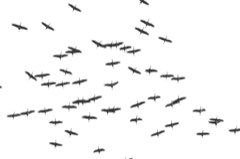 Wintering cranes at ArjuzanxWaves of cranes dropping into the flooded roost after dark, a continuous rolling chorus that carries for kilometres over the pine plantations.
More: all spectacles in Spain · cranes · bird migration hotspots · Spain in February · Spain in March · Spain in November