
Spring crane staging: Hornborgasjön and Pulken
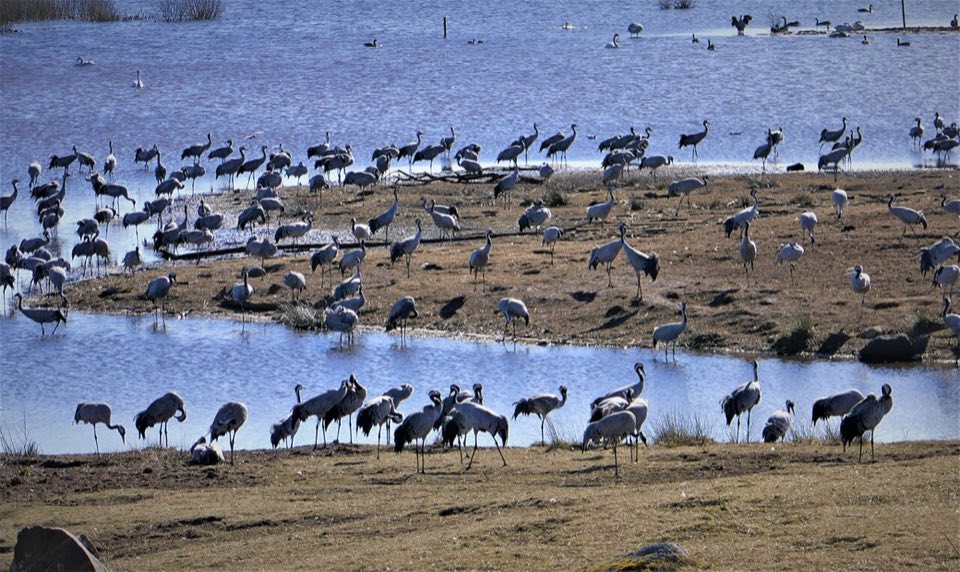
Common crane (Grus grus) — up to ~25,000 at Hornborgasjön; thousands at Pulken, 110,000 counted over one spring season. Hornborgasjön (Västergötland) and Pulken, Kristianstads Vattenrike (Skåne), Sweden.
Best time: 25 Mar – 12 Apr (March to April). Where: Trandansen, Hornborgasjön (south end, by Bjurums kyrka), Naturum Hornborgasjön / Fågeludden (east shore), Utemuseum Pulken, Yngsjö (Kristianstads Vattenrike) (Sweden). Time of day: Cranes leave the roost at first light and stream into the fields around Trandansen — the first hour after sunrise is the loudest.
- You can go on your own
- Low cost
- Binoculars helpful
- Sound 5/5
Open it in the interactive calendarSunrise and sunset listening times for the day you pick, and the map.
When is the best time?
Peak: 25 Mar – 12 Apr. Last week of March to about 12 April; first birds late Feb, season ends when the last leave in late April
Active from 10 Mar to 25 Apr (March to April) in a typical year.
Time of day
Cranes leave the roost at first light and stream into the fields around Trandansen — the first hour after sunrise is the loudest; dancing peaks mid-morning and again in the hour before they fly back to roost at dusk. At Pulken the evening flight into the roost wetland is the main event.
- Dawn flight and dancing: 30 min before sunrise → 2 h after sunrise
- Evening flight to roost: 90 min before sunset → last light
What will you hear?
Thousands of cranes bugling in chorus — trumpeting that carries for kilometres, rising to a roar when a flock lifts; unison calls of pairs, wing noise of landing flocks, whooper swans and lapwings in the background.
Binoculars?
Binoculars helpful. Cranes feed 100–400 m from the Trandansen viewpoint and the Pulken tower; bird guides at Trandansen have scopes. The bugling carries without any optics.
Where to go
- Trandansen, Hornborgasjön (south end, by Bjurums kyrka) — Info centre open daily 18 Mar–15 Apr 08:00–18:00 (2026), bird guides 20 Mar–12 Apr 10:00–14:00; site itself open all year; car park SEK 150/day in crane season (fee funds the cranes' barley). Map
- Naturum Hornborgasjön / Fågeludden (east shore) — Free naturum with tower and three hides; cranes are NOT here — this is for the lake's other birds; overnight campervan parking SEK 150. Map
- Utemuseum Pulken, Yngsjö (Kristianstads Vattenrike) — Accessible bird tower 300 m from the free car park (open 06:00–20:00); entry ban in the rest of the reserve 1 Mar–20 Apr; evening roost flight into the Helge å wetland. Map
How to go on your own, and what it costs
Hornborgasjön: road 184 between Skara and Falköping, follow the yellow crane signs to Trandansen; bus 203 Skara–Falköping stops at 'Trandansen'. Site and info centre are free; pay the parking fee inside the info centre (Swish needs a Swedish bank account). Pulken: from the E22 take road 118 through Åhus towards Yngsjö, turn west towards Everöd, car park signed on the left after 2 km; bus 551 to Yngsjö skolan then 2.3 km on foot. Both: stay on marked trails and respect the spring bird-protection zones.
Cost: Free entry at both; Trandansen parking SEK 150 per car per day in crane season (2026), naturum parking free; Pulken parking free.
Field-recording notes
Trandansen gets busy from mid-morning; for clean crane chorus be there before sunrise when the car park is nearly empty, or record from the public road/bus stop beside the site at dusk. Road 184 runs past Trandansen — face away from it. The barley feeding is management (keeps cranes off sown fields), not a show; the birds are wild and move with the weather, so check the live count/webcams on hornborga.com before driving. Pulken: tower and car park only during the access ban; the roost flight comes in over the tower, good for wing noise. Bird flu outbreaks (Pulken, spring 2026) can change arrangements — check before going.
Sources
- Hornborga.com – Experience the crane dance (dates, hours, fees)
- Hornborga.com – Parking
- Länsstyrelsen Västra Götaland – Hornborgasjön reserve rules
- Kristianstads Vattenrike – Pulken
Similar spectacles
 Cranes at Lac du DerTens of thousands of cranes bugling as they leave the lake at first light in wave after wave, then the evening return with the sky full of trumpeting skeins.
 Cranes at Laguna de GallocantaUp to 100,000 cranes lifting off the salt lagoon at first light in a continuous trumpeting roar that lasts half an hour, then skeins bugling over the steppe villages.
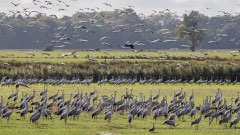 Crane autumn staging: Rügen-Bock, Linum, Diepholz, MüritzWaves of trumpeting families flying in at dusk, the roost's night-long murmur over shallow water, dawn's mass departure with tens of thousands calling at once; greylag and white-fronted geese in the same flights.
 Pyrenean passes: raptor, stork, pigeon & crane migrationMostly visual, but woodpigeon flocks pass with a rush of wings, cranes bugle over the pass, and pre-dawn passerine flight calls stream through — with gunfire from the neighbouring hunting passes.
 Cranes dancing on the dune heaths and bogsCrane pairs duetting and bugling across the wet dune slacks at first light, the dance's wing-flaps, curlew, golden plover and snipe drumming around them; ravens; the North Sea in Thy.
 Vejlerne: bitterns, cranes and Northern Europe's largest reedbedsBittern booming from several directions at once, spotted crake whiplashes, water rail squeals, cranes trumpeting at dawn, bearded reedlings pinging, greylag families, black terns over the lagoons; wind in 8 km of reed.
More: all spectacles in Sweden · cranes · bird migration hotspots · March · Sweden in April