
Pyrenean passes: raptor, stork, pigeon & crane migration
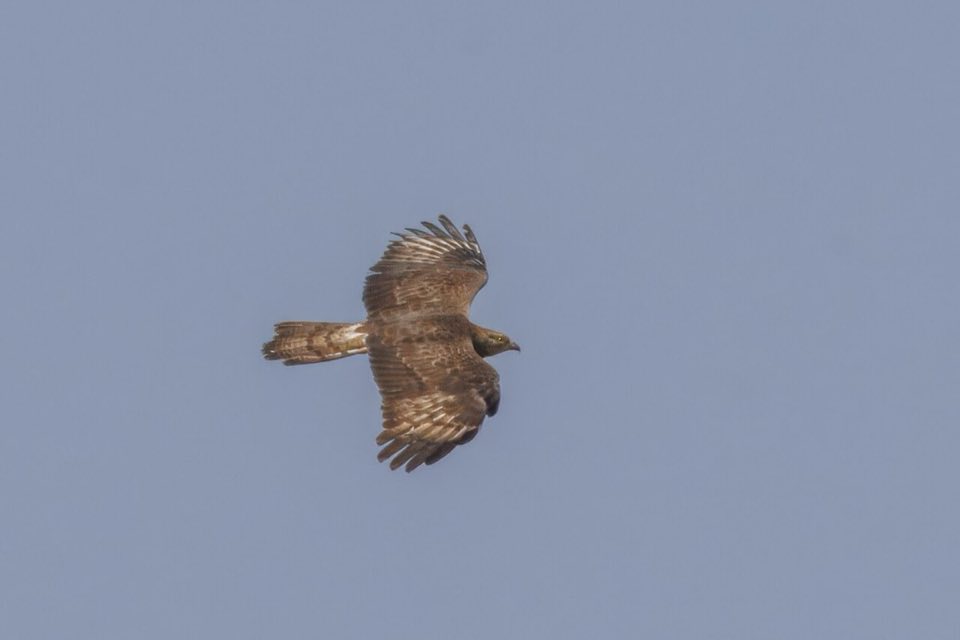
Honey buzzard, black & red kite, black stork, woodpigeon, common crane, passerines. Basque Pyrenees, Pyrénées-Atlantiques, France.
Best time: 20 Aug – 5 Nov (August to November). Where: Col d'Organbidexka (1,283 m), Col de Lindux (Roncevaux), Col de Lizarrieta (Sare) (France). Time of day: Passerine flight calls from about 2 h before sunrise and pigeon flocks through the morning.
- You can go on your own
- Free
- Telescope recommended
- Sound 3/5
Open it in the interactive calendarSunrise and sunset listening times for the day you pick, and the map.
When is the best time?
Peak: 20 Aug – 5 Nov. Honey buzzards late Aug–early Sept; kites Sept–Oct; woodpigeons and cranes mid Oct–early Nov
Active from 15 Jul to 15 Nov (July to November) in a typical year.
Time of day
Passerine flight calls from about 2 h before sunrise and pigeon flocks through the morning; raptors and storks once thermals build, roughly 10:00–16:00.
- Pigeons and passerines: 2 h before sunrise → 2 h after sunrise
- Raptor passage: 10:00 → 16:00
What will you hear?
Mostly visual, but woodpigeon flocks pass with a rush of wings, cranes bugle over the pass, and pre-dawn passerine flight calls stream through — with gunfire from the neighbouring hunting passes.
Binoculars?
Telescope recommended. Raptors and storks pass high over the col; binoculars essential, a scope to sort kites and honey buzzards.
Where to go
- Col d'Organbidexka (1,283 m) — LPO count site, daily 15 July–15 Nov; free to visit, observers welcome. Map
- Col de Lindux (Roncevaux) — Second LPO site near Roncesvalles; autumn only. Map
- Col de Lizarrieta (Sare) — Woodpigeon 'palombière' pass; traditional net and gun hunting on the col in Oct–Nov. Map
How to go on your own, and what it costs
Col d'Organbidexka: drive the D19 from Larrau, park at the pass — the LPO count site is free and observers are welcome daily 15 July–15 Nov. Col de Lindux: from the Roncevaux road. Lizarrieta: D406 from Sare; the pass is a hunting site in Oct–Nov.
Cost: Free.
Field-recording notes
The interesting acoustic story is the pigeon hunt itself: Lizarrieta and the passes around Organbidexka are shot from hides ('palombières') and nets from 1 Oct, so gunshots dominate weekends. Organbidexka was bought out of the hunting lease in 1979 — the count site is shot-free but its neighbours are not. Fog and wind are frequent; the Larrau road is open.
Sources
Similar spectacles
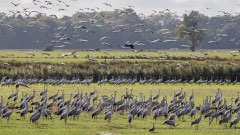 Crane autumn staging: Rügen-Bock, Linum, Diepholz, MüritzWaves of trumpeting families flying in at dusk, the roost's night-long murmur over shallow water, dawn's mass departure with tens of thousands calling at once; greylag and white-fronted geese in the same flights.
 Cranes at Laguna de GallocantaUp to 100,000 cranes lifting off the salt lagoon at first light in a continuous trumpeting roar that lasts half an hour, then skeins bugling over the steppe villages.
 The Zwin: wader passage, ringing season and the stork colonyBill-clattering of storks greeting at the nest; dunlin and redshank flocks over the salt marsh at the top of the tide; curlews; the sea behind the dunes; in autumn a steady trickle of migrating pipits and finches over the dike.
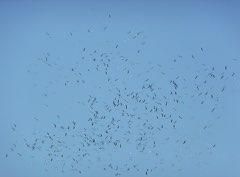 Strait of Gibraltar: raptor & stork passageMostly visual — kettles of thousands — but bee-eater flocks pour over calling all day, honey buzzards pass at head height in a levante, and the stork pre-roost at Los Lances is a bill-clattering crowd.
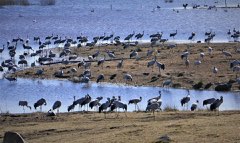 Spring crane staging: Hornborgasjön and PulkenThousands of cranes bugling in chorus — trumpeting that carries for kilometres, rising to a roar when a flock lifts; unison calls of pairs, wing noise of landing flocks, whooper swans and lapwings in the background.
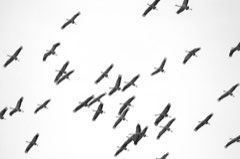 Cranes at Lac du DerTens of thousands of cranes bugling as they leave the lake at first light in wave after wave, then the evening return with the sky full of trumpeting skeins.
More: all spectacles in France · cranes · storks · bird migration hotspots · France in August · France in September · France in October · France in November