
Crane autumn staging: Rügen-Bock, Linum, Diepholz, Müritz
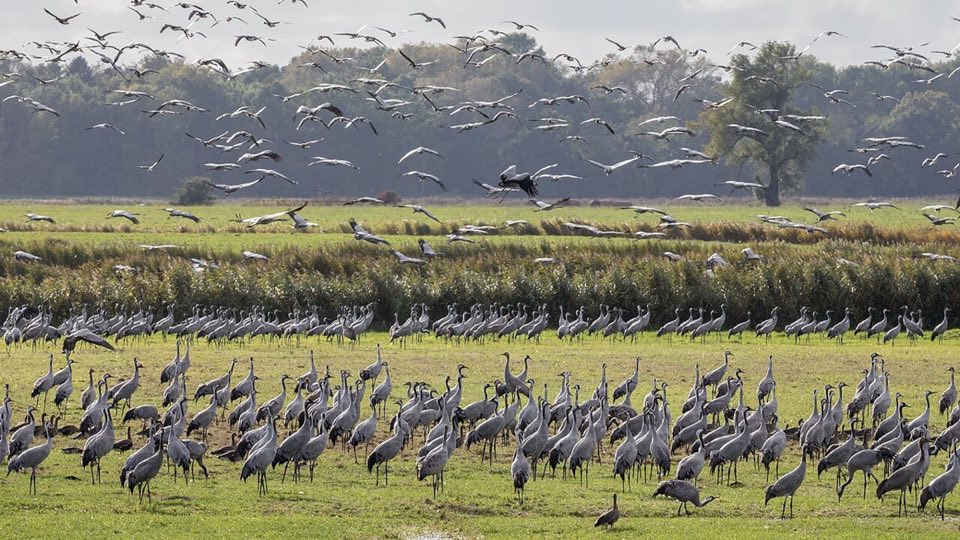
Common crane (Grus grus) — 50,000–70,000 at Rügen-Bock, tens of thousands at Linum and in the Diepholz moors. Mecklenburg-Vorpommern, Brandenburg, Lower Saxony, Germany.
Best time: 5 Oct – 31 Oct (October). Where: Kranorama at Günzer See / Kranich-Informationszentrum Groß Mohrdorf (NABU), Pramort, Zingst (Nationalpark Vorpommersche Boddenlandschaft), Linum ponds / NABU Storchenschmiede (Rhinluch) (Germany). Time of day: Arrive 2 h before sunset: the roost flight runs from about an hour before sunset until dark, the roost murmurs all night, and the mass departure comes from 45 min before sunrise to 30 min after.
- You can go on your own
- Free
- Binoculars helpful
- Sound 5/5
Open it in the interactive calendarSunrise and sunset listening times for the day you pick, and the map.
When is the best time?
Peak: 5 Oct – 31 Oct. Mid to end of October at the Bodden; Linum and Diepholz peak in the second half of October into early November
Active from 10 Sep to 20 Nov (September to November) in a typical year.
Time of day
Arrive 2 h before sunset: the roost flight runs from about an hour before sunset until dark, the roost murmurs all night, and the mass departure comes from 45 min before sunrise to 30 min after. Linum NABU tours start 1.5 h before sunset (Fri–Sun).
- Evening roost flight: 1 h before sunset → 30 min after last light
- Dawn departure: 45 min before sunrise → 30 min after sunrise
What will you hear?
Waves of trumpeting families flying in at dusk, the roost's night-long murmur over shallow water, dawn's mass departure with tens of thousands calling at once; greylag and white-fronted geese in the same flights.
Binoculars?
Binoculars helpful. Flight lines put cranes 50–100 m overhead; binoculars for the feeding fields from the Kranorama and Rehden tower.
Where to go
- Kranorama at Günzer See / Kranich-Informationszentrum Groß Mohrdorf (NABU) — Observation building overlooking a feeding field; the information centre is 14 km NW of Stralsund. Rügen-Bock roost is a closed core zone. Map
- Pramort, Zingst (Nationalpark Vorpommersche Boddenlandschaft) — Dune viewpoint on the main roost; reachable only on foot or by bike (10 km) and closed at dusk in the crane season — day roost views only, book the park's evening tours. Map
- Linum ponds / NABU Storchenschmiede (Rhinluch) — One of the largest inland roosts in Europe; NABU tours Fri–Sun late Sept to early Nov; evening viewing point in the village. Map
- Rehdener Geestmoor tower, Diepholzer Moorniederung (BUND) — Three-level tower on the Moordamm; up to 25,000 cranes in a single evening; strict visitor routing. Map
How to go on your own, and what it costs
Linum: park in the village (NABU Storchenschmiede car park) and walk to the public viewing point and the dyke along the ponds — free at any hour; the NABU tours are optional. Kranorama at Günzer See: free observation building, signed from Groß Mohrdorf. Pramort: bike or walk 10 km from Zingst; in the crane season it is open 08:00–15:00 (until dusk with the Nationalpark-Card from the Zingst Kurhaus) and closed after sunset. Rehden: free BUND tower on the Moordamm, strict routing.
Cost: Free viewpoints; NABU Linum tours €10 evening / €12 morning (2026); Pramort Nationalpark-Card €7.50 per person for late access (2026).
Who runs access
- NABU Storchenschmiede Linum – crane tours (NGO) — Evening arrival and morning departure tours, Fri–Sun, late Sept–early Nov; registration required.
Field-recording notes
The roosts are all closed zones (national park core, NSG) — the sound you can legally get is the flight lines and feeding fields, which at Linum and Diepholz put birds directly overhead at 50–100 m. Arrive 2 h before sunset, set a wide pair (AB or ORTF) pointing along the flight line, and stay after the crowds leave: the roost murmur is audible from the public dyke at Linum on still nights. Noise: B96/B105 near Stralsund, the Zingst road, and at Diepholz the A1 and the Rehden gas storage compressors (constant hum in south wind). Cold, still evenings with a high-pressure inversion carry the roost 3–4 km. Frost after 1 Nov empties the sites within days.
Sources
- Nationalpark Vorpommersche Boddenlandschaft – Kranichrast FAQ
- NABU Berlin – Kranichsaison Storchenschmiede Linum
- BUND Diepholzer Moorniederung – Kraniche
- NABU – Kranichwochen an Oder und Bodden
Similar spectacles
 Cranes at Lac du DerTens of thousands of cranes bugling as they leave the lake at first light in wave after wave, then the evening return with the sky full of trumpeting skeins.
 Pyrenean passes: raptor, stork, pigeon & crane migrationMostly visual, but woodpigeon flocks pass with a rush of wings, cranes bugle over the pass, and pre-dawn passerine flight calls stream through — with gunfire from the neighbouring hunting passes.
 Spring crane staging: Hornborgasjön and PulkenThousands of cranes bugling in chorus — trumpeting that carries for kilometres, rising to a roar when a flock lifts; unison calls of pairs, wing noise of landing flocks, whooper swans and lapwings in the background.
 Cranes at Laguna de GallocantaUp to 100,000 cranes lifting off the salt lagoon at first light in a continuous trumpeting roar that lasts half an hour, then skeins bugling over the steppe villages.
 Cranes dancing on the dune heaths and bogsCrane pairs duetting and bugling across the wet dune slacks at first light, the dance's wing-flaps, curlew, golden plover and snipe drumming around them; ravens; the North Sea in Thy.
 Vejlerne: bitterns, cranes and Northern Europe's largest reedbedsBittern booming from several directions at once, spotted crake whiplashes, water rail squeals, cranes trumpeting at dawn, bearded reedlings pinging, greylag families, black terns over the lagoons; wind in 8 km of reed.
More: all spectacles in Germany · cranes · bird migration hotspots · Germany in October