
Okomu: the white-throated monkey's forest and a 43-metre tree house at dawn
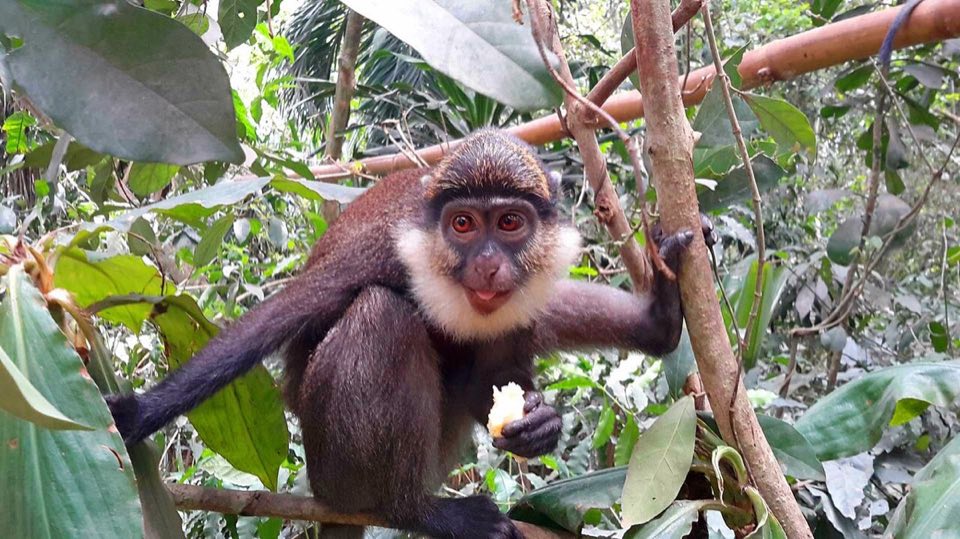
White-throated guenon (Cercopithecus erythrogaster, Endangered — Okomu is its stronghold), mona and putty-nosed monkeys, red-capped mangabey, forest elephant (Critically Endangered, rarely seen), forest buffalo, chimpanzee; about 150 bird species — hornbills, grey parrots, picathartes reported. Okomu National Park, Ovia South-West, Edo State, Nigeria.
Best time: 1 Dec – 28 Feb (December to February). Where: Okomu National Park – headquarters, chalets and the tree houses, Udo – access village on the Benin City road, Benin City – airport and transport hub (Nigeria). Time of day: From 40 minutes before sunrise to about 09:00 from the tree-house platform, when the guenon troops and hornbills move through the canopy.
- Partly on your own
- Entry fee
- Binoculars helpful
- Sound 4/5
Open it in the interactive calendarSunrise and sunset listening times for the day you pick, and the map.
When is the best time?
Peak: 1 Dec – 28 Feb. December to February, the dry season: the trails are dry, the canopy is thinner and the monkeys and hornbills are vocal from first light; the tree houses are usable without the daily storms
Active from 1 Nov to 31 Mar (November to March) in a typical year.
Time of day
From 40 minutes before sunrise to about 09:00 from the tree-house platform, when the guenon troops and hornbills move through the canopy; a second active hour before dusk; elephants are heard rather than seen, mostly at night from the chalets
- Canopy dawn: 40 min before sunrise → 09:00
- Evening movement: 1 h before sunset → last light
- Night from the chalets: last light → 00:00
What will you hear?
A lowland forest dawn from above the canopy: hornbills whooshing past at eye level, the chatter and 'pyow' alarm of white-throated and putty-nosed monkeys, mangabey whoops, grey parrots screaming to the fig trees, cicadas rising with the light; at night from the stilt chalets, tree hyrax, owls and, with luck, the crash of elephants in the swamp forest.
Binoculars?
Binoculars helpful. From the tree house the canopy is at eye level and hornbills pass within 20 m; binoculars for the guenons in the foliage.
Where to go
- Okomu National Park – headquarters, chalets and the tree houses — Stilt chalets just outside the entrance and two tree houses in the forest, one 43 m up a silk-cotton tree; guides for forest walks are assigned here. Coordinates are the park's OSM point. Map
- Udo – access village on the Benin City road — The turn-off village; the park is about 60 km north-west of Benin City by road. Map
- Benin City – airport and transport hub — Flights from Lagos and Abuja; taxis to the park take 1.5–2 hours. Map
How to go on your own, and what it costs
Taxi or bus Benin City–Udo, then a motorbike or taxi to the park entrance; pay entry at the headquarters, hire the park guide for forest walks and the tree house, sleep in the stilt chalets for the dawn. No private walking in the forest.
Cost: Entry, guide and chalet rates are set by the Nigeria National Park Service and not published online — check current prices with the park office.
Free or no-guide alternative: The park road from Udo to the headquarters runs through forest and plantation edge: hornbills, parrots and the monkey chorus at dawn from the roadside before the entrance, no fee.
Field-recording notes
A guided park: forest walks are with a park guide, the tree house is reached with the guide and can be used from first light if arranged the evening before. A rig left on the platform overnight is possible by agreement with the conservator. Since 2022 the Africa Nature Investors Foundation has funded 38 extra rangers and the park is described as 'relatively peaceful' with logging at a minimum; expect chainsaw noise from the plantations outside the boundary and the Okomu Oil Palm estate on the park's edge. Southern Nigeria: check current travel advice for Edo State and travel by road only in daylight. No playback; the white-throated guenon is Endangered and hunted outside the park.
Sources
- Okomu National Park (Wikipedia) — white-throated guenon, elephants, tree houses, chalets
- NAN – Restoring Okomu National Park's integrity for eco-tourism development (2025; ANI Foundation partnership, security)
Similar spectacles
 Tiwai Island — eleven primates and the Moa river dawnOne of the densest primate soundscapes in Africa: Diana monkeys' explosive alarm calls, red colobus chatter, the roar of king colobus, chimps' pant-hoots across the river, hornbills whooshing overhead, and the Moa river's rapids underneath.
 Sapo National Park — pygmy hippo, elephants and the deepest forest in West AfricaPrimary Upper Guinea rainforest with nothing man-made within a day's walk: casqued hornbills, chimps, Diana monkeys, the whistles of duikers, elephants rumbling at night, tree hyrax, and the full insect and frog layer of a forest that has never been logged.
 Upper Guinea rainforest dawn chorus — Kakum & AnkasaGreat blue turacos bubbling from the emergents, the far-carrying wailing of white-crested hornbills, yellow-casqued hornbills' whooshing wingbeats, chattering monkeys, cicadas switching on with the light and the screaming of tree hyrax at night.
 Korup: drills, red colobus and the oldest rainforest dawn in AfricaDrill and mangabey troops crashing and grunting through the understorey, red colobus shrieks, chimpanzee pant-hoots at a distance, hornbills, the buzz of cicadas at first light and, from the Rengo camp, a night of tree hyrax and frogs over the Mana river.
 Monte Alén: the Río Muni rainforest dawn, elephants and the goliath frog riversA Central African lowland chorus: hornbills whooshing overhead, the bubbling of greenbuls and the far pant-hoots of chimpanzees, mandrill grunts, elephant rumbles at the swamp edge. The goliath frog itself is nearly silent (no vocal sac) — its rivers are a night of other frogs and the roar of water over rock.
 Obô forest dawn: São Tomé's endemic birds above Bom SucessoA dawn chorus made of species found nowhere else: the oriole's fluting, the thrush, the weavers' chatter, the giant sunbird's rattle from the canopy, speirops flocks; the croak of the dwarf olive ibis in the deep forest at Monte Carmo in the first light, and the scops owl's whistle after dark. Dripping forest, streams, no traffic.
More: all spectacles in Nigeria · dawn choruses · Nigeria in January · Nigeria in February · Nigeria in December