
Monte Alén: the Río Muni rainforest dawn, elephants and the goliath frog rivers
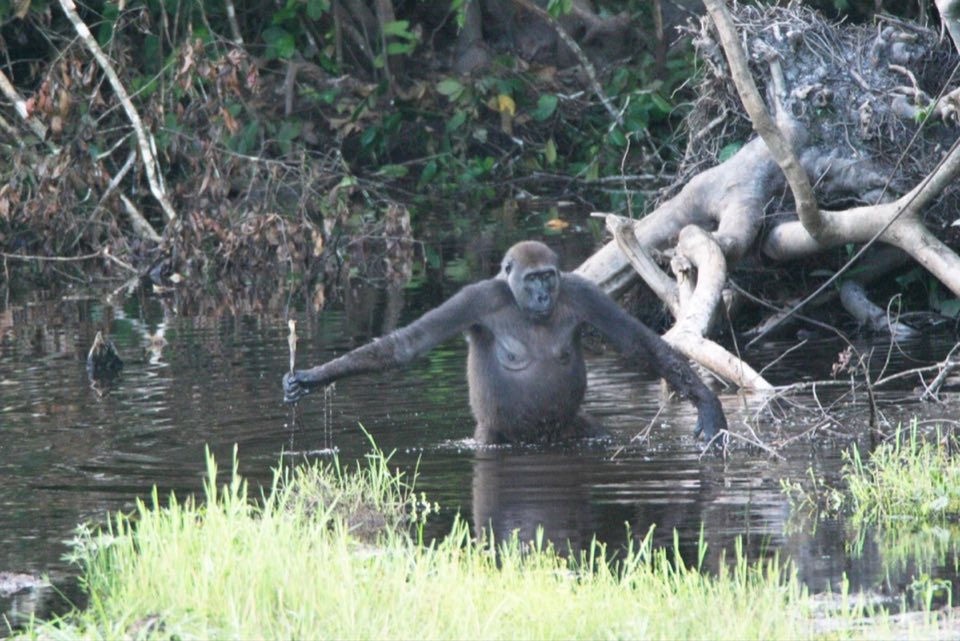
Western lowland gorilla, chimpanzee, mandrill, forest elephant, forest buffalo, 16 primate species in all; goliath frog (Conraua goliath) in the southern rivers; hornbills, grey parrots, picathartes. Monte Alén National Park, Centro Sur, Río Muni (mainland), Equatorial Guinea.
Best time: 15 Dec – 15 Feb and 15 Jun – 31 Aug (December to February, June to August). Where: Monte Alén – park trails and Lago Atoc (park centre), Niefang – town on the park's eastern road, Bata – coast city and access (Equatorial Guinea). Time of day: From 40 minutes before sunrise to about 09:00 on the forest trails.
- Guide, ranger or boat needed
- Entry fee
- Binoculars helpful
- Sound 5/5
Open it in the interactive calendarSunrise and sunset listening times for the day you pick, and the map.
When is the best time?
- Peak 1: 15 Dec – 15 Feb — Main dry season: trails passable, chorus at full strength
- Peak 2: 15 Jun – 31 Aug — Short dry season: second window, more overcast
Active from 1 Dec to 31 Aug (December to August) in a typical year.
Time of day
From 40 minutes before sunrise to about 09:00 on the forest trails; elephants and buffalo at the Lago Atoc swamp edge at first light and dusk; frogs, tree hyrax and owls through the night from camp
- Dawn chorus: 40 min before sunrise → 09:00
- Swamp edge: 1 h before sunset → last light
- Frog & hyrax night: last light → 00:00
What will you hear?
A Central African lowland chorus: hornbills whooshing overhead, the bubbling of greenbuls and the far pant-hoots of chimpanzees, mandrill grunts, elephant rumbles at the swamp edge. The goliath frog itself is nearly silent (no vocal sac) — its rivers are a night of other frogs and the roar of water over rock.
Binoculars?
Binoculars helpful. Dense forest — most of it is heard; binoculars for hornbills and monkeys in the canopy and for the swamp edge at dawn.
Where to go
- Monte Alén – park trails and Lago Atoc (park centre) — The lake and the designated camp are a second-day hike from the entrance; coordinates are the park centre from Wikipedia, not the camp. Map
- Niefang – town on the park's eastern road — The Niefang–Gabon road forms the park's eastern boundary; guides are found near the entrance and the old hotel site. Map
- Bata – coast city and access — About two hours by private transport to the park; agencies and permits here. Map
How to go on your own, and what it costs
A local guide and park permit are required (INDEFOR, the forestry authority, issues permits). Cheapest legal way: shared taxi Bata–Niefang, ask for the park guides at the entrance near the old hotel, pay the entry and guide fee and camp with your own tent and food.
Cost: Park entry and guide per day — not published. Check current prices.
Free or no-guide alternative: The Niefang–Gabon road runs along the park's eastern edge: at dawn the forest chorus, hornbills and parrots are free from the roadside, and the elephants are sometimes heard from there.
Field-recording notes
A local guide is essential (and expected by the authorities) and the old hotel and campsites are no longer usable, so it is tents and your own food and water. Poaching pressure is significant and animals are wary: gorilla and chimp encounters are elusive, the elephants are heard more than seen — a still rig at the swamp edge at dawn does better than walking. No playback. Rain can fall in any month (3,000–3,500 mm a year) and the humidity is total: silica, dry bags, a way to dry capsules. Photography near military or official sites in Equatorial Guinea causes trouble; keep gear discreet on the road. Goliath frog hunting is prohibited in the park — do not handle them.
Sources
Similar spectacles
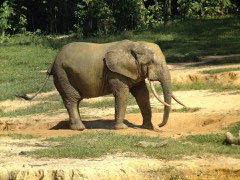 Lobéké bais: elephants, gorillas and grey parrots at the clearingsGrey parrot flocks whistling and screeching over Djangui, elephants splashing, rumbling and trumpeting in the mud of Petite Savane, gorilla chest-beats from the edge, forest hogs grunting, and the rainforest dawn behind it all.
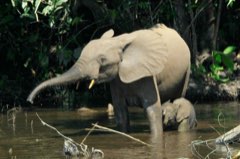 Langoué Bai: elephants, gorillas and red river hogs at the Ivindo clearingA bai at night is the best elephant listening in Central Africa: rumbles, trumpets, splashing and the squabbling of family groups at the mineral pools, with tree hyrax, frogs and owls in the forest ring. By day, red river hog groups of fifty, gorilla chest-beats and 'hoo' series from the edge, and the whistles of grey parrots in hundreds.
 Nouabalé-Ndoki: gorillas and elephants at Mbeli BaiA silverback's chest-beats and a family's contented feeding grunts in the open, from a platform 20 m above one of the Congo Basin's most-watched clearings; elephants splashing at night, sitatunga barking, parrots at dawn, and a rainforest with no engine within a day's walk.
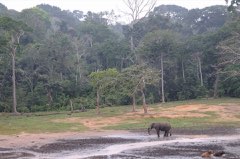 Sapo National Park — pygmy hippo, elephants and the deepest forest in West AfricaPrimary Upper Guinea rainforest with nothing man-made within a day's walk: casqued hornbills, chimps, Diana monkeys, the whistles of duikers, elephants rumbling at night, tree hyrax, and the full insect and frog layer of a forest that has never been logged.
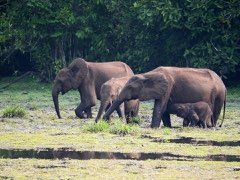 Ziama massif — forest elephants and the Guinean rainforest dawnA full Upper Guinea rainforest dawn — casqued hornbills' wingbeats and whooping, Diana monkeys, chimps, the great blue turaco — and at night the crash and rumble of forest elephants in one of their last Guinean refuges.
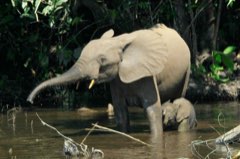 Omo Forest: forest elephants and a lowland-forest dawnA lowland rainforest dawn an hour and a half from Lagos — hornbills, turacos, chattering mangabeys — and at night the breaking branches, rumbles and occasional trumpet of elephants moving past the camp.
More: all spectacles in Equatorial Guinea · elephants · gorillas · dawn choruses · January · February · June · July · August · December