
Bioko's southern beaches: leatherbacks, green turtles and the Caldera primates
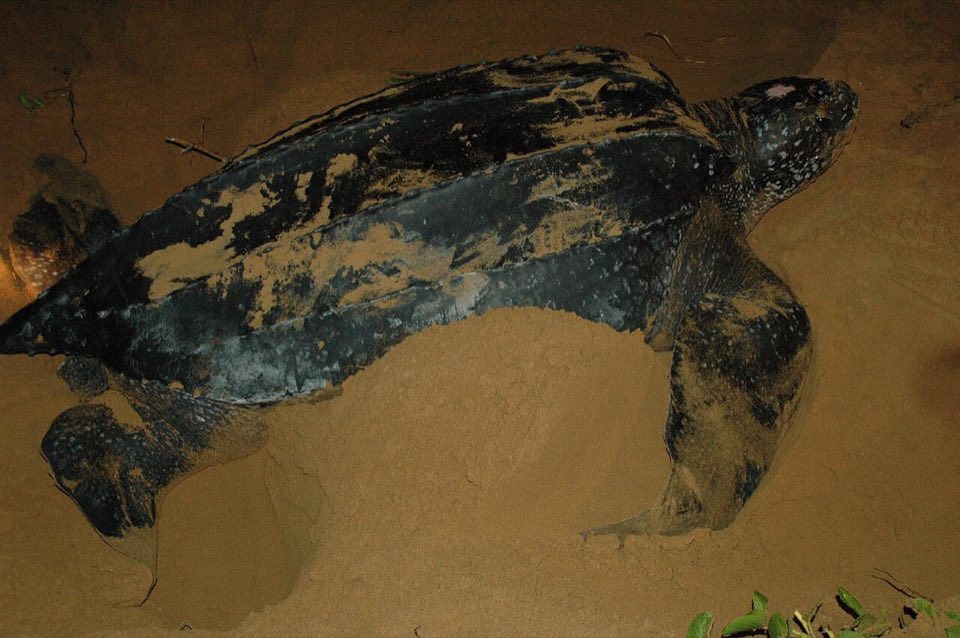
Leatherback (Dermochelys coriacea), green (Chelonia mydas), olive ridley and hawksbill turtles nesting; drill (Mandrillus leucophaeus), Pennant's red colobus, black colobus, Bioko red-eared monkey and Preuss's monkey in the Gran Caldera de Luba forest above the beaches. Ureca, Moaba and Moraka beaches, Gran Caldera de Luba Scientific Reserve, Bioko Sur, Equatorial Guinea.
Best time: 15 Dec – 15 Feb (December to February). Where: Ureca (San Pedro de Ureka) – village and community turtle guards, Moaba beach – leatherback camp, Moraka beach – green turtle camp (Equatorial Guinea). Time of day: Females come ashore from about two hours after dark to an hour before dawn, mostly 22:00–03:00.
- Guide, ranger or boat needed
- Paid trip only
- Binoculars helpful
- Sound 3/5
Open it in the interactive calendarSunrise and sunset listening times for the day you pick, and the map.
When is the best time?
Peak: 15 Dec – 15 Feb. Mid December to mid February: January is the leatherback nesting peak and the only reliably dry weather on the south coast; the Moaba (leatherback) and Moraka (green turtle) beaches are patrolled nightly by the Ureca community and the Bioko Biodiversity Protection Program camps
Active from 1 Nov to 31 Mar (November to March) in a typical year.
Time of day
Females come ashore from about two hours after dark to an hour before dawn, mostly 22:00–03:00; primates call from the forest behind the beach in the first hour of light and again before dusk
- Nesting turtles: 2 h after last light → 03:00
- Primate dawn: first light → 90 min after sunrise
- Evening primates: 1 h before sunset → last light
What will you hear?
Black-sand surf, then the scrape and sigh of a leatherback digging a few metres away. At dawn the forest behind Moaba is one of the richest primate choruses in Africa: drill grunts and crowing, the chatter of red-eared monkeys, colobus roars, hornbills and the Bioko race of the grey parrot. Waterfalls drop straight onto the beach between the nesting bays.
Binoculars?
Binoculars helpful. Turtles are at arm's length in the dark (red torch); binoculars for colobus and drills 20–40 m up in the forest at dawn.
Where to go
- Ureca (San Pedro de Ureka) – village and community turtle guards — The southernmost village on Bioko, at the end of the new road from Luba via Belebu; the beach guards have patrolled these beaches since 1996 and the Ureka permit is paid here. Map
- Moaba beach – leatherback camp — About 3 km of beach east of Ureca inside the reserve, with the BBPP research camp; reached on foot along the shore with river crossings (waist-deep at high tide). Coordinates approximate. Map
- Moraka beach – green turtle camp — West of Ureca, the green turtle beach with the second BBPP camp; same shoreline walk, same crossings. Coordinates approximate. Map
- Moka – highland village and research base — At 1,400 m on the way south: the Moka wildlife centre and forest trails are the easiest place on Bioko for drills and colobus at dawn, without the beach walk. Map
How to go on your own, and what it costs
The Caldera reserve and the south-coast permits are issued in Malabo and need arranging in advance; nobody walks in. Cheapest legal way: shared taxi Malabo–Luba–Ureca on the new road, the Ureca community guard fee and a village room, then the beach walk with a local guard.
Cost: Packaged one-night trips from Malabo with the Ureka permit are advertised at about £330 per person (2025); independent: Ureca community fee plus guide, check locally; the Caldera reserve permit is separate.
Free or no-guide alternative: No legal way onto the reserve beaches without the permits. The forest around Moka village is outside the strict reserve: a dawn walk on the Moka trails gives drills, colobus and the Bioko dawn chorus for the price of a shared taxi and a local guide.
Field-recording notes
Red light only on the beaches; no light on a female until she lays, and keep the rig behind her. Beach guards and BBPP staff decide where you may walk — they are there against poaching and will ask. Primates on Bioko are hunted for the Malabo bushmeat market and are shy; recording is from a still position at dawn, no playback. Expect saturating humidity, salt and very loud surf on the exposed south coast: the quiet recording is at the stream mouths and in the forest. Volunteers' reports say nobody will take you to the beaches in the rains (May–October) because of the river crossings. Permits: a permit to leave Malabo and one for the Caldera reserve, plus the Ureca community fee — arrange them in Malabo in advance (the Ureca community and the Bioko Biodiversity Protection Program are the bodies involved), not on the day. Keep cameras out of sight at checkpoints.
Sources
Similar spectacles
 Mangroves of the Congo mouth: manatees, turtle beaches and the only marine park in the DRCA mangrove dawn: the drip and click of the Rhizophora at low water, kingfishers, herons, fish eagles, the blow of a manatee surfacing in a side channel (a short, sharp exhalation, easy to miss), hippos grunting in the back creeks; at night on the beach, surf and a nesting ridley's scraping — and the Congo's current audible against the sandbanks at Banana.
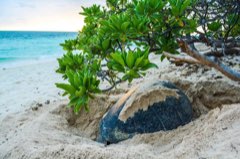 Turtle nights on São Tomé — Praia Jalé, Praia Inhame and Morro PeixeSurf on a black-sand beach, the scrape and thrown sand of a green turtle digging, her breathing, and the forest behind the beach: São Tomé scops owl, frogs, the squeak of fruit bats in the coconut palms. Quiet beaches without engine noise — the south is the end of the road.
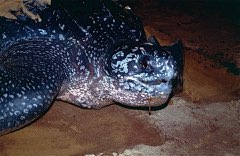 Leatherback nesting from Pongara to Mayumba — Gabon's turtle coastA leatherback digging is a slow, heavy scrape and the hiss of thrown sand, with deep sighing breaths — audible from 20 m on a still night between sets of surf. Otherwise the night is surf, the odd nightjar and, at Pongara, hippos and elephants in the forest behind the beach.
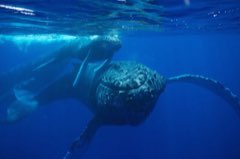 Conkouati-Douli: humpback whales and leatherback nestingBlows and breaches from the beach, humpback song on a hydrophone from a drifting pirogue, and at night the digging and heavy breathing of a leatherback on a wild beach with no lights for 50 km; chimpanzees pant-hooting from the lagoon islands at dawn.
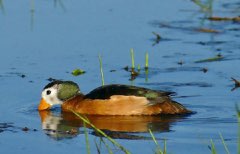 Kartong — wetland pools, Allahein river mouth and turtle beachCrakes and pygmy geese in the sand-mine pools, a wader roost at the Allahein mouth, and on rainy-season nights the beach with the surf and, if you are lucky, a nesting green turtle's breathing.
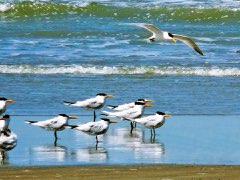 Sherbro and the Turtle Islands — terns, waders and turtle beachesTern and wader roosts on white sandbanks between eight Sherbro-speaking fishing islands, surf, and the villages' evening singing; dolphins in the channels.
More: all spectacles in Equatorial Guinea · sea turtles · wildlife at night · January · February · December