
Langoué Bai: elephants, gorillas and red river hogs at the Ivindo clearing
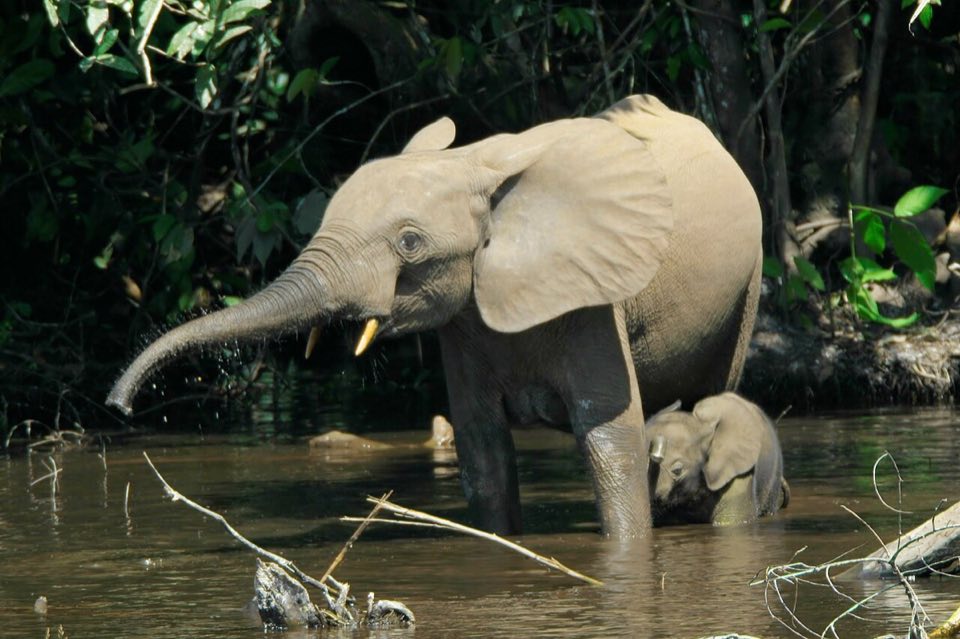
Forest elephant (up to 90 visits a day in the high season), western lowland gorilla (Gabon's densest population), forest buffalo, sitatunga, red river hog; grey-necked picathartes, great blue turaco, grey parrots. Ivindo National Park, Ogooué-Ivindo (UNESCO World Heritage), Gabon.
Best time: 1 Jul – 15 Sep (July to September). Where: Langoué Bai – observation platform, Ivindo village and river ferry (Booué side), Kongou falls – Ivindo river (Gabon). Time of day: On the platform from first light to about 10:00 and again 15:00 to dusk.
- Guide, ranger or boat needed
- Entry fee
- Binoculars helpful
- Sound 5/5
Open it in the interactive calendarSunrise and sunset listening times for the day you pick, and the map.
When is the best time?
Peak: 1 Jul – 15 Sep. July to mid September, the long dry season: the walk in is passable and elephant visits to the bai peak; gorilla visits are highest January–August, so June–August is the overlap
Active from 1 Jun to 30 Sep (June to September) in a typical year.
Time of day
On the platform from first light to about 10:00 and again 15:00 to dusk; elephants come and go all day and through the night (the platform can be slept on), gorilla families mostly in the morning
- Morning on the bai: first light → 10:00
- Afternoon: 15:00 → last light
- Elephant night: last light → sunrise
What will you hear?
A bai at night is the best elephant listening in Central Africa: rumbles, trumpets, splashing and the squabbling of family groups at the mineral pools, with tree hyrax, frogs and owls in the forest ring. By day, red river hog groups of fifty, gorilla chest-beats and 'hoo' series from the edge, and the whistles of grey parrots in hundreds.
Binoculars?
Binoculars helpful. Elephants are 50–300 m away on an open clearing; gorillas at the far edge need binoculars, a scope helps.
Where to go
- Langoué Bai – observation platform — Three-level platform on the clearing edge, about 1 hour's walk from the camp; coordinates approximate — the bai is in the park's south, reached from the Ivindo village side. Map
- Ivindo village and river ferry (Booué side) — 4x4 from Booué, then the villagers' ferry over the Ivindo, then about 3 hours of track and a 2-hour walk to the camp; coordinates approximate. Map
- Kongou falls – Ivindo river — Northern sector: 3 km wide cataract reached by 3 hours of motor-pirogue from the Makokou jetty; elephants bathe below the falls in the dry season. Map
- Makokou – northern access town — 12–14 hours by road from Libreville; the IRET research institute is 12 km out of town. Map
How to go on your own, and what it costs
Only with an ANPN permit and park guides, arranged weeks ahead with ANPN in Libreville. Cheapest legal way: train or minibus Libreville–Booué, hire a 4x4 in Booué to Ivindo village, the ferry, the track and the walk with park porters; camp at Langoué with your own food. Kongou falls: Makokou, then a motor-pirogue hired at the jetty with the park's agreement.
Cost: ANPN entry, guides, porters and the 4x4 hire — transport is the largest cost; no published tariff, check current prices with ANPN.
Free or no-guide alternative: No free way to the bai. The Ivindo river at Makokou and the Ogooué bank at Booué give a Central African river dawn — hornbills, parrots, fish eagles — for nothing, and the Kongou pirogue is the cheaper half of the park.
Field-recording notes
A full-night rig on the platform is the point of coming: ask the park for permission to sleep on it (visitors have done so) and leave a recorder running — elephants are at the pools all night. No white light on the bai; red torch only. The camp and platform were reported in poor repair in recent years and quads that used to carry gear are gone: everything is on your back for 2 hours uphill, so weight is the limit. Gorillas are never approached — the platform is the viewing point and there is no habituated group here. Ferries stop at the villagers' discretion; a day's wait is normal. Arrange everything in advance through ANPN; there is no walk-in.
Sources
- Four days at Langoué Bai — platform, camp and animals (African Aquatic Conservation Fund blog)
- Ivindo National Park (Wikipedia)
- Kongou Falls (Wikipedia)
Similar spectacles
 Lobéké bais: elephants, gorillas and grey parrots at the clearingsGrey parrot flocks whistling and screeching over Djangui, elephants splashing, rumbling and trumpeting in the mud of Petite Savane, gorilla chest-beats from the edge, forest hogs grunting, and the rainforest dawn behind it all.
 Nouabalé-Ndoki: gorillas and elephants at Mbeli BaiA silverback's chest-beats and a family's contented feeding grunts in the open, from a platform 20 m above one of the Congo Basin's most-watched clearings; elephants splashing at night, sitatunga barking, parrots at dawn, and a rainforest with no engine within a day's walk.
 Monte Alén: the Río Muni rainforest dawn, elephants and the goliath frog riversA Central African lowland chorus: hornbills whooshing overhead, the bubbling of greenbuls and the far pant-hoots of chimpanzees, mandrill grunts, elephant rumbles at the swamp edge. The goliath frog itself is nearly silent (no vocal sac) — its rivers are a night of other frogs and the roar of water over rock.
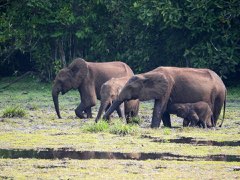 Odzala-Kokoua: forest elephants and grey parrots at Lango baiElephants blowing, splashing and rumbling in the bai's mineral pools a few metres below the deck, families greeting with trumpets and roars, grey parrot flocks whistling in to drink, forest buffalo grunting in the sedge, and a night of frogs, hyrax and distant hyena.
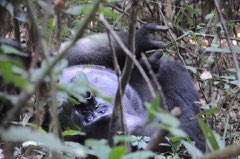 Ngaga: habituated western lowland gorillas in the marantaceae forestChest-beats, hoots and the crashing of a silverback's display in dense marantaceae, the soft grunting and belching of a feeding family a few metres away, monkeys overhead and a night of tree hyrax and frogs from the camp's raised rooms.
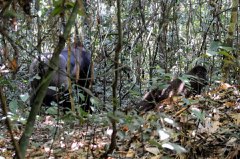 Lésio-Louna: rewilded gorillas and the Batéké plateauGorillas calling and feeding on the river islands seen from a pirogue, the wide, wind-swept quiet of the Batéké plateau at dawn with larks and cisticolas, and at night frogs and nightjars along the gallery forests.
More: all spectacles in Gabon · elephants · gorillas · mountain wildlife · Gabon in July · Gabon in August · Gabon in September