
Wildlife to see in Germany in March
3 spectacles at their peak in Germany in March, and 7 more still going on. Wild animals only: no zoos, no wildlife parks, no hunting. Open Germany in March in the interactive calendar for listening times on the day you pick.
At their peak in March
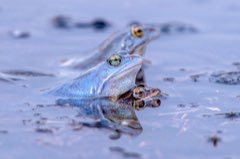 Fire-bellied toads, natterjacks and blue moor frogsFire-bellied toad's melancholy 'uh...uh' by the hundred over shallow pasture ponds, moor frog's bubbling 'waug-waug' underwater chorus, natterjack's ratcheting trill carrying 2 km across dune slacks, tree frogs at full volume, bittern and crane in the background.
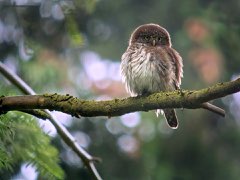 Bavarian Forest: pygmy and Tengmalm's owls, woodpeckers, lynx countryPygmy owl's piping series at dusk, Tengmalm's 'po-po-po-po' from the bark-beetle deadwood forest, Ural owl barking, three-toed woodpecker drumming rolls, nutcrackers; the loudest silence in Germany in the dead-spruce stands.
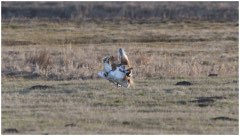 Great bustard display, Havelland and BelzigBustards are essentially silent — the display is visual ('foam bath'); what you hear is the wet-meadow dawn: lapwing, curlew, skylark, whinchat, snipe drumming, crane pairs bugling, geese, and later corncrake.
Also going on in March
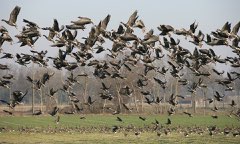 Arctic geese on the Lower RhineWhite-fronted geese's high yelping in skeins of thousands, bean geese's deeper 'kayak', the roar of a roost lifting off the Rhine at first light, whooper swans on the Bislicher Altrhein; barges and the A57 underneath.
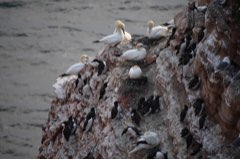 Helgoland Lummenfelsen: guillemots, gannets and the 'Lummensprung'Germany's only seabird cliff: guillemot growls, kittiwake screaming, gannet colony grating, fulmar cackles; at the jump, chicks peeping and adults calling them down to the sea 40 m below.
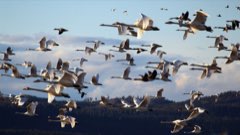 Lower Oder Valley: whooper swans, geese and the flooded poldersWhooper swan bugling in chorus over the polder ice-edge, geese lifting at dawn by the thousand, smew and goldeneye wing-whistle, eagle yelps; in October, cranes; in May, corncrakes at night.
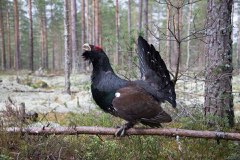 Capercaillie and black grouse — the ones you do not visitThe capercaillie's accelerating clicks, 'cork-pop' and grinding — a very quiet song (audible to ~200 m) that is almost never recorded in Germany without a permit. Black grouse bubbling in the Alps.
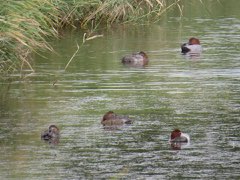 Lake Constance winter: 100,000+ waterbirds in the UnterseeMassed diving-duck rafts (wing-whistle on take-off), coot squabbles, whooper swan choruses, bean geese, gull roosts; the Untersee is shallow and calm, so sound carries across the water from the Swiss shore.
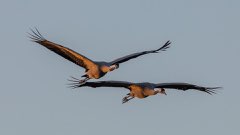 Müritz: cranes, ospreys and sea eagles in summerCrane pairs duetting at dawn from the bogs, bittern booming, osprey whistles over the lakes, eagle calls, woodlark and nightjar on the sandy heaths at dusk, marsh frogs; in autumn thousands of cranes flying into Rederangsee.
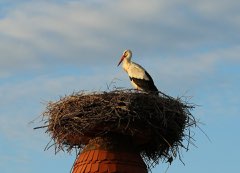 Stork villages: Rühstädt and BergenhusenBill-clattering duets from nests on every roof, hissing chicks begging in June, the whoosh of adults landing; swallows, village sparrows and church bells; cranes and geese on the Elbe floodplain behind.