
Great bustard display, Havelland and Belzig
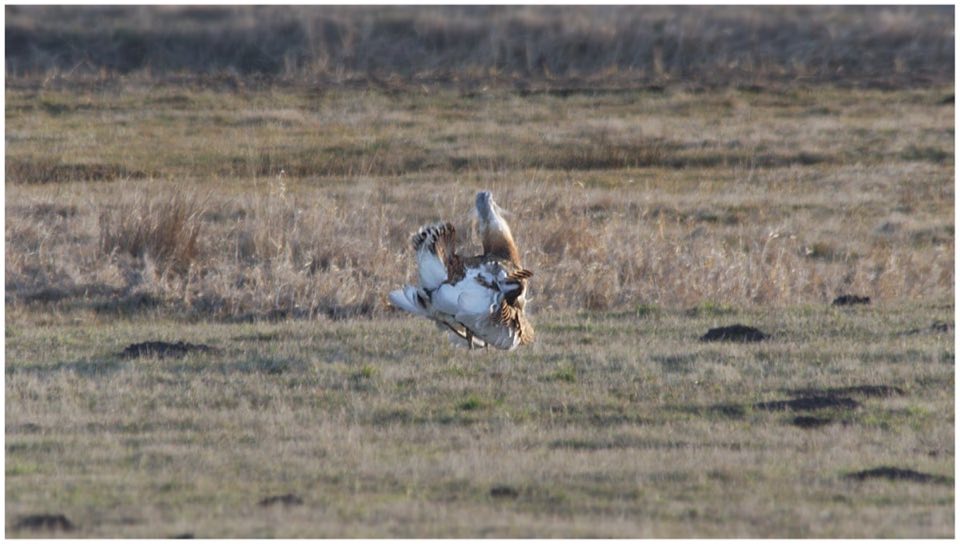
Great bustard (Otis tarda) — Germany's ~350 birds in three Brandenburg areas; also montagu's harrier, whinchat, lapwing. Havelländisches Luch, Belziger Landschaftswiesen, Fiener Bruch (Brandenburg / Saxony-Anhalt), Germany.
Best time: 25 Mar – 30 Apr (March to April). Where: Vogelschutzwarte Buckow and the Garlitz observation towers (Havelländisches Luch), Belziger Landschaftswiesen (Naturpark Hoher Fläming), Fiener Bruch (Genthin, Saxony-Anhalt) (Germany). Time of day: Display from about 30 min before sunrise for 2 h, with the wet-meadow chorus at its densest.
- You can go on your own
- Free
- Telescope recommended
- Sound 1/5
Open it in the interactive calendarSunrise and sunset listening times for the day you pick, and the map.
When is the best time?
Peak: 25 Mar – 30 Apr. Last week of March to end of April, at first light on calm mornings
Active from 10 Mar to 20 May (March to May) in a typical year.
Time of day
Display from about 30 min before sunrise for 2 h, with the wet-meadow chorus at its densest; a second, shorter display bout in the hour before sunset.
- Dawn display: 30 min before sunrise → 2 h after sunrise
- Evening display: 1 h before sunset → sunset
What will you hear?
Bustards are essentially silent — the display is visual ('foam bath'); what you hear is the wet-meadow dawn: lapwing, curlew, skylark, whinchat, snipe drumming, crane pairs bugling, geese, and later corncrake.
Binoculars?
Telescope recommended. Bustards display 300–500 m from the Garlitz towers and are near-silent; a scope is the whole point.
Where to go
- Vogelschutzwarte Buckow and the Garlitz observation towers (Havelländisches Luch) — Two free-access towers 2 km SE of Buckow directly on the display ground; guided tours by the Förderverein Großtrappenschutz during the lek. Map
- Belziger Landschaftswiesen (Naturpark Hoher Fläming) — Observation tower at Schmerwitz/Klepzig; second population. Map
- Fiener Bruch (Genthin, Saxony-Anhalt) — Third area; tower near Karow. Map
How to go on your own, and what it costs
Garlitz towers: two free-access towers 2 km south-east of Buckow, reached by the farm track from Garlitz — walk in before first light. Belzig: tower at Schmerwitz/Klepzig off the road. Fiener Bruch: tower near Karow. Towers only; the fenced areas are closed.
Cost: Free; guided lek tours by the Förderverein and the NaturparkZentrum Westhavelland (check current prices).
Who runs access
- NaturparkZentrum Westhavelland – Großtrappenbalz tours (park authority) — Expert-led tours in April–May; dates in the events calendar.
Field-recording notes
The bustard areas are fenced predator-exclusion zones inside NSGs — towers only, no walking in. The bustards are the excuse; the acoustic reward is one of the last big wet-meadow bird communities in Germany, so bring a wide pair to the tower base and record the whole soundscape. The B5 and the Berlin–Hannover rail line are 5–8 km away and audible in still air; the Luch is otherwise very quiet, with fog at dawn. Displaying males flush at 500 m — no approach outside the towers, drones are prohibited.
Sources
- Förderverein Großtrappenschutz – Havelländisches Luch
- Naturpark Westhavelland – Großtrappenbalz
- NABU Brandenburg – Großtrappen tours
Similar spectacles
 Capercaillie and black grouse leks in the eastern forestsCapercaillie's clicking, cork-pop and grinding song from pine bog edges, wing-beats of cocks flying in, black grouse bubbling on the open bogs; cranes, whooper swans and Tengmalm's owl in the same nights.
 Black grouse leksBubbling 'rookooing' from displaying males, hissing 'tchu-wee' sneezes and flutter jumps; curlew and snipe often in the same soundscape.
 Black grouse leks in the AlpsBubbling 'rookooing' and hissing from males on snow patches at the treeline, ring ouzels, water pipits, and meltwater.
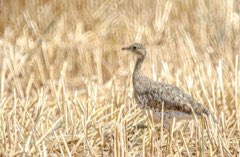 La Crau steppe: little bustard, sandgrouse & stone-curlewLittle bustards' dry 'prrrt' with a foot-stamp and wing-whirr jump, sandgrouse 'catar-catar' flights to drinking pools, calandra larks in continuous song-flight, stone-curlews at dusk.
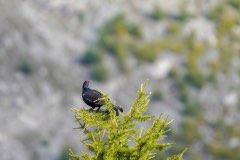 Black grouse leks in the Alps and JuraBubbling 'rookooing' rolling across a snow-patched alpine meadow from several cocks, sneezing 'tchu-shwee' hisses, wing-flutter jumps; ring ouzel and water pipit around them; cowbells not yet arrived.
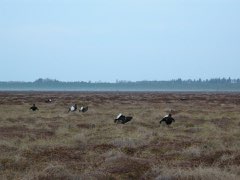 Black grouse leks above the treelineBubbling 'rookooing' and explosive hisses from several cocks on a snow-patched clearing, wing-flutter jumps, ring ouzel and ptarmigan croaks; cowbells arrive later in the season.
More: all spectacles in Germany · leks · Germany in March · Germany in April