
Red-billed tropicbird colony, Îles de la Madeleine
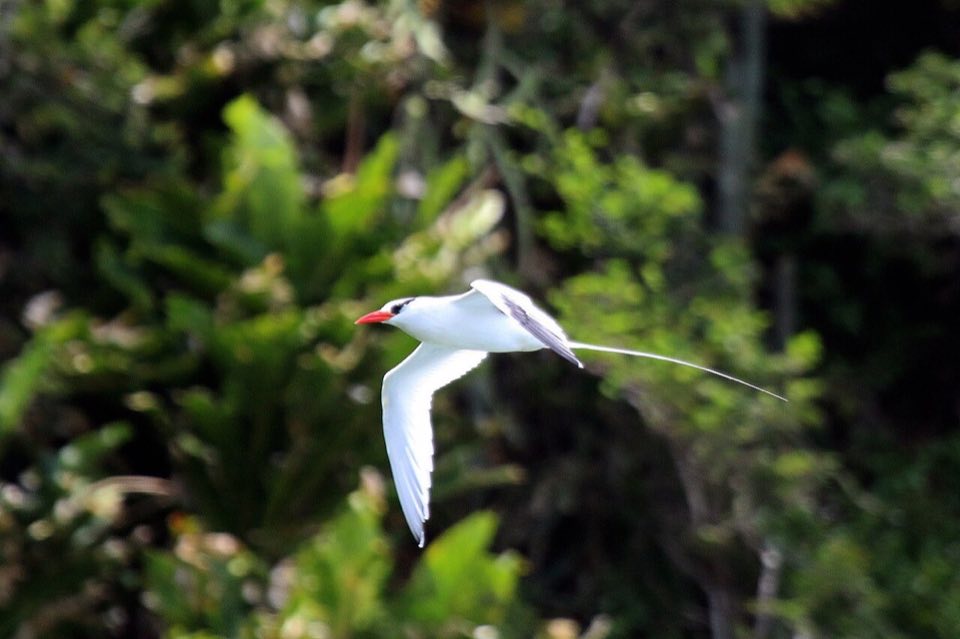
Red-billed tropicbird (Phaethon aethereus), bridled tern, white-breasted (great) cormorant, ospreys in winter. Parc National des Îles de la Madeleine, off Dakar, Senegal.
Best time: 1 Oct – 31 Mar (October to March). Where: Sarpan island (main island), Anse Bernard / Soumbédioune park office (Senegal). Time of day: Mornings when the park pirogues run (about 09:00–16:00).
- Guide, ranger or boat needed
- Entry fee
- No binoculars needed
- Sound 3/5
Open it in the interactive calendarSunrise and sunset listening times for the day you pick, and the map.
When is the best time?
Peak: 1 Oct – 31 Mar. Tropicbirds are present all year; nesting is concentrated in the dry season (roughly October to March — the exact peak isn't well documented). Bridled terns nest in the rains (June–September)
Active from 1 Jan to 31 Dec (all year) in a typical year.
Time of day
Mornings when the park pirogues run (about 09:00–16:00); displaying tropicbirds circle the cliffs through the day
- Park boat hours: 09:00 → 16:00
What will you hear?
Tropicbirds' rasping, ratcheting display screams as pairs circle the basalt cliffs of Sarpan island a few metres overhead, surf in the sea caves, and Dakar's hum across 4 km of water.
Binoculars?
No binoculars needed. Tropicbirds circle a few metres over the cliff path; naked eye.
Where to go
- Sarpan island (main island) — Landing at the small cove with the park guide; a path circles the island past the nesting ledges — stay on it. Map
- Anse Bernard / Soumbédioune park office — DPN office on the Corniche where entry is paid and the pirogue boards (weather permitting — the crossing is cancelled in swell). Map
How to go on your own, and what it costs
Island access is only by the park's own pirogue with a park guide (park rule). Go to the DPN office at Anse Bernard on the Corniche Ouest in the morning; boats run when there are enough people and the sea allows.
Cost: Park entry plus pirogue, a few thousand CFA per person (recent reports) — check current prices at the office.
Free or no-guide alternative: Tropicbirds commute past the Corniche and the Mamelles lighthouse headland; from the public cliff path below the Phare des Mamelles you can watch (and sometimes hear) them for free, but the colony itself is island-only.
Who runs access
- Parc National des Îles de la Madeleine – DPN pirogue (Anse Bernard) (park authority) — The only boat; guide included.
Field-recording notes
Smallest national park in the world, and a guide accompanies you on the island; visits are short (1–2 h), so a fast, hand-held approach — the birds fly within touching distance of the cliff path. Surf and wind are constant; the north-facing cave side is the loudest. No off-path walking, no drones; the cormorant and tern ledges are not to be approached.
Sources
Similar spectacles
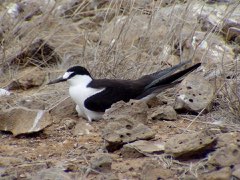 The Tinhosas: the only great seabird colony of the eastern tropical AtlanticA sooty tern colony of this size is a wall of sound audible from a kilometre downwind: the 'wide-awake' calls of over a quarter of a million birds, noddies' rattles, booby honks, surf on bare rock. From a drifting boat with the engine off it is one of the great seabird sound events of the Atlantic.
 Banc d'Arguin terns & Arcachon brent geeseA grating Sandwich tern colony of thousands of pairs on a sandbank in the Atlantic swell; in winter, the rolling 'rronk' of brent flocks on the eelgrass beds.
 Balearic shearwater & storm petrel islandsHoarse, cackling Balearic shearwaters arriving to cliff burrows after dark, storm petrels purring in cave crevices, Audouin's gull colonies and Eleonora's falcons screaming over the sea in late summer.
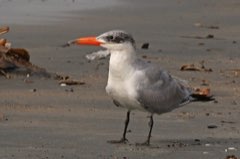 Tanji beach and the Bijol Islands — terns, gulls and the fish-landing roostA gull-and-tern roost of thousands screaming over the fish-landing beach as pirogues come in, the market crowd, the smokehouses, and across the water the Bijol colonies — The Gambia's only breeding seabirds.
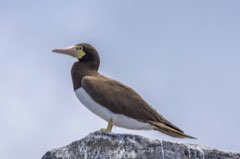 Île Alcatraz — the only brown booby colony between Cabo Verde and São ToméA tropical booby rock: the braying and whistling of thousands of brown boobies, the grating roar of a royal tern colony, wings everywhere, guano and fish — a sound that exists nowhere else on the West African mainland coast. Only the sea and your own outboard compete.
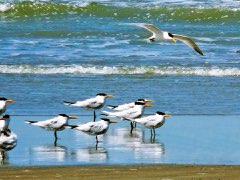 Sherbro and the Turtle Islands — terns, waders and turtle beachesTern and wader roosts on white sandbanks between eight Sherbro-speaking fishing islands, surf, and the villages' evening singing; dolphins in the channels.
More: all spectacles in Senegal · seabird colonies · Senegal in January · Senegal in February · Senegal in March · Senegal in October · Senegal in November · Senegal in December