
Aftout es Saheli — West Africa's only lesser flamingo breeding colony
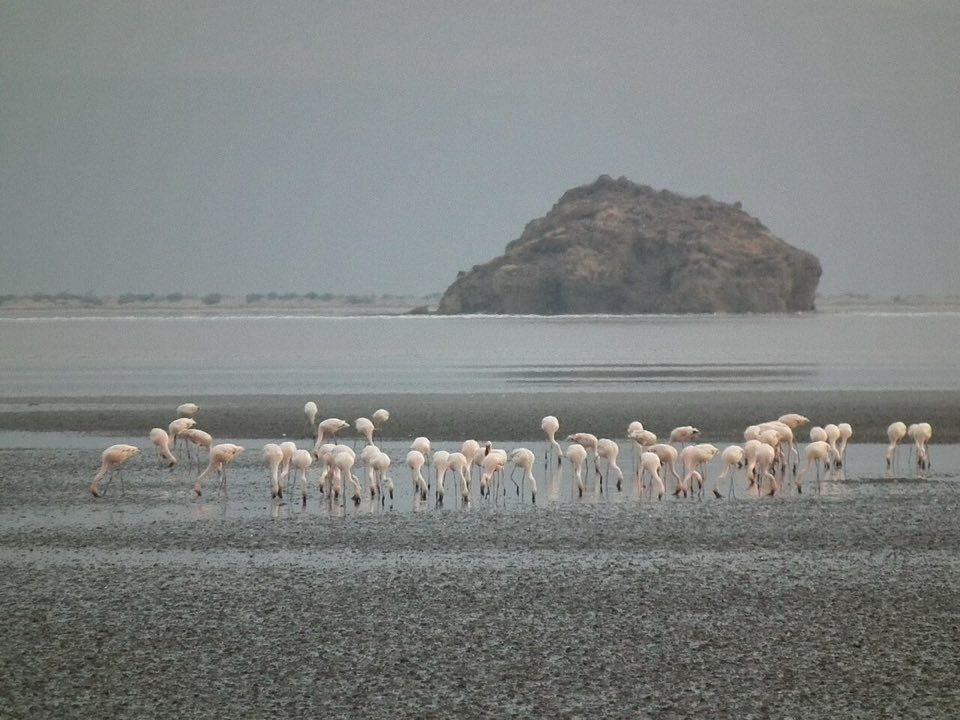
Lesser flamingo (Phoeniconaias minor, about 4,800 incubating in 2011) and greater flamingo (about 10,000) in a mixed colony; up to 38,000 greater flamingos, pelicans, spoonbills and garganey wintering on the lagoon. Aftout es Saheli coastal lagoon, north of Diawling National Park (Trarza), Mauritania.
Best time: 15 Mar – 15 May (March to May). Where: Aftout es Saheli — north-eastern lagoon (colony islets), Keur Macène, Diawling park HQ & Bell basin (Mauritania). Time of day: Dawn to mid-morning from the lagoon edge before the wind and heat haze.
- Guide, ranger or boat needed
- Entry fee
- Telescope recommended
- Sound 4/5
Open it in the interactive calendarSunrise and sunset listening times for the day you pick, and the map.
When is the best time?
Peak: 15 Mar – 15 May. Mid March to mid May in a breeding year — greater flamingos start incubating mid February, lesser flamingos peak in late March, chicks crèche in April–May; the lagoon dries by late June. Breeding is irregular and depends on the flood — ask the park first
Active from 1 Feb to 15 Jun (February to June) in a typical year.
Time of day
Dawn to mid-morning from the lagoon edge before the wind and heat haze; the colony's noise carries best in the still hour before sunrise; evening feeding flights at sunset
- Colony at dawn: first light → 150 min after sunrise
- Evening flights: 1 h before sunset → last light
What will you hear?
Fourteen thousand flamingo chicks and their parents: a continuous honking, growling roar from the colony islets that carries over a kilometre of flat water at dawn, the wing-thunder of a few thousand adults lifting at a jackal, and the lesser flamingos' higher yapping among the greater flamingos' goose-like calls. Around it, the silence of the Sahel coast.
Binoculars?
Telescope recommended. The colony islets are kept off-limits — you watch from 500 m to 1 km across the water; a scope is essential, the sound still carries.
Where to go
- Aftout es Saheli — north-eastern lagoon (colony islets) — The four colony islets emerge in the NE of the lagoon as the water drops; approach is prohibited during breeding — view from the eastern shore track with park staff. Coordinates approximate, for the general area north of Keur Macène. Map
- Keur Macène — Village on the northern edge of Diawling park and the gateway to the Aftout depression; park guides and 4x4s arranged here or at the park HQ. Map
- Diawling park HQ & Bell basin — Entrance on the Rosso–Diama road; the park runs the counts and the surveillance post that watches the colony. Map
How to go on your own, and what it costs
Diawling park HQ (from Rosso or the Diama dam; Saint-Louis is 1.5 h away across the border) — pay the park entry, hire a park guide and a 4x4 to the Aftout shore. The colony islets are closed; the guide takes you to the agreed viewpoint. Check with the park in February whether the flamingos are breeding this year.
Cost: Diawling park entry and guide: a few hundred MRU per person per day plus 4x4 hire (several thousand MRU per day) — check current prices with the park.
Free or no-guide alternative: Outside the breeding islets, the Aftout's flamingo flocks (tens of thousands in January) feed along Chott Boul and the lagoon's southern end next to the public Diama–N'Diago road: watch and listen free from the road at dawn in winter. No legal way to the breeding colony without the park.
Who runs access
- Parc National du Diawling — park guides and surveillance post (park authority) — The park supports the Aftout counts and guards the colony; the only legal way to the viewpoint.
Field-recording notes
Only with the Diawling park: the colony is unprotected on paper but the park's team guards it (electric fence, predator traps, anti-poaching) and nobody approaches the islets — one disturbance can abandon thousands of eggs. Record from the shore at dawn with a parabola; the wind is up by 09:00 and the harmattan dust is fierce in March. Access is by 4x4 on sand tracks; impossible in the July–October rains and the lagoon is dry by late June. Predators (jackals, hyena, honey badger) walk the shore at night — a static rig overnight needs the wardens' agreement. Research/recording permit from the park (PND) and, for anything published, the Ministry.
Sources
- Bird Conservation International (Moreno-Opo et al.) – Successful breeding of lesser and greater flamingos at Aftout es Saheli, 2011 (timings, numbers, predator management)
- KBA factsheet – Aftout es Sâheli (only lesser flamingo breeding site in West Africa; January counts 2012–2020; access and threats)
Similar spectacles
 Fuente de Piedra: the great flamingo colonyTwenty thousand flamingos honking, growling and gabbling across a flat salt lagoon — the colony is a continuous roar from kilometres away on a still morning — with the goose-like flight calls of flocks commuting to feed, gull-billed terns and stilts yelping over the shallows.
 Flamingo colonies of the CamargueGoose-like honking from thousands of birds, the massed 'marching' displays, and flights of hundreds passing low over the étangs at dusk.
 Flamingo colonies & courtshipGoose-like gabbling of big flocks, and the synchronised 'marching' displays with a constant honking.
 Ebro Delta: Audouin's gulls, terns and flamingosAudouin's gull colony (historically over half the world population at Punta de la Banya) as a nasal, laughing wall of sound, tern colonies screaming over the salt pans, flamingos honking across the lagoons, and frogs in the rice fields at night.
 Oued Souss estuary — Audouin's gulls, flamingos and waders at Agadir's doorA gull-and-wader soundscape: Audouin's gulls' nasal calls, slender-billed and laughing gulls, flamingos honking, stilts and greenshank — over Agadir's surf and the N10 bridge traffic. Not a hushed site, but a very accessible one.
 Great white pelican colony at DjoudjA wall of pelican grunts and chick begging from a few thousand pairs packed onto low islets a boat-length away, wings slapping water as flotillas fish in formation, and darters and cormorants in the tamarisks.
More: all spectacles in Mauritania · flamingos · stork, heron and flamingo colonies · March · Mauritania in April · May