
Fuente de Piedra: the great flamingo colony

Greater flamingo (Phoenicopterus roseus) — up to 25,000 pairs and 15,000 chicks in a good year; gull-billed tern, avocet, black-winged stilt, common crane in winter. Laguna de Fuente de Piedra, Antequera, Málaga, Spain.
Best time: 1 Apr – 15 Jul (April to July). Where: Centro de Visitantes José Antonio Valverde / Cerro del Palo (north shore), Mirador de la Vicaría, Laguna de Cantarranas / Mirador de Cantarranas (Spain). Time of day: Colony noise never stops but is loudest from an hour before sunrise to mid morning and again from late afternoon to dark.
- You can go on your own
- Free
- Telescope recommended
- Sound 4/5
Open it in the interactive calendarSunrise and sunset listening times for the day you pick, and the map.
When is the best time?
Peak: 1 Apr – 15 Jul. April to mid July: 30,000+ birds in April, chicks in crèches from June; in wet years numbers hold into August–September, in dry years the lagoon empties and the colony fails
Active from 15 Feb to 31 Aug (February to August) in a typical year.
Time of day
Colony noise never stops but is loudest from an hour before sunrise to mid morning and again from late afternoon to dark; cranes fly in to roost at dusk in winter. Visitor centre roughly 10:00–14:00 and 16:00–18:00 (17:00–19:00 April–September; check).
- Morning colony: 1 h before sunrise → 10:30
- Evening flights and colony: 150 min before sunset → 30 min after sunset
What will you hear?
Twenty thousand flamingos honking, growling and gabbling across a flat salt lagoon — the colony is a continuous roar from kilometres away on a still morning — with the goose-like flight calls of flocks commuting to feed, gull-billed terns and stilts yelping over the shallows.
Binoculars?
Telescope recommended. The breeding islands are 1–2 km out in the lagoon; a scope from the Cerro del Palo and Vicaría hides (rental binoculars at the centre). Feeding flocks at the Laguneto are close.
Where to go
- Centro de Visitantes José Antonio Valverde / Cerro del Palo (north shore) — Visitor centre with hides, the 250 m Laguneto trail and the Las Albinas trail (2.4 km) along the north shore; beside the village. Map
- Mirador de la Vicaría — Hide on the drive round the lagoon, northern sector. Map
- Laguna de Cantarranas / Mirador de Cantarranas — Western sector viewpoint over the small lagoon and the main lake. Map
How to go on your own, and what it costs
From the A-92 (Antequera–Sevilla) take the Fuente de Piedra exit; the visitor centre is signed on the north edge of the village — free car park, free hides and trails at all hours, centre hours as above. A 21 km loop of paved farm roads circles the lagoon with signed viewpoints (Vicaría, Cantarranas). Guided visits with telescopes and bike hire can be booked at the centre.
Cost: Free; guided visits from the centre paid (check current prices).
Field-recording notes
The colony is far out and the lagoon flat and open — the sound reaches the shore as a broad roar best caught on a windless dawn from the north-shore hides. The A-92 motorway and the Córdoba–Málaga railway run past the north and east sides; Cantarranas on the west is quieter. The reserve islands are strictly off limits (nesting failure from disturbance is the main risk) — no boats, no drones. In dry summers the lake is a dust pan and the birds are gone; check water levels.
Sources
Similar spectacles
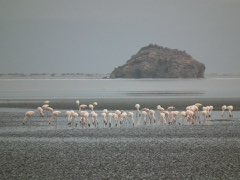 Aftout es Saheli — West Africa's only lesser flamingo breeding colonyFourteen thousand flamingo chicks and their parents: a continuous honking, growling roar from the colony islets that carries over a kilometre of flat water at dawn, the wing-thunder of a few thousand adults lifting at a jackal, and the lesser flamingos' higher yapping among the greater flamingos' goose-like calls. Around it, the silence of the Sahel coast.
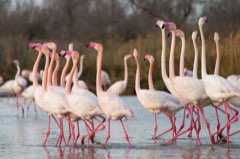 Flamingo colonies of the CamargueGoose-like honking from thousands of birds, the massed 'marching' displays, and flights of hundreds passing low over the étangs at dusk.
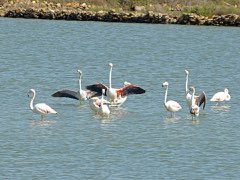 Flamingo colonies & courtshipGoose-like gabbling of big flocks, and the synchronised 'marching' displays with a constant honking.
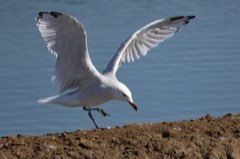 Oued Souss estuary — Audouin's gulls, flamingos and waders at Agadir's doorA gull-and-wader soundscape: Audouin's gulls' nasal calls, slender-billed and laughing gulls, flamingos honking, stilts and greenshank — over Agadir's surf and the N10 bridge traffic. Not a hushed site, but a very accessible one.
 Tree-nesting white stork colony, March floodplainBill-clattering across a colony of 40–50 nests in the oak canopy, chick hissing, black-headed gulls from the oxbows, oriole, nightingale, tree frogs and fire-bellied toads in the flooded meadows, Konik horses.
 Heronries, cormorant colonies and spring flood chorus, Kopački ritCroaking, bill-snapping heronries in flooded willows, cormorant grunts, spoonbill chick begging, eagle yelps, fire-bellied toad and marsh frog choruses under everything, cuckoo, golden oriole.
More: all spectacles in Spain · flamingos · stork, heron and flamingo colonies · Spain in April · Spain in May · Spain in June · Spain in July