
Spring raptor & stork passage over the Strait — Jbel Moussa
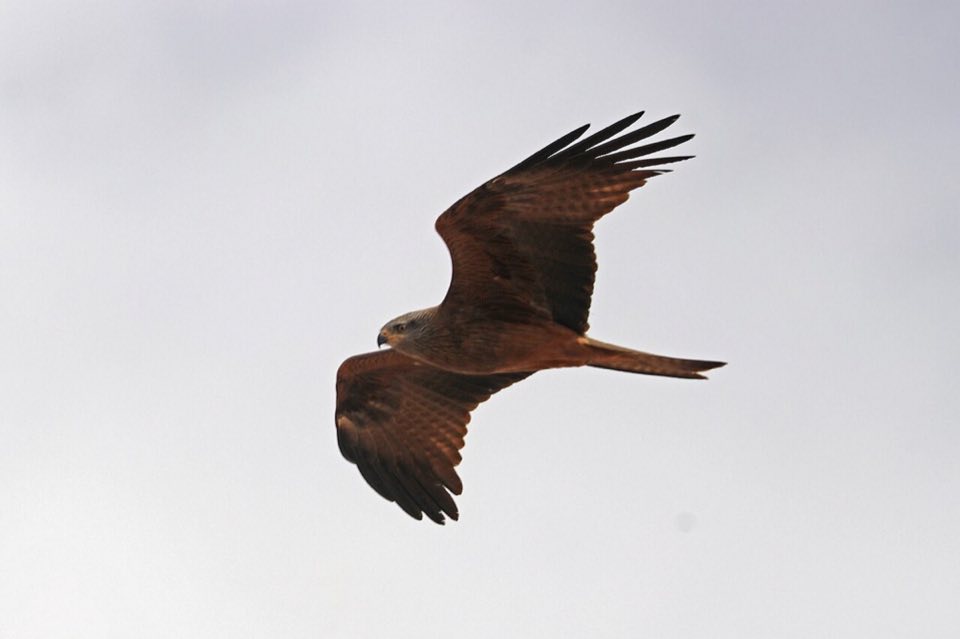
Black kite (Milvus migrans), honey buzzard (Pernis apivorus), short-toed eagle, booted eagle, white & black storks, Egyptian & griffon vultures, Rüppell's vulture (rare). Strait of Gibraltar, Tangier–Tétouan, Morocco.
Best time: 10 Mar – 30 Apr (March to April). Where: Jbel Moussa summit ridge (from Belyounech), Belyounech village & bay, Cap Spartel, Tangier (Morocco). Time of day: From about 2 hours after sunrise, once thermals build, to mid afternoon.
- You can go on your own
- Free
- Telescope recommended
- Sound 2/5
Open it in the interactive calendarSunrise and sunset listening times for the day you pick, and the map.
When is the best time?
Peak: 10 Mar – 30 Apr. Mid March to end of April; black kites peak in March, honey buzzards in the first half of May
Active from 20 Feb to 31 May (February to May) in a typical year.
Time of day
From about 2 hours after sunrise, once thermals build, to mid afternoon; birds arrive from Tarifa and pile up over the ridge when the levante blows
- Thermal passage: 2 h after sunrise → 15:00
What will you hear?
Mostly a visual event: kettles of hundreds of kites and storks spilling off the Spanish side and gaining height over Belyounech. Sound is the wind, bill-clattering storks on the ground, griffons' rasping wing-noise overhead and the reintroduced griffon colony's grunts on the cliffs.
Binoculars?
Telescope recommended. Kettles of kites and storks spill over the ridge at height; binoculars essential, a scope to sort eagles and vultures.
Where to go
- Jbel Moussa summit ridge (from Belyounech) — Track from the village to the ridge; the 2016–17 counts (24,000–40,000 raptors of 20 species in spring) were made from here. Griffon vultures re-established in 2021 nest on the north face — keep off the cliff edge. Map
- Belyounech village & bay — Roadhead and easiest low-level watchpoint; storks come in low over the bay in a westerly. Map
- Cap Spartel, Tangier — Western exit of the Strait; better in autumn and for seabird passage, quieter than Jbel Moussa. Map
How to go on your own, and what it costs
Grand taxi or own car to Belyounech (30 km east of Tangier, via Fnideq); the ridge path starts behind the village and takes about 2 hours. No gate, no fee, no guide needed. Stay off the north-face cliffs (griffon nests) and away from the military post and the Ceuta border fence.
Cost: Free (2026).
Field-recording notes
The ridge is a wind site by definition — the count days with most birds are the days with most wind, so plan for a blimp-and-fur rig and accept that clean ambience happens only in the lee. Belyounech sits next to the Ceuta border and a military zone: photograph and record only towards the sea and the birds, and expect to be asked what you are doing. No permit is needed on the public tracks; the Site of Biological and Ecological Interest (SIBE) status means no off-track driving. Autumn (Aug–Oct) is also heavy but is counted mainly from the Spanish shore.
Sources
- MaghrebOrnitho – Spring raptor migration at Jbel Moussa 2017 (report)
- MaghrebOrnitho – Jbel Moussa tag (griffon reintroduction, counts)
- Trektellen – live migration counts (search Morocco / Strait sites)
Similar spectacles
 The Zwin: wader passage, ringing season and the stork colonyBill-clattering of storks greeting at the nest; dunlin and redshank flocks over the salt marsh at the top of the tide; curlews; the sea behind the dunes; in autumn a steady trickle of migrating pipits and finches over the dike.
 Strait of Gibraltar: raptor & stork passageMostly visual — kettles of thousands — but bee-eater flocks pour over calling all day, honey buzzards pass at head height in a levante, and the stork pre-roost at Los Lances is a bill-clattering crowd.
 Pyrenean passes: raptor, stork, pigeon & crane migrationMostly visual, but woodpigeon flocks pass with a rush of wings, cranes bugle over the pass, and pre-dawn passerine flight calls stream through — with gunfire from the neighbouring hunting passes.
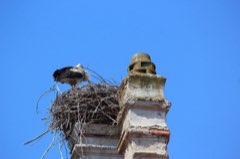 Tree-nesting white stork colony, March floodplainBill-clattering across a colony of 40–50 nests in the oak canopy, chick hissing, black-headed gulls from the oxbows, oriole, nightingale, tree frogs and fire-bellied toads in the flooded meadows, Konik horses.
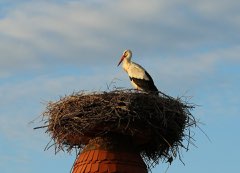 Stork villages: Rühstädt and BergenhusenBill-clattering duets from nests on every roof, hissing chicks begging in June, the whoosh of adults landing; swallows, village sparrows and church bells; cranes and geese on the Elbe floodplain behind.
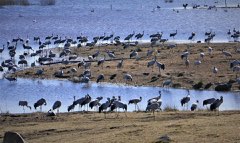 Spring crane staging: Hornborgasjön and PulkenThousands of cranes bugling in chorus — trumpeting that carries for kilometres, rising to a roar when a flock lifts; unison calls of pairs, wing noise of landing flocks, whooper swans and lapwings in the background.
More: all spectacles in Morocco · storks · bird migration hotspots · Morocco in March · Morocco in April