
Raptor migration: Strait of Messina
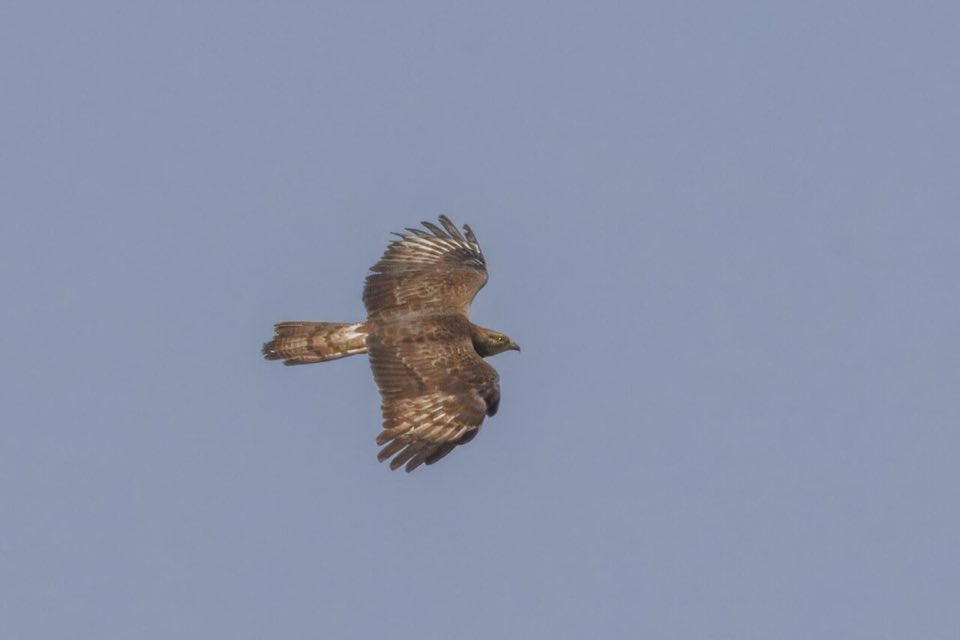
Honey buzzard, black kite, marsh/Montagu's/pallid harriers, hobby, black stork. Sicily / Calabria; Salento, Italy.
Best time: 25 Apr – 15 May and 20 Aug – 15 Sep (April to May, August to September). Where: Monti Peloritani – Dinnammare, Sicily, Punta Pezzo / Aspromonte, Calabria, Capo d'Otranto, Puglia (Italy). Time of day: Raptors move once thermals build, from about 10:00 to 16:00.
- You can go on your own
- Free
- Telescope recommended
- Sound 2/5
Open it in the interactive calendarSunrise and sunset listening times for the day you pick, and the map.
When is the best time?
- Peak 1: 25 Apr – 15 May — Late April to mid May: honey buzzard peak (5,541 on 30 April in one count)
- Peak 2: 20 Aug – 15 Sep — Late August to mid September: autumn honey buzzard passage (7,738 raptors counted 24 Aug–10 Sep 2004, 74% honey buzzards)
Active from 15 Mar to 15 Oct (March to October) in a typical year.
Time of day
Raptors move once thermals build, from about 10:00 to 16:00; bee-eater and swift flocks pass from early morning.
- Raptor passage: 10:00 → 16:00
What will you hear?
Mostly visual — kettles of raptors — but also bee-eater flocks overhead, and swifts and hirundines passing.
Binoculars?
Telescope recommended. Kettles high over the Strait at midday; binoculars essential, a scope for harrier and stork identification.
Where to go
- Monti Peloritani – Dinnammare, Sicily — MEDRAPTORS watch-points. Map
- Punta Pezzo / Aspromonte, Calabria — Calabrian side. Map
- Capo d'Otranto, Puglia — Spring raptor crossing; LIPU/volunteer camps. Map
How to go on your own, and what it costs
Dinnammare: drive the Peloritani ridge road from Messina to the Dinnammare sanctuary car park; the MEDRAPTORS count point is by the road, volunteers welcome. Punta Pezzo: public headland at Villa San Giovanni. Capo d'Otranto: the lighthouse road and headland.
Cost: Free.
Field-recording notes
Poaching was historically a problem here — anti-poaching camps welcome help. For sound, treat it as a video/field day rather than a recording target.
Sources
Similar spectacles
 Spring crane staging: Hornborgasjön and PulkenThousands of cranes bugling in chorus — trumpeting that carries for kilometres, rising to a roar when a flock lifts; unison calls of pairs, wing noise of landing flocks, whooper swans and lapwings in the background.
 Wadden Sea autumn: millions of waders and geeseKnot and dunlin flocks in the tens of thousands wheeling with a rushing wing-roar, curlew and godwit calls at the roost, brent geese growling, barnacle geese yapping; wind, surf and the tide-edge trickle.
 Autumn migration at Lista, Jomfruland and UtsiraDawn flight calls of thousands of thrushes, pipits and finches leaving the coast, waders on the Lista beaches, skuas and gannets passing the lighthouse in a westerly gale; at night, redwing and song thrush calls overhead.
 Falsterbo: Scandinavia's autumn migration funnelA continuous stream of flight calls at dawn — chaffinch, brambling, meadow pipit, yellow wagtail, siskin — thousands of birds an hour on a big day; cranes bugling high overhead in late Sept–Oct; the sea on both sides of the point.
 Gedser Odde: autumn migration off Denmark's southern tipRivers of chaffinch and brambling calls over the car park on a big October morning, wood pigeons' wing-clatter, eider flocks crooning as they round the point, little gulls' chatter, the Fehmarn Belt surf; the station's own sound recorder (PUC) logs the night migration overhead.
 Snettisham wader spectacularTens of thousands of knot flying in smoky clouds with a roaring wing-rush, then a low twittering murmur as they pack onto the roost banks.
More: all spectacles in Italy · bird migration hotspots · Italy in April · Italy in May · Italy in August · Italy in September