
Lopé: the mandrill super-groups of the dry season
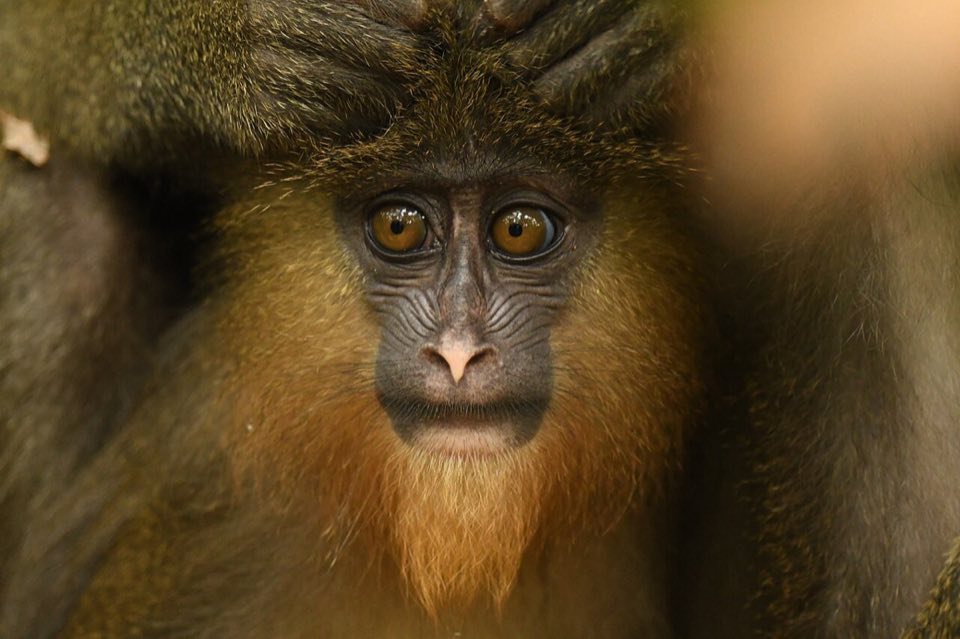
Mandrill (Mandrillus sphinx) hordes of 700–1,000; forest elephant, forest buffalo, red river hog, sun-tailed monkey, black colobus, grey-cheeked mangabey; chimpanzee and western lowland gorilla in the forest. Lopé National Park, Ogooué-Ivindo (Lopé-Okanda UNESCO site), Gabon.
Best time: 1 Jul – 15 Oct (July to October). Where: Lopé village – station and park headquarters, Lopé savanna–forest mosaic north of the village, Booué – road and rail town (Gabon). Time of day: Trackers locate the horde by radio from about 07:00 and walk you in ahead of its line of travel.
- Guide, ranger or boat needed
- Entry fee
- Binoculars helpful
- Sound 5/5
Open it in the interactive calendarSunrise and sunset listening times for the day you pick, and the map.
When is the best time?
Peak: 1 Jul – 15 Oct. July to October, the dry season, when the horde that WCS and the park follow by radio comes together in one super-group of hundreds; July is the breeding peak, with the males at their brightest
Active from 1 May to 15 Dec (May to December) in a typical year.
Time of day
Trackers locate the horde by radio from about 07:00 and walk you in ahead of its line of travel; the crossing of a horde past a hide lasts 10–30 minutes, usually between 09:00 and 13:00; elephants and buffalo are on the savanna from first light and at dusk
- Tracking & crossing: 07:00 → 13:00
- Savanna dawn: sunrise → 90 min after sunrise
- Elephants on the savanna: 1 h before sunset → last light
What will you hear?
A horde of several hundred mandrills on the move is one of the loudest things in an African forest: a rolling wave of grunts, two-phase 'crowing' from the males, screams, branches breaking and the drumming of hundreds of feet in the leaf litter, approaching for minutes before anything is seen and fading for minutes after. Around it, the savanna–forest dawn: hornbills, greenbuls, elephants rumbling at the forest edge.
Binoculars?
Binoculars helpful. The horde passes a hide at 30–50 m in dense forest — ears first, then naked eye; binoculars for elephants and monkeys on the savanna edge.
Where to go
- Lopé village – station and park headquarters — The Transgabonais stops here; the park office, the SEGC/WCS research base and the village rooms are all within a few kilometres. Coordinates are the village. Map
- Lopé savanna–forest mosaic north of the village — The mandrill horde ranges through the gallery forests and savanna edge here; the trackers choose the day's hide position. Map
- Booué – road and rail town — Alternative access from the east; the Libreville–Lopé train also stops here. Map
How to go on your own, and what it costs
Tracking is only with the park's mandrill team (ANPN/WCS) on a dated permit issued by ANPN; group sizes are small. Cheapest legal way: train Libreville–Lopé (overnight), a room in Lopé village, the ANPN park fee and the tracking permit paid locally — avoid all-inclusive packages if you want to keep it under a few hundred euros.
Cost: ANPN park entry plus a mandrill-tracking permit and guide; amounts are not published online and change — check current prices with the Lopé park office.
Free or no-guide alternative: Without a tracking permit, the savanna road and the forest edge around Lopé village at dawn still give elephants, buffalo, monkeys and — on a lucky day — a horde heard crossing a gallery forest; the sound carries a kilometre.
Field-recording notes
Mandrill tracking is a permit-limited activity run with the park's researchers: a small group, a fixed hide and no following of the horde — ideal conditions for recording if you have a rig ready before the crossing starts (you get one pass). Bring a long cable and a second recorder for a spaced pair: the horde fills 100 m of forest. No playback, ever — these are studied, radio-collared animals. Permits sell out months ahead in July–September. Lopé's savannas are burned in the dry season; smoke haze and the smell of fire are normal from July. Gabon's trains run at night and are hours late; build slack into every day.
Sources
- WCS Gabon – Mandrill research and tourism at Lopé (radio-collars, hides)
- Bradt – Gabon mandrill tracking (May–December, dry-season super-groups July–October)
- Lopé mandrill tracking trip report – a 400-strong horde crossing in July
- Lopé National Park (Wikipedia)
Similar spectacles
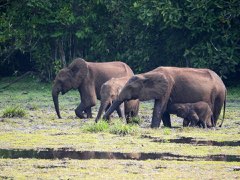 Odzala-Kokoua: forest elephants and grey parrots at Lango baiElephants blowing, splashing and rumbling in the bai's mineral pools a few metres below the deck, families greeting with trumpets and roars, grey parrot flocks whistling in to drink, forest buffalo grunting in the sedge, and a night of frogs, hyrax and distant hyena.
 Lemming years and the owl irruptionLemmings squeaking and chattering from every tussock and running across the trail, long-tailed skuas mewing, snowy owl barks and short-eared owl wing-claps, rough-legged buzzard mewing, arctic fox yips at a den; in a crash year, silence.
 Ngaga: habituated western lowland gorillas in the marantaceae forestChest-beats, hoots and the crashing of a silverback's display in dense marantaceae, the soft grunting and belching of a feeding family a few metres away, monkeys overhead and a night of tree hyrax and frogs from the camp's raised rooms.
 Musk ox on DovrefjellIn the rut, bulls' guttural roars and the crack of two 400 kg skulls colliding at 50 km/h, which carries across the plateau; otherwise snorts and grazing, golden plover and dotterel whistles, wind on the tundra.
 Marmots, ibex and chamois in the Berchtesgaden AlpsMarmot whistles echoing off the Watzmann east face, chough flocks, chamois sneezes, ptarmigan on the Steinernes Meer plateau, golden eagle; cowbells on the alpine pastures; in autumn, roaring stags in the Klausbachtal.
 Mercantour summer: marmots, ibex and wolf countryMarmot alarm whistles across high cirques, ibex hooves on rock, alpine choughs and lammergeier wingbeats; wolf howls are possible but rare and never guaranteed.
More: all spectacles in Gabon · mountain wildlife · Gabon in July · Gabon in August · Gabon in September · October