
Kilum-Ijim: Bannerman's turaco and the Mount Oku forest
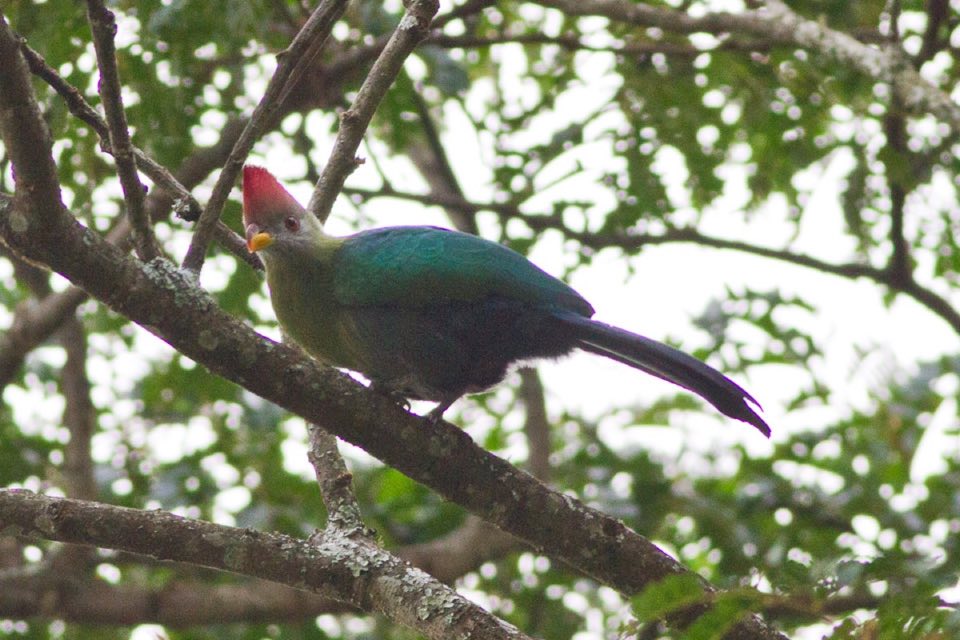
Bannerman's turaco (Tauraco bannermani), banded wattle-eye, Bamenda apalis, Cameroon montane greenbul, mountain robin-chat; Lake Oku clawed frog in the crater lake. Mount Oku, Kilum-Ijim community forest, North-West Region, Cameroon.
Best time: 1 Dec – 28 Feb (December to February). Where: Elak-Oku – Kilum forest trails, Lake Oku – crater lake (Cameroon). Time of day: From first light to about 09:00.
- Partly on your own
- Low cost
- Binoculars helpful
- Sound 4/5
Open it in the interactive calendarSunrise and sunset listening times for the day you pick, and the map.
When is the best time?
Peak: 1 Dec – 28 Feb. December to February: dry, clear mornings at 2,000–2,800 m; the turaco calls all year but carries best in the dry, still air
Active from 1 Nov to 31 Mar (November to March) in a typical year.
Time of day
From first light to about 09:00; turaco calling again in the late afternoon
- Dawn chorus: first light → 09:00
- Afternoon turacos: 16:00 → sunset
What will you hear?
The deep, hoarse 'kow-kow-kow' of Bannerman's turaco rolling across the last big montane forest of the Bamenda highlands, wattle-eyes and apalises in the understorey, and cattle and church bells from the villages below.
Binoculars?
Binoculars helpful. The turaco calls from the forest at close range; binoculars help see its red wings and the wattle-eyes in the understorey.
Where to go
- Elak-Oku – Kilum forest trails — Village at the foot of the forest with community guides; trails climb to Lake Oku. Map
- Lake Oku – crater lake — Sacred lake inside the forest at 2,200 m; frogs at night, turacos in the surrounding forest. Map
How to go on your own, and what it costs
Shared taxi Bamenda–Kumbo–Elak-Oku; ask at the community forest office/fon's palace for permission and a guide (customary). The lower forest edge tracks are walkable alone at dawn.
Cost: Community permission and guide fee by negotiation; check current prices.
Free or no-guide alternative: The forest-edge farm tracks above Elak-Oku are free at dawn and the turaco's call carries down from the forest without entering it.
Field-recording notes
Community-managed forest: a village guide and the traditional authorities' permission are the norm, and the lake is sacred — no swimming, no boats, no collecting. Cold nights (frost possible), heavy dew, wood smoke from the villages at dawn. The North-West Region has been at the centre of the Anglophone conflict since 2017; check current travel advice very carefully and ask the community before travelling.
Sources
Similar spectacles
 Tiwai Island — eleven primates and the Moa river dawnOne of the densest primate soundscapes in Africa: Diana monkeys' explosive alarm calls, red colobus chatter, the roar of king colobus, chimps' pant-hoots across the river, hornbills whooshing overhead, and the Moa river's rapids underneath.
 Sapo National Park — pygmy hippo, elephants and the deepest forest in West AfricaPrimary Upper Guinea rainforest with nothing man-made within a day's walk: casqued hornbills, chimps, Diana monkeys, the whistles of duikers, elephants rumbling at night, tree hyrax, and the full insect and frog layer of a forest that has never been logged.
 Upper Guinea rainforest dawn chorus — Kakum & AnkasaGreat blue turacos bubbling from the emergents, the far-carrying wailing of white-crested hornbills, yellow-casqued hornbills' whooshing wingbeats, chattering monkeys, cicadas switching on with the light and the screaming of tree hyrax at night.
 Monte Alén: the Río Muni rainforest dawn, elephants and the goliath frog riversA Central African lowland chorus: hornbills whooshing overhead, the bubbling of greenbuls and the far pant-hoots of chimpanzees, mandrill grunts, elephant rumbles at the swamp edge. The goliath frog itself is nearly silent (no vocal sac) — its rivers are a night of other frogs and the roar of water over rock.
 Obô forest dawn: São Tomé's endemic birds above Bom SucessoA dawn chorus made of species found nowhere else: the oriole's fluting, the thrush, the weavers' chatter, the giant sunbird's rattle from the canopy, speirops flocks; the croak of the dwarf olive ibis in the deep forest at Monte Carmo in the first light, and the scops owl's whistle after dark. Dripping forest, streams, no traffic.
 Dindéfélo — savanna chimpanzees pant-hooting under the Fouta Djallon escarpmentThe northern-most chimpanzee chorus in Africa: pant-hoots climbing to screams from the gallery forest under the escarpment, buttress drumming echoing off the cliff, baboons barking in reply, then the waterfall and a hornbill dawn. The village wakes with cockerels, mortars and the mosque — walk 20 minutes out and it is gone.
More: all spectacles in Cameroon · dawn choruses · Cameroon in January · Cameroon in February · Cameroon in December