
Varanger in winter: Steller's and king eiders
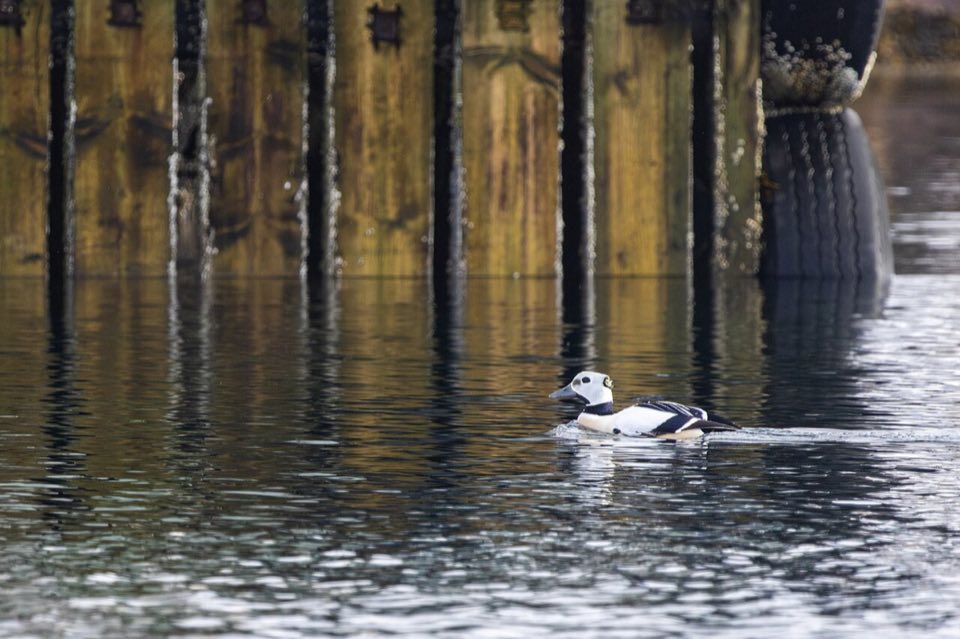
Steller's eider (Polysticta stelleri), king eider, common eider, long-tailed duck, white-billed diver, glaucous gull, sea eagles; the Arctic 'blue light'. Båtsfjord, Vardø, Vadsø, Nesseby — Varanger, Finnmark, Norway.
Best time: 1 Feb – 25 Mar (February to March). Where: Båtsfjord harbour and the floating king eider hide (Biotope), Vardø harbour, Nesseby church point (Varangerbotn) (Norway). Time of day: The few hours of usable light, about 10:00–14:00 in February.
- You can go on your own
- Free
- Binoculars essential
- Sound 3/5
Open it in the interactive calendarSunrise and sunset listening times for the day you pick, and the map.
When is the best time?
Peak: 1 Feb – 25 Mar. February to 25 March (king eider rafts at Vardø from early February; Steller's in the harbours)
Active from 15 Nov to 15 Apr (November to April) in a typical year.
Time of day
The few hours of usable light, about 10:00–14:00 in February; eiders croon in the harbours throughout, so work the whole window from the Biotope hides.
- Daylight: 10:00 → 14:00
What will you hear?
Long-tailed duck yodelling from rafts of hundreds, king and Steller's eider crooning at close range in the harbours, the crunch of sea ice on the shore, wind; fish-plant conveyors and the odd trawler.
Binoculars?
Binoculars essential. Eiders croon in the harbours 20–50 m off, but rafts of long-tailed ducks and king eiders sit far out; binoculars needed, scope in the blue light.
Where to go
- Båtsfjord harbour and the floating king eider hide (Biotope) — Fishing harbour where eiders feed on fish waste; the hide puts you at water level among king eiders. Map
- Vardø harbour — Steller's eiders and long-tailed ducks inside the harbour; king eider rafts offshore from the Hornøya boat. Map
- Nesseby church point (Varangerbotn) — Classic Steller's eider and long-tailed duck spot on the inner fjord; the Biotope wind shelter/hide. Map
- Vadsø – Vadsøya — Harbour and island; eiders and gulls; the E75 runs the whole coast. Map
How to go on your own, and what it costs
Drive the E75 between Varangerbotn and Vardø: the Biotope hides at Nesseby church, Vadsø and Båtsfjord harbour are free and open; harbours are public quays. Flights to Kirkenes or Vadsø, hire car; winter tyres and daylight 10:00–14:00 in February.
Cost: Free.
Field-recording notes
The harbours are where the ducks are, so fish-processing plants, boats and the E75 are in the mix — but Varanger in February at -15 °C and a 12-knot wind is mostly the wind. Biotope's hides (Nesseby, Båtsfjord, Vardø) are built precisely as wind shelters; use them. Sea ice at the shore adds a wonderful creaking bed on cold still days. Cables and batteries fail in the cold; keep spares warm. Eiders are hunted in Norway outside the reserves, but Varanger's winter flocks are essentially unhunted.
Sources
- Biotope – Varanger in winter and early spring
- Biotope – King Eider hide Båtsfjord
- Varanger.net – Båtsfjord
Similar spectacles
 Whooper swans & barnacle geeseBugling whoopers and yapping barnacle flocks like a huge crowd; the whole Svalbard barnacle population is on one estuary.
 Arctic geese on the Lower RhineWhite-fronted geese's high yelping in skeins of thousands, bean geese's deeper 'kayak', the roar of a roost lifting off the Rhine at first light, whooper swans on the Bislicher Altrhein; barges and the A57 underneath.
 Lower Oder Valley: whooper swans, geese and the flooded poldersWhooper swan bugling in chorus over the polder ice-edge, geese lifting at dawn by the thousand, smew and goldeneye wing-whistle, eagle yelps; in October, cranes; in May, corncrakes at night.
 Wintering cranes at ArjuzanxWaves of cranes dropping into the flooded roost after dark, a continuous rolling chorus that carries for kilometres over the pine plantations.
 Wintering cranes in the Extremadura dehesaTens of thousands of cranes flying into the roosts at sunset in wave after wave, bugling in the acorn dehesa by day, with wintering lapwings, golden plovers and greylags.
 Two million waders wintering on the Banc d'ArguinA roar of wings when a roost of tens of thousands lifts, knot and godwit flocks calling on the move, flamingos and spoonbills in the shallows, and the only human sound the creak of an Imraguen lanche's sail. Night roosts murmur continuously.
More: all spectacles in Norway · winter geese, swans and ducks · February · March