
Two million waders wintering on the Banc d'Arguin
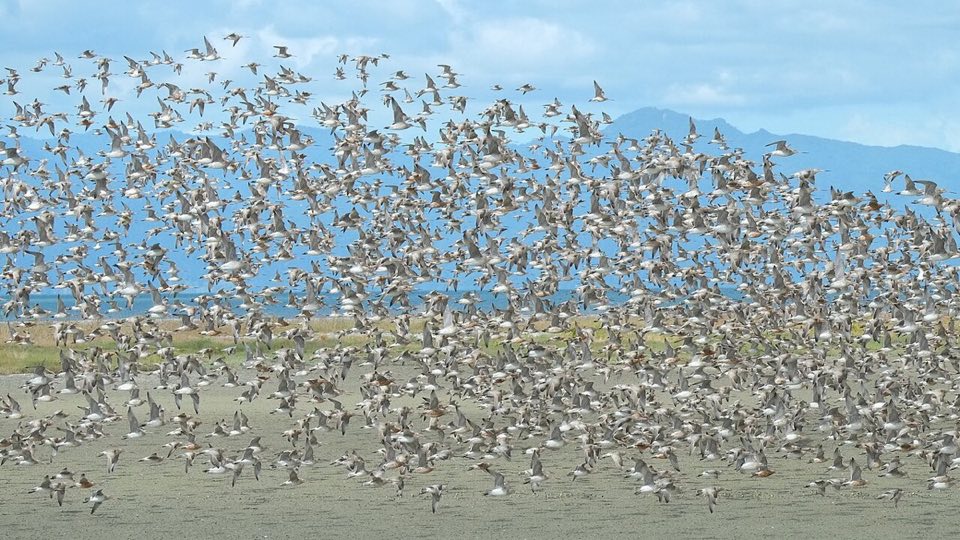
Dunlin (~800,000), bar-tailed godwit (~540,000), red knot (~370,000), curlew sandpiper, ringed plover, grey plover, whimbrel, greater flamingo; Palearctic terns and gulls. Parc National du Banc d'Arguin, between Nouakchott and Nouadhibou, Mauritania.
Best time: 1 Nov – 28 Feb and 10 Mar – 15 Apr (November to April). Where: Iwik village & Cap Tafarit, Tidra island & the Nair/Arel islets, Mamghar (Nouamghar) — southern gateway (Mauritania). Time of day: The 2 hours around high water, when the flats flood and birds pack the roost islands.
- Partly on your own
- Entry fee
- Telescope recommended
- Sound 5/5
Open it in the interactive calendarSunrise and sunset listening times for the day you pick, and the map.
When is the best time?
- Peak 1: 1 Nov – 28 Feb — November to February: ~2 million wintering waders (January counts 1.4–1.8 million)
- Peak 2: 10 Mar – 15 Apr — Mid March to mid April: departure — flocks fattening and leaving north in waves
Active from 15 Sep to 30 Apr (September to April) in a typical year.
Time of day
The 2 hours around high water, when the flats flood and birds pack the roost islands; dawn for the flight lines off the roosts
- Dawn flight: 30 min before sunrise → 2 h after sunrise
Depends on the tide: best around high tide. Check local tide tables.
What will you hear?
A roar of wings when a roost of tens of thousands lifts, knot and godwit flocks calling on the move, flamingos and spoonbills in the shallows, and the only human sound the creak of an Imraguen lanche's sail. Night roosts murmur continuously.
Binoculars?
Telescope recommended. Roosts of tens of thousands on flats and islets 200 m+ from the lanche or shore; scope recommended, binoculars minimum.
Where to go
- Iwik village & Cap Tafarit — The main visitor base: the park's Iwik sector (sections C–D) has the densest roosts. Sailing lanches with a village guide are the way onto the water; no motorised boats are allowed in the park. Map
- Tidra island & the Nair/Arel islets — Roost and breeding islands in the heart of the bay — landing on the islets is prohibited; the boat can anchor off. Map
- Mamghar (Nouamghar) — southern gateway — Southern Imraguen village at the park boundary, reached along the beach from Nouakchott at low tide; big high-tide roosts on the sandbars. Map
How to go on your own, and what it costs
Public transport gets you to Chami on the N2 (Nouakchott–Nouadhibou buses); from there it is 4x4 track to Iwik — hitch with park vehicles or hire a taxi-brousse in Chami. Buy the park permit at the Chami office. In Iwik the village campement and lanche skippers are hired directly, no tour company needed; the shore roosts around Iwik and Cap Tafarit are walkable from the village with the permit.
Cost: Park access fee 200 MRU per person per night (PNBA, 2026), vehicles and boats need a PNBA permit issued once the fee is paid; lanche with skipper and village guide by negotiation in Iwik (older guidebook figures UM20,000 + UM5,000 in old ouguiya) — check current prices.
Free or no-guide alternative: Mamghar (Nouamghar) is reachable along the beach from Nouakchott and the sandbar roosts and flight lines are watched free from the village shore; the park permit is still legally required inside the boundary, but no guide or boat.
Who runs access
- Iwik village lanches and campement (arranged via the PNBA post in Iwik) (community project) — Sail-powered lanches with local skippers; the only boats allowed in the park.
Field-recording notes
You are 100 km from the nearest engine noise, which makes the Banc d'Arguin one of the cleanest large-scale wader soundscapes anywhere — the only real limitations are wind (trade winds most days, calm at dawn and in the evening) and sand: the flats are backed by the Sahara, so seal recorders and expect dust in every fur. Bring a hydrophone: the tidal channels have shrimp crackle and passing dolphins. The park entry permit is compulsory (Chami office on the N2, or Nouadhibou/Nouakchott); guides and lanches are hired in Iwik or Mamghar; no landing on the islands, no drones, no wandering onto the flats near roosts. Nights are cold from December.
Sources
- Parc National du Banc d'Arguin (official)
- UNESCO – Banc d'Arguin National Park
- Bird Conservation International – Changes in the waterbird community of the PNBA 1980–2017
Similar spectacles
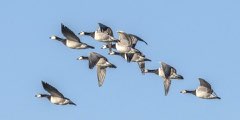 Wadden Sea autumn: geese, waders and whooper swans in the marshBarnacle goose yapping in flocks of tens of thousands over the Ballum marsh, brent geese growling on the flats, golden plover flocks whistling, whooper swan families bugling on the polders at night, curlew; the tide.
 Pink-footed goose dawn flightsTens of thousands of geese lifting off the mudflats at first light in a wall of 'wink-wink' calls, wave after wave overhead.
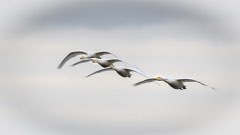 Whooper swans & barnacle geeseBugling whoopers and yapping barnacle flocks like a huge crowd; the whole Svalbard barnacle population is on one estuary.
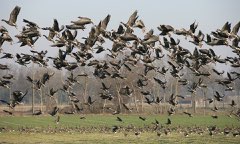 Arctic geese on the Lower RhineWhite-fronted geese's high yelping in skeins of thousands, bean geese's deeper 'kayak', the roar of a roost lifting off the Rhine at first light, whooper swans on the Bislicher Altrhein; barges and the A57 underneath.
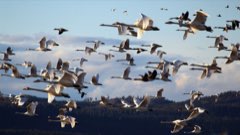 Lower Oder Valley: whooper swans, geese and the flooded poldersWhooper swan bugling in chorus over the polder ice-edge, geese lifting at dawn by the thousand, smew and goldeneye wing-whistle, eagle yelps; in October, cranes; in May, corncrakes at night.
 Wintering cranes at ArjuzanxWaves of cranes dropping into the flooded roost after dark, a continuous rolling chorus that carries for kilometres over the pine plantations.
More: all spectacles in Mauritania · winter geese, swans and ducks · Mauritania in January · Mauritania in February · March · Mauritania in April · Mauritania in November · Mauritania in December