
Humpback whales off Loango — the Gulf of Guinea breeding ground
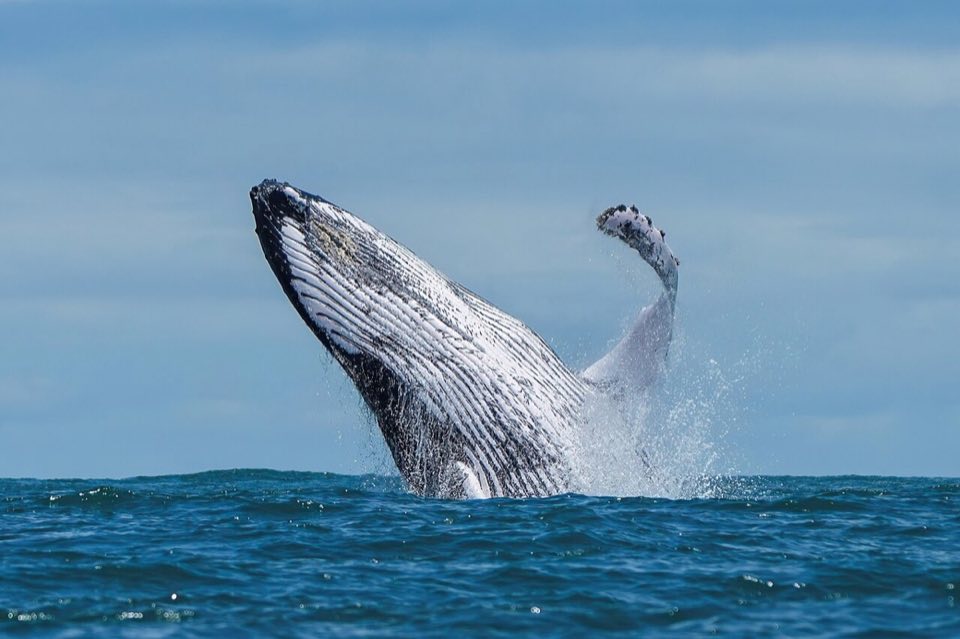
Humpback whale (Megaptera novaeangliae) — the West African 'breeding stock B' — with Atlantic humpback dolphin and bottlenose dolphin inshore; occasional killer whale. Loango National Park coast, Ogooué-Maritime, Gabon.
Best time: 15 Jul – 15 Sep (July to September). Where: Mayumba – national park coast, Iguéla – lagoon mouth and beach, Sette Cama – beach and headland (southern sector) (Gabon). Time of day: Boats go out in the calmer morning sea, roughly 08:00–11:00.
- Partly on your own
- Paid trip only
- Binoculars essential
- Sound 3/5
Open it in the interactive calendarSunrise and sunset listening times for the day you pick, and the map.
When is the best time?
Peak: 15 Jul – 15 Sep. Mid July to mid September: whale boats go out from the Iguéla lagoon only in this window, and mothers with calves sit close inshore off the Iguéla and Sette Cama beaches
Active from 1 Jul to 30 Sep (July to September) in a typical year.
Time of day
Boats go out in the calmer morning sea, roughly 08:00–11:00; from the beach, blows and breaches are easiest against the low sun of the last two hours before sunset when the sea is flat and the haze has dropped
- Boat window: 08:00 → 11:00
- Shore watching: 2 h before sunset → sunset
What will you hear?
Blows and tail-slaps carry over a flat sea; a hydrophone over the side of a drifting boat in August picks up singing males — the real sound event is underwater. On shore, surf and the roar of the Atlantic swell dominate; the whales are a visual spectacle from the beach.
Binoculars?
Binoculars essential. From shore the whales are 500 m to 2 km out — binoculars needed, a scope better; from the boat they come within 50 m.
Where to go
- Mayumba – national park coast — The Mayumba marine park (15 km offshore) protects migrating humpbacks on the same July–September passage; shore watching from the beach south of the town. Map
- Iguéla – lagoon mouth and beach — Whale boats leave from the Iguéla lagoon in the northern sector of the park; the beach north of the mouth is a long, empty shore-watching point. Map
- Sette Cama – beach and headland (southern sector) — Village outside the park's southern boundary; the open ocean beach is walkable at low tide and whales pass within a kilometre of the shore in August. Map
- Omboué – lagoon town and airstrip — Access town on the Fernan Vaz lagoon; boats to Iguéla and the park leave from here. Map
How to go on your own, and what it costs
Shore watching is free from the Sette Cama beach (village pirogue from Gamba across the Ndogo lagoon, then walk north along the beach) or from the beach at Iguéla. Boats go out from the Iguéla lagoon and from the Sette Cama camps as 2–3 hour trips, bookable only with a stay there. Reach Omboué by bush taxi and lagoon boat from Port-Gentil, or fly Libreville–Omboué.
Cost: Whale trips are sold with accommodation and not priced separately; expect several hundred euros a day all-in at Iguéla (check current prices). Shore watching at Sette Cama: free apart from the pirogue crossing.
Free or no-guide alternative: Walk the open beach north of Sette Cama village at low tide in August: blows, breaches and mother–calf pairs are regular inside a kilometre of the shore, and elephants and buffalo use the same beach at first light.
Field-recording notes
Hydrophone work from a drifting boat with the engine off is the way in: ask the skipper for a 15-minute drift at each encounter — the boats are used to photographers, not recordists, so say it before leaving. Gabon applies a park permit and guide rule inside Loango; the open beach at Sette Cama is outside the park boundary and free to walk. Rain is rare in August but the sky is grey and the swell is big: a sea-state-dependent spectacle, with cancelled days. No sanctioned swim-with-whales activity in Gabon; keep the boat at the skipper's distance.
Sources
Similar spectacles
 Conkouati-Douli: humpback whales and leatherback nestingBlows and breaches from the beach, humpback song on a hydrophone from a drifting pirogue, and at night the digging and heavy breathing of a leatherback on a wild beach with no lights for 50 km; chimpanzees pant-hooting from the lagoon islands at dawn.
 Humpback whales off Cape Three PointsBlows and breaches from the headland; with a hydrophone from a canoe, song from singing males in the breeding season — the reason to come. Above water this is mostly a sighting.
 Humpback whales off Ouidah and Grand-PopoBlows, breaches and tail slaps from the boat; with a hydrophone over the side and the engine off, humpback song in the breeding season.
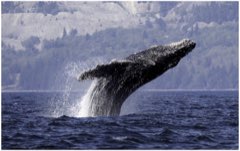 Humpback whales off KribiBlows, breaches and tail slaps; with a hydrophone over the side and the engine cut, male song in the breeding season. Sousa dolphins hunt in the surf line off the estuaries.
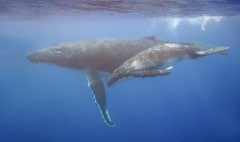 Humpback mothers and calves off São Tomé and PríncipeBlows, tail-slaps and the slap of a breach carry over a flat sea; a hydrophone from a drifting boat in September finds singing males at depth. From the headlands it is a visual spectacle against the surf; the islands are quiet enough that a blow is heard from the cliff on a still evening.
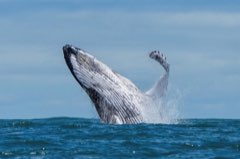 Humpback whales off Namibe and BenguelaBlows and breaches close inshore below desert cliffs, with a hydrophone over the side of a fishing boat: humpback song. Above water the Namib coast is fog, surf and cormorants.
More: all spectacles in Gabon · humpback whales · whales, dolphins and seals · Gabon in July · Gabon in August · Gabon in September