
Baie de l'Aiguillon: wader roosts and winter geese
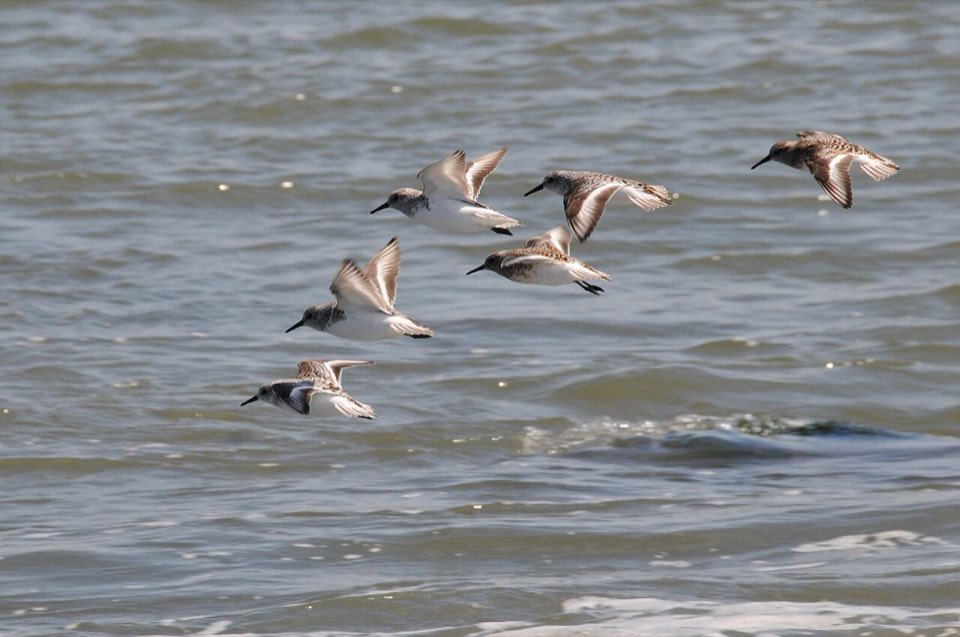
Dunlin, grey plover, knot, black-tailed godwit, avocet, curlew, oystercatcher; wigeon, pintail, teal; greylag and brent geese; common crane at dusk in December; osprey on passage. Baie de l'Aiguillon, Vendée / Charente-Maritime (Marais poitevin), France.
Best time: 1 Oct – 28 Feb (October to February). Where: Pointe de l'Aiguillon, Pointe Saint-Clément, Esnandes, La Marina, Charron (dyke) (France). Time of day: Everything happens on the tide: waders are pushed off the 3,700 ha of mudflats on to the salt-marsh roosts in the 2 h before high water and stream back as it drops.
- You can go on your own
- Free
- Telescope recommended
- Sound 4/5
Open it in the interactive calendarSunrise and sunset listening times for the day you pick, and the map.
When is the best time?
Peak: 1 Oct – 28 Feb. October to February; 25,000+ waders are already in the bay by September, geese and ducks peak December–January
Active from 15 Aug to 31 Mar (August to March) in a typical year.
Time of day
Everything happens on the tide: waders are pushed off the 3,700 ha of mudflats on to the salt-marsh roosts in the 2 h before high water and stream back as it drops. Ducks feed on the Marais poitevin meadows at night and sit in the bay by day; cranes arrive over Saint-Michel-en-l'Herm in the last hour before dark.
- Dawn on the mudflats: 30 min before sunrise → 2 h after sunrise
- Evening roost flights: 90 min before sunset → 20 min after sunset
Depends on the tide: best around high tide. Check local tide tables.
What will you hear?
The roar of 20,000 dunlin and plover lifting off the mud as the tide covers it, godwit and curlew flocks calling as they cross the dyke, wigeon whistling by the thousand on winter mornings, greylags at dawn and, in December, cranes bugling in to roost over the marsh.
Binoculars?
Telescope recommended. Roosts are 300 m to 1 km out on the salt marsh; a scope from the dykes. Flights pass overhead at the points at high water — binoculars then.
Where to go
- Pointe de l'Aiguillon — Southern tip of the Vendée side; dyke path along the bay to the point, big high-tide roosts on the marsh. Map
- Pointe Saint-Clément, Esnandes — Charente side; cliff-top view over the whole bay, free, car park. Map
- La Marina, Charron (dyke) — Dyke over the Sèvre niortaise estuary marsh; reserve guided outings start here. Map
- Observatoire de Saint-Michel-en-l'Herm — Hide on the reclaimed polders; the December crane roost flight. Map
How to go on your own, and what it costs
Pointe de l'Aiguillon: from L'Aiguillon-la-Presqu'île drive to the end of the point and walk the dyke (free). Pointe Saint-Clément: signed from Esnandes, free car park. Charron: the Marina dyke from the village. Saint-Michel-en-l'Herm: the observatory on the polder road. Reserve-run guided 'La baie au fil des saisons' outings (about 3 h, autumn and winter dates on the reserve site) are free but need booking.
Cost: Free.
Field-recording notes
Dykes and points are open at all hours and free; the reserve itself (mudflats and salt marsh) is closed to walking, vehicles and dogs — record from the dyke. Hunting is allowed on the surrounding marsh and polders in winter (shots at dawn and dusk), not in the reserve. Wind off the Atlantic is the limit; the Esnandes cliff is sheltered in a southerly, the Aiguillon dyke in a northerly. Oyster farms and mussel-bouchot tractors work the bay at low water.
Sources
- OFB – Réserve naturelle nationale de la baie de l'Aiguillon
- Réserve naturelle Baie de l'Aiguillon – counts and outings
Similar spectacles
 Wadden Sea autumn: geese, waders and whooper swans in the marshBarnacle goose yapping in flocks of tens of thousands over the Ballum marsh, brent geese growling on the flats, golden plover flocks whistling, whooper swan families bugling on the polders at night, curlew; the tide.
 Pink-footed goose dawn flightsTens of thousands of geese lifting off the mudflats at first light in a wall of 'wink-wink' calls, wave after wave overhead.
 Whooper swans & barnacle geeseBugling whoopers and yapping barnacle flocks like a huge crowd; the whole Svalbard barnacle population is on one estuary.
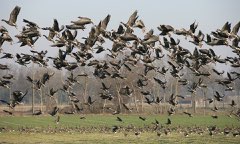 Arctic geese on the Lower RhineWhite-fronted geese's high yelping in skeins of thousands, bean geese's deeper 'kayak', the roar of a roost lifting off the Rhine at first light, whooper swans on the Bislicher Altrhein; barges and the A57 underneath.
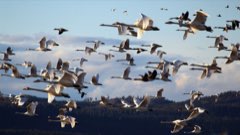 Lower Oder Valley: whooper swans, geese and the flooded poldersWhooper swan bugling in chorus over the polder ice-edge, geese lifting at dawn by the thousand, smew and goldeneye wing-whistle, eagle yelps; in October, cranes; in May, corncrakes at night.
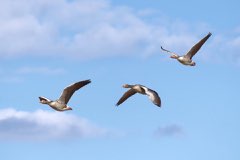 Goose autumn at the Lange Lacke, SeewinkelGeese in skeins of thousands crossing the pastures at dusk, greylag chatter on the soda lake roost through the night, cranes trumpeting overhead in late October, eagle calls; the salt-steppe silence in between.
More: all spectacles in France · wild geese · winter geese, swans and ducks · France in January · France in February · France in October · France in November · France in December