
Doñana in winter: geese and the marismas
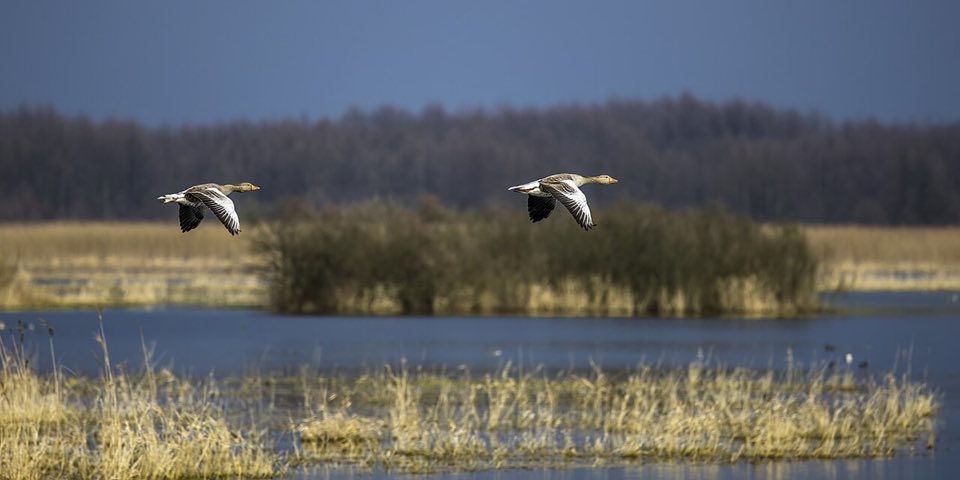
Greylag goose (Anser anser), wigeon, teal, pintail, shoveler, flamingo, glossy ibis, spoonbill, cranes. Huelva / Seville, Andalusia, Spain.
Best time: 1 Dec – 31 Jan (December to January). Where: Centro de Visitantes José Antonio Valverde (Cerrado Garrido), El Rocío marsh front (Madre de las Marismas), Dehesa de Abajo, La Puebla del Río (Spain). Time of day: Geese lift from the marsh from about 45 min before sunrise and fly to the dunes in the first hour of light.
- You can go on your own
- Free
- Telescope recommended
- Sound 5/5
Open it in the interactive calendarSunrise and sunset listening times for the day you pick, and the map.
When is the best time?
Peak: 1 Dec – 31 Jan. December–January (in wet winters; the marsh has been dry in recent drought years)
Active from 1 Nov to 28 Feb (November to February) in a typical year.
Time of day
Geese lift from the marsh from about 45 min before sunrise and fly to the dunes in the first hour of light; the return from an hour before sunset to dusk. The 25 km track to Valverde is driven in the dark.
- Dawn flight: 45 min before sunrise → 1 h after sunrise
- Evening return: 1 h before sunset → last light
What will you hear?
Tens of thousands of greylags calling at first light, wigeon whistling in rafts, flamingos honking, glossy ibis colonies grunting, and the near-total absence of roads in the marsh core.
Binoculars?
Telescope recommended. Geese pass overhead at dawn, but rafts and ibis colonies on the open marsh are far out — scope from the Valverde centre and hides.
Where to go
- Centro de Visitantes José Antonio Valverde (Cerrado Garrido) — In the heart of the marsh via 25 km of dirt track from Villamanrique / Isla Mayor — open to private cars, condition varies. Map
- El Rocío marsh front (Madre de las Marismas) — The village's sand streets overlook the marsh; horses, and pilgrimage weekends. Map
- Dehesa de Abajo, La Puebla del Río — Reserve lagoon with hides and Europe's largest white stork tree colony; rice-field geese. Map
- Centro de Visitantes La Rocina — Boardwalks through the stream forest; hides on the Charco de la Boca. Map
How to go on your own, and what it costs
José Antonio Valverde centre: drive the 25 km dirt track from Villamanrique or Isla Mayor in the dark (any car in dry weather; ask the centre about conditions) — free. El Rocío: park on the sand streets and stand at the marsh front. Dehesa de Abajo: free hides. La Rocina: free boardwalks from the car park. The national park core is only entered on the official 4x4 tours from El Acebuche or Sanlúcar.
Cost: Free; official 4x4 tours of the park core are paid (check current prices).
Field-recording notes
The national park core is closed except on the official 4x4 tours (from El Acebuche and Sanlúcar); everything above is in the buffer or on public tracks. Check the marsh is actually flooded — Doñana has suffered severe droughts and aquifer over-extraction; dry years mean few geese. Rice-field pumps and the A-49 are absent from the Valverde area, which is exceptionally quiet at dawn.
Sources
Similar spectacles
 Wadden Sea autumn: geese, waders and whooper swans in the marshBarnacle goose yapping in flocks of tens of thousands over the Ballum marsh, brent geese growling on the flats, golden plover flocks whistling, whooper swan families bugling on the polders at night, curlew; the tide.
 Pink-footed goose dawn flightsTens of thousands of geese lifting off the mudflats at first light in a wall of 'wink-wink' calls, wave after wave overhead.
 Whooper swans & barnacle geeseBugling whoopers and yapping barnacle flocks like a huge crowd; the whole Svalbard barnacle population is on one estuary.
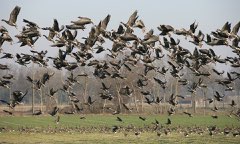 Arctic geese on the Lower RhineWhite-fronted geese's high yelping in skeins of thousands, bean geese's deeper 'kayak', the roar of a roost lifting off the Rhine at first light, whooper swans on the Bislicher Altrhein; barges and the A57 underneath.
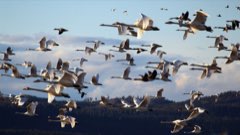 Lower Oder Valley: whooper swans, geese and the flooded poldersWhooper swan bugling in chorus over the polder ice-edge, geese lifting at dawn by the thousand, smew and goldeneye wing-whistle, eagle yelps; in October, cranes; in May, corncrakes at night.
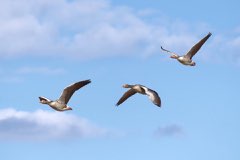 Goose autumn at the Lange Lacke, SeewinkelGeese in skeins of thousands crossing the pastures at dusk, greylag chatter on the soda lake roost through the night, cranes trumpeting overhead in late October, eagle calls; the salt-steppe silence in between.
More: all spectacles in Spain · wild geese · winter geese, swans and ducks · Spain in January · Spain in December