
Ural owls in the Wienerwald and Dürrenstein wilderness
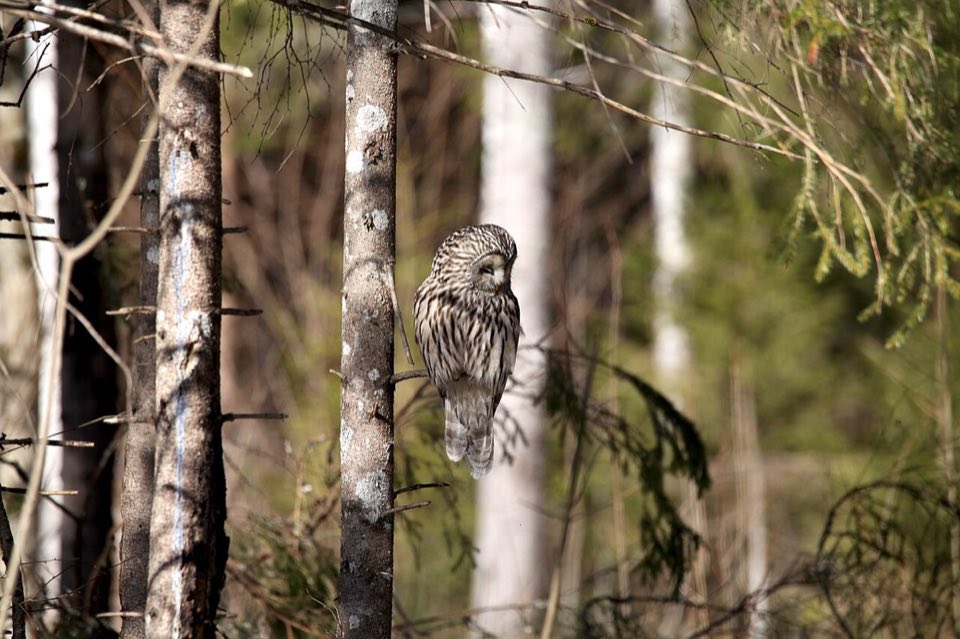
Ural owl (Strix uralensis) — reintroduced since 2009; tawny, Tengmalm's and pygmy owl; white-backed woodpecker; lynx in Dürrenstein. Biosphärenpark Wienerwald, Wildnisgebiet Dürrenstein-Lassingtal, Nationalpark Kalkalpen, Austria.
Best time: 15 Feb – 25 Mar and 15 Sep – 31 Oct (February to March, September to October). Where: Wildnisgebiet Dürrenstein-Lassingtal (Lunz am See), Biosphärenpark Wienerwald (Naturpark Sparbach / Kaltenleutgeben), Nationalpark Kalkalpen – Reichraming (Austria). Time of day: Calling starts at dusk and is most regular in the 2 h after.
- You can go on your own
- Free
- No binoculars needed
- Sound 4/5
Open it in the interactive calendarSunrise and sunset listening times for the day you pick, and the map.
When is the best time?
- Peak 1: 15 Feb – 25 Mar — Mid February to late March: main courtship (Hauptbalz starts in January, eggs March/April)
- Peak 2: 15 Sep – 31 Oct — Mid September to October: autumn courtship (Herbstbalz) — territorial song series most frequent and complete, loud barking between partners
Active from 15 Sep to 31 Mar (September to March) in a typical year.
Time of day
Calling starts at dusk and is most regular in the 2 h after; a second bout in the hour before dawn. Cold, still nights.
- Evening calling: 15 min after sunset → 2 h after last light
- Pre-dawn calling: 1 h before first light → first light
What will you hear?
Ural owl's deep barking 'wuh-wuh... wu-wuhuh' series, female's hoarse heron-like calls, tawny owl duets, pygmy owl piping in the Dürrenstein old growth; snow-quiet beech forest.
Binoculars?
No binoculars needed. Owls call from the dark beech forest; ears only, no torches near nests.
Where to go
- Wildnisgebiet Dürrenstein-Lassingtal (Lunz am See) — UNESCO primeval beech forest (Rothwald); strictly guided access only to the core; the surrounding forest roads are open. Map
- Biosphärenpark Wienerwald (Naturpark Sparbach / Kaltenleutgeben) — First release area; owls in mature beech close to Vienna; some suburban noise. Map
- Nationalpark Kalkalpen – Reichraming — Recent reintroduction zone; forest roads walkable at night. Map
How to go on your own, and what it costs
Dürrenstein: the Lassing valley forest roads from Lunz am See are open at night on foot and free; the primeval core (Rothwald) is guided-only. Wienerwald: Naturpark Sparbach (small entry fee by day) and the public forest roads. Kalkalpen: Reichraming forest roads at night. No playback, no nest approach.
Cost: Free on forest roads; Dürrenstein guided core visits (check current prices); Naturpark Sparbach entry €9.50 adult (2026).
Who runs access
- Wildnisgebiet Dürrenstein-Lassingtal – guided tours (park authority) — The only way into the Rothwald primeval forest core.
Field-recording notes
The reintroduction project asks for no playback and no nest-box approach — Ural owls attack near nests, and disturbance of a strictly protected reintroduced species is an offence. Dürrenstein's core is closed without a guide; the Lassing valley roads are fine at night and quiet (no through traffic). Wienerwald has Vienna's hum and the A21 — pick the Sparbach side. Late February at 800–1,000 m means snow: crunch is your main self-noise; stand still. Owls answer each other across valleys — two spaced omnis 50 m apart capture the exchange.
Sources
- Habichtskauz Wiederansiedlung Österreich
- Wildnisgebiet Dürrenstein-Lassingtal
- Nationalpark Kalkalpen (English)
Similar spectacles
 Wolf howling and Ural owls, Kočevski Rog nightsPack howls with high pup yips from rendezvous sites, carrying several km across karst dolines; Ural owl's deep barking 'wuh-wuh-wuho' and female's hoarse calls; Tengmalm's owl in late winter; red deer in the same windows from mid September.
 Príncipe after dark: the scops owl described in 2022, and the island's endemics at dawnA fast, insect-like 'tuu-tuu-tuu' at about one note a second, often as a duet with the female higher-pitched, from the old-growth forest of the uninhabited south — a sound nobody had named until 2022. Before dark, the island's grey parrots screaming to roost; at dawn, the thrush, the thrush-babbler, the speirops and the Príncipe sunbird in a forest with no roads.
 Tawny owl territorial callingHoots and 'ke-wick' duets and disputes as young birds try to settle territories; sometimes three or four birds answering.
 Bavarian Forest: pygmy and Tengmalm's owls, woodpeckers, lynx countryPygmy owl's piping series at dusk, Tengmalm's 'po-po-po-po' from the bark-beetle deadwood forest, Ural owl barking, three-toed woodpecker drumming rolls, nutcrackers; the loudest silence in Germany in the dead-spruce stands.
 Paklenica canyons: eagle owl, chamois and rock birdsEagle owl's deep 'oo-hu' bouncing between 400 m canyon walls, rock partridge cackling at dawn, alpine swift screams, blue rock thrush, chamois alarm whistles, the Velika Paklenica stream.
 Eagle owl winter callingDeep 'oo-hu' territorial hoots from cliffs, sometimes in male–female duet, echoing off rock.
More: all spectacles in Austria · owls · wildlife at night · February · March · Austria in September · Austria in October