
Technopole — Dakar's urban wetland roost
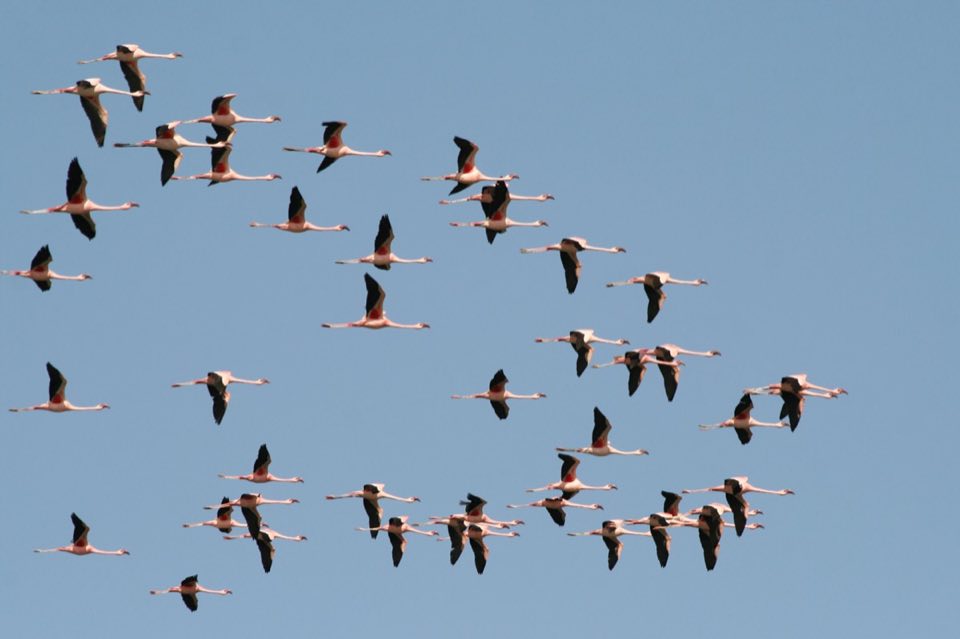
Black-winged stilt, avocet, ruff, little stint, greater flamingo, gull-billed & whiskered terns, slender-billed gull, herons and egret roost, Palearctic warblers in the reeds. Pikine / Technopole, Dakar, Senegal.
Best time: 1 Nov – 15 Mar (November to March). Where: Technopole lakes (Grand Lac), Lac Rose (Retba) (Senegal). Time of day: First 2 hours after sunrise before the city noise and heat.
- You can go on your own
- Free
- Binoculars essential
- Sound 2/5
Open it in the interactive calendarSunrise and sunset listening times for the day you pick, and the map.
When is the best time?
Peak: 1 Nov – 15 Mar. November to mid March; thousands of waders when the lakes hold water
Active from 15 Sep to 30 Apr (September to April) in a typical year.
Time of day
First 2 hours after sunrise before the city noise and heat; the egret/heron roost fills in the last hour of light
- Morning: sunrise → 2 h after sunrise
- Evening roost: 1 h before sunset → last light
What will you hear?
Wader and stilt calls over rain-fed lakes ringed by the Pikine suburbs; more a sighting spectacle, but the heron roost at dusk is loud.
Binoculars?
Binoculars essential. Stilts, waders and flamingos are 100–300 m out across the lakes; binoculars needed, a scope for the far shore.
Where to go
- Technopole lakes (Grand Lac) — Open access on the tracks around the lakes off the Pikine–Cambérène road; being filled and built on year by year. Map
- Lac Rose (Retba) — Salt lake north-east of Dakar: flamingos and waders, heavy tourism. Map
How to go on your own, and what it costs
Taxi or bus to the Technopole/Cambérène roundabout; the lake tracks are open and free. Daylight visits only in practice (urban area).
Cost: Free (2026).
Field-recording notes
A city site with all that implies — included because it is the easiest place on the flyway to check what is in, and a good half-day before the flight. Threatened by infill; go while it lasts.
Sources
Similar spectacles
 Wadden Sea autumn: geese, waders and whooper swans in the marshBarnacle goose yapping in flocks of tens of thousands over the Ballum marsh, brent geese growling on the flats, golden plover flocks whistling, whooper swan families bugling on the polders at night, curlew; the tide.
 Pink-footed goose dawn flightsTens of thousands of geese lifting off the mudflats at first light in a wall of 'wink-wink' calls, wave after wave overhead.
 Whooper swans & barnacle geeseBugling whoopers and yapping barnacle flocks like a huge crowd; the whole Svalbard barnacle population is on one estuary.
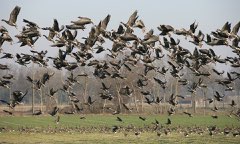 Arctic geese on the Lower RhineWhite-fronted geese's high yelping in skeins of thousands, bean geese's deeper 'kayak', the roar of a roost lifting off the Rhine at first light, whooper swans on the Bislicher Altrhein; barges and the A57 underneath.
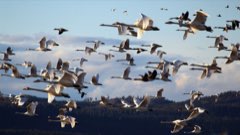 Lower Oder Valley: whooper swans, geese and the flooded poldersWhooper swan bugling in chorus over the polder ice-edge, geese lifting at dawn by the thousand, smew and goldeneye wing-whistle, eagle yelps; in October, cranes; in May, corncrakes at night.
 Wintering cranes at ArjuzanxWaves of cranes dropping into the flooded roost after dark, a continuous rolling chorus that carries for kilometres over the pine plantations.
More: all spectacles in Senegal · winter geese, swans and ducks · Senegal in January · Senegal in February · Senegal in March · Senegal in November · Senegal in December