
Palearctic ducks and waders wintering at Djoudj
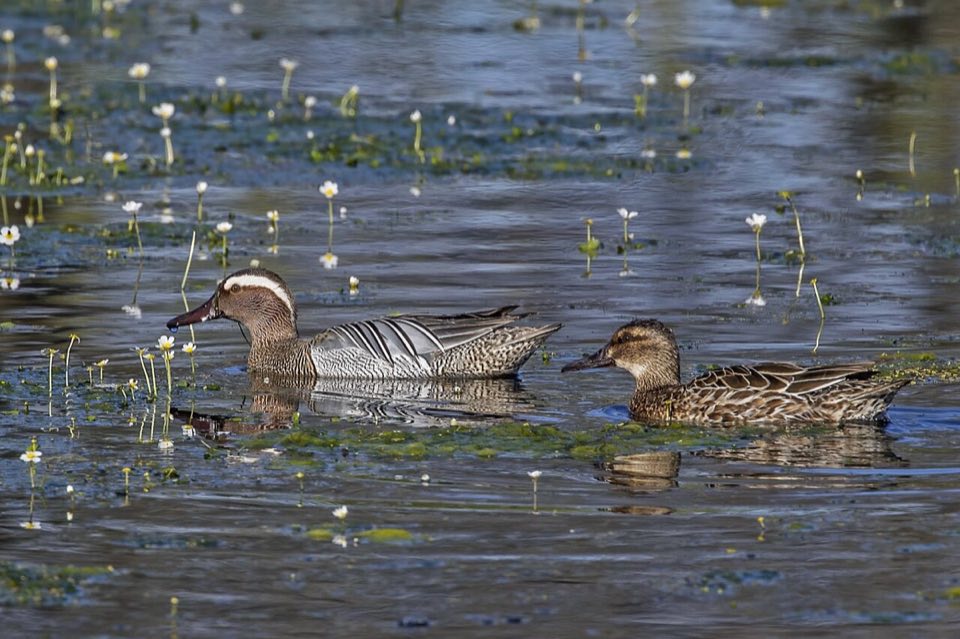
Garganey (hundreds of thousands), pintail, shoveler, ruff, black-tailed godwit; white-faced whistling duck, greater & lesser flamingo, spur-winged goose, crowned crane. Parc National des Oiseaux du Djoudj, Senegal delta (Saint-Louis), Senegal.
Best time: 15 Nov – 15 Feb (November to February). Where: Ndiaël basin and the Trois Marigots, Djoudj park entrance & Station biologique, Grand Lac observation tower (Senegal). Time of day: From first light to about 09:00 for the duck flight between roost and feeding marsh.
- Partly on your own
- Entry fee
- Binoculars essential
- Sound 5/5
Open it in the interactive calendarSunrise and sunset listening times for the day you pick, and the map.
When is the best time?
Peak: 15 Nov – 15 Feb. Mid November to mid February — up to 1.5 million waterbirds, 3 million on peak passage; the Grand Lac dries and empties towards April
Active from 15 Oct to 15 Apr (October to April) in a typical year.
Time of day
From first light to about 09:00 for the duck flight between roost and feeding marsh; the last hour before dark for the return and the egret/cormorant roost
- Dawn duck flight: first light → 150 min after sunrise
- Evening return: 1 h before sunset → last light
What will you hear?
Garganey and pintail flocks in the hundreds of thousands lifting off the Grand Lac in continuous waves, whistling ducks and spur-winged geese over the pirogue, flamingo chorus in the shallows and the wing-roar of a pelican colony taking off — one of the loudest waterbird soundscapes on the whole flyway.
Binoculars?
Binoculars essential. Duck flocks lift 200 m to 1 km from the Grand Lac tower; binoculars needed, a scope sorts pintail from garganey.
Where to go
- Ndiaël basin and the Trois Marigots — Re-flooded Ramsar reserve 3 km east of Ross-Béthio, south of the N3: historically tens of thousands of garganey and pintail and a 134,000 ruff pre-roost; holds 20,000+ waterbirds again since the re-watering (13 billion CFA project, 2017). Roadside and dyke viewing; the Trois Marigots are a hunting zone in season. Map
- Djoudj park entrance & Station biologique — Entry post, park pirogues and guides; the campement and the biological station are the base. 60 km north of Saint-Louis via Ross-Béthio. Map
- Grand Lac observation tower — Drive-in tower on the park track overlooking the main duck lake; the classic dawn position. Map
- Marigot du Djoudj – pelican pirogue route — Park pirogue from the jetty along the marigot to the pelican colony, 1.5–2 hours. Map
How to go on your own, and what it costs
Own car or taxi from Saint-Louis (about 1.5 h; no public transport to the gate — a shared taxi to Ross-Béthio then a hired car). Pay the entry fee at the gate; you can drive the park tracks and the Grand Lac tower yourself, but a park guide is required in the vehicle and the pelican colony is only by park pirogue.
Cost: Entry about 2,000 CFA per person plus vehicle fee; park pirogue about 3,000–5,000 CFA per person; guide fee per day (recent trip reports) — check current prices at the gate.
Free or no-guide alternative: The public dyke road along the park's southern edge and the Ndiaël/Trois-Marigots marshes between Ross-Béthio and the gate hold the same duck flocks feeding at dawn, free from the roadside.
Who runs access
- Djoudj park pirogues and guides (DPN, at the entrance) (park authority) — Park-run; the only boats allowed on the marigots.
Field-recording notes
The delta is flat, dry and windy from mid-morning; the harmattan brings fine dust from December — capsules gunk up in a day without a windshield and cases need wiping nightly. Dawn is calm and remarkably quiet apart from the campement generator, cattle and dogs from the villages on the dyke, and the park's outboard pirogues (which start at 08:00 — be in position before). Night recording on the dyke tracks is by arrangement with the conservateur. Hunting is banned in the park but licensed duck shooting continues on the surrounding Ndiaël and Trois-Marigots zones in season. No playback, no drones, no walking on the lake bed.
Sources
- Source for Ndiaël basin and the Trois Marigots
- UNESCO – Djoudj National Bird Sanctuary
- Birdingplaces – Djoudj
- Direction des Parcs Nationaux du Sénégal
Similar spectacles
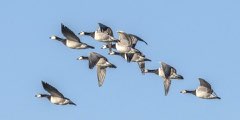 Wadden Sea autumn: geese, waders and whooper swans in the marshBarnacle goose yapping in flocks of tens of thousands over the Ballum marsh, brent geese growling on the flats, golden plover flocks whistling, whooper swan families bugling on the polders at night, curlew; the tide.
 Pink-footed goose dawn flightsTens of thousands of geese lifting off the mudflats at first light in a wall of 'wink-wink' calls, wave after wave overhead.
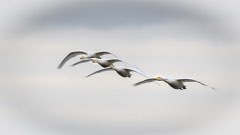 Whooper swans & barnacle geeseBugling whoopers and yapping barnacle flocks like a huge crowd; the whole Svalbard barnacle population is on one estuary.
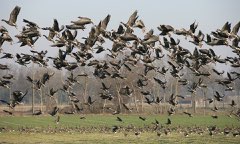 Arctic geese on the Lower RhineWhite-fronted geese's high yelping in skeins of thousands, bean geese's deeper 'kayak', the roar of a roost lifting off the Rhine at first light, whooper swans on the Bislicher Altrhein; barges and the A57 underneath.
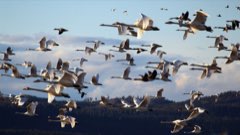 Lower Oder Valley: whooper swans, geese and the flooded poldersWhooper swan bugling in chorus over the polder ice-edge, geese lifting at dawn by the thousand, smew and goldeneye wing-whistle, eagle yelps; in October, cranes; in May, corncrakes at night.
 Wintering cranes at ArjuzanxWaves of cranes dropping into the flooded roost after dark, a continuous rolling chorus that carries for kilometres over the pine plantations.
More: all spectacles in Senegal · winter geese, swans and ducks · Senegal in January · Senegal in February · Senegal in November · Senegal in December