
Wintering waders and ducks on Merja Zerga
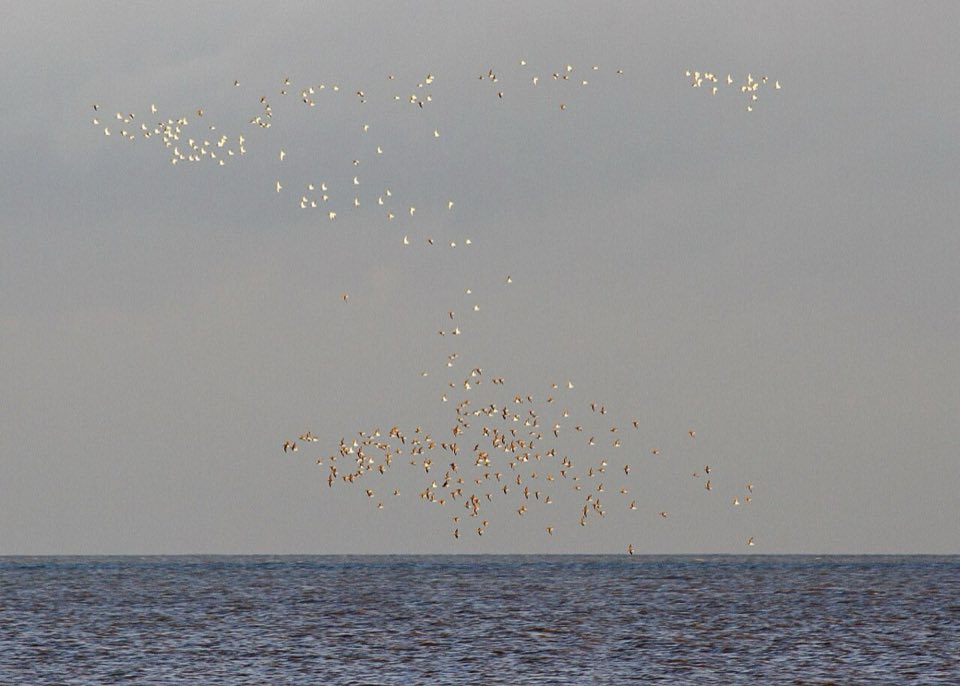
Dunlin, bar-tailed godwit, grey plover, avocet, greater flamingo, wigeon, shoveler, pintail, marbled teal; Audouin's & slender-billed gulls. Moulay Bousselham, Gharb coast, Morocco.
Best time: 15 Nov – 15 Feb (November to February). Where: Moulay Bousselham – lagoon jetty and boatmen, South-east shore track (Merja Zerga eastern basin), Lac de Sidi Boughaba (Mehdia, Kénitra) (Morocco). Time of day: Rising tide in the 2 hours before high water pushes 50,000+ waders onto the roosts.
- Partly on your own
- Free
- Telescope recommended
- Sound 4/5
Open it in the interactive calendarSunrise and sunset listening times for the day you pick, and the map.
When is the best time?
Peak: 15 Nov – 15 Feb. Mid November to mid February; the January count is the reference
Active from 1 Oct to 31 Mar (October to March) in a typical year.
Time of day
Rising tide in the 2 hours before high water pushes 50,000+ waders onto the roosts; dawn and the last hour before dark for duck and flamingo movement
- Dawn duck flight: first light → 2 h after sunrise
- Evening roost: 90 min before sunset → last light
Depends on the tide: best around high tide. Check local tide tables.
What will you hear?
A continuous layer of wader contact calls over the lagoon, whole flocks lifting in a rush of wings when a marsh harrier crosses, flamingo honking from the shallows, and the bark of grey herons. Boatmen's pirogues are still mostly rowed or poled inside the lagoon.
Binoculars?
Telescope recommended. Roosts of 50,000 waders are far out on the flats from the shore; scope from the shore, binoculars from the pirogue.
Where to go
- Moulay Bousselham – lagoon jetty and boatmen — Ramsar site (1980) and Morocco's most important wader wetland: 50,000–100,000 waders and 15–30,000 ducks in winter. Local boatmen (the village has a long tradition of bird guiding) take you into the lagoon at first light. Map
- South-east shore track (Merja Zerga eastern basin) — Drive-in access along the farm tracks from Moulay Bousselham towards the Oued Drader inflow; reed-fringed edge with crakes and marbled teal. Map
- Lac de Sidi Boughaba (Mehdia, Kénitra) — Freshwater Ramsar lake 60 km south with marbled teal, ferruginous duck and crested coot; managed reserve with an education centre, open in daylight only. Map
How to go on your own, and what it costs
Bus or grand taxi to Moulay Bousselham (from Kénitra or Larache); the lagoon shore, the jetty and the farm tracks round the eastern basin are free and open at all hours. The roost flats can't be walked, so the inside of the lagoon is by local pirogue — hired on the spot at the jetty, no operator needed.
Cost: Shore free; boatman roughly 150–300 MAD for 2–3 hours per boat (recent trip reports) — check current prices.
Free or no-guide alternative: Walk the south-east shore track from the village towards the Oued Drader inflow at first light: the same duck flight and wader roost calls from the public bank, no boat.
Field-recording notes
The lagoon is open Atlantic coast: wind almost every afternoon, calm most dawns. Village noise (calls to prayer, generators, the Friday souk) reaches the north shore; the eastern basin is quieter. A boat is the only way to sit inside the roost soundfield, and a rowed pirogue at the mudflat edge on a rising tide is a superb platform — brief the boatman to stop and drift, no engine. This is a Biological Reserve: no walking onto the roost flats, no playback. Hunting is closed inside the reserve but waterfowl shooting happens on surrounding marshes in season (Oct–Feb), so expect shots at dawn on weekends.
Sources
- Birdingplaces – Merja Zerga
- Wikipedia – Merja Zerga (Ramsar site)
- GREPOM – BirdLife Morocco (waterbird counts)
Similar spectacles
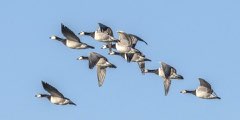 Wadden Sea autumn: geese, waders and whooper swans in the marshBarnacle goose yapping in flocks of tens of thousands over the Ballum marsh, brent geese growling on the flats, golden plover flocks whistling, whooper swan families bugling on the polders at night, curlew; the tide.
 Pink-footed goose dawn flightsTens of thousands of geese lifting off the mudflats at first light in a wall of 'wink-wink' calls, wave after wave overhead.
 Whooper swans & barnacle geeseBugling whoopers and yapping barnacle flocks like a huge crowd; the whole Svalbard barnacle population is on one estuary.
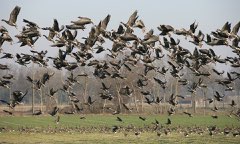 Arctic geese on the Lower RhineWhite-fronted geese's high yelping in skeins of thousands, bean geese's deeper 'kayak', the roar of a roost lifting off the Rhine at first light, whooper swans on the Bislicher Altrhein; barges and the A57 underneath.
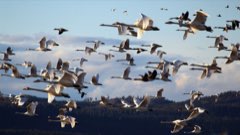 Lower Oder Valley: whooper swans, geese and the flooded poldersWhooper swan bugling in chorus over the polder ice-edge, geese lifting at dawn by the thousand, smew and goldeneye wing-whistle, eagle yelps; in October, cranes; in May, corncrakes at night.
 Wintering cranes at ArjuzanxWaves of cranes dropping into the flooded roost after dark, a continuous rolling chorus that carries for kilometres over the pine plantations.
More: all spectacles in Morocco · winter geese, swans and ducks · Morocco in January · Morocco in February · Morocco in November · Morocco in December