
Irish seabird cities: Cliffs of Moher, Great Saltee and the Skelligs
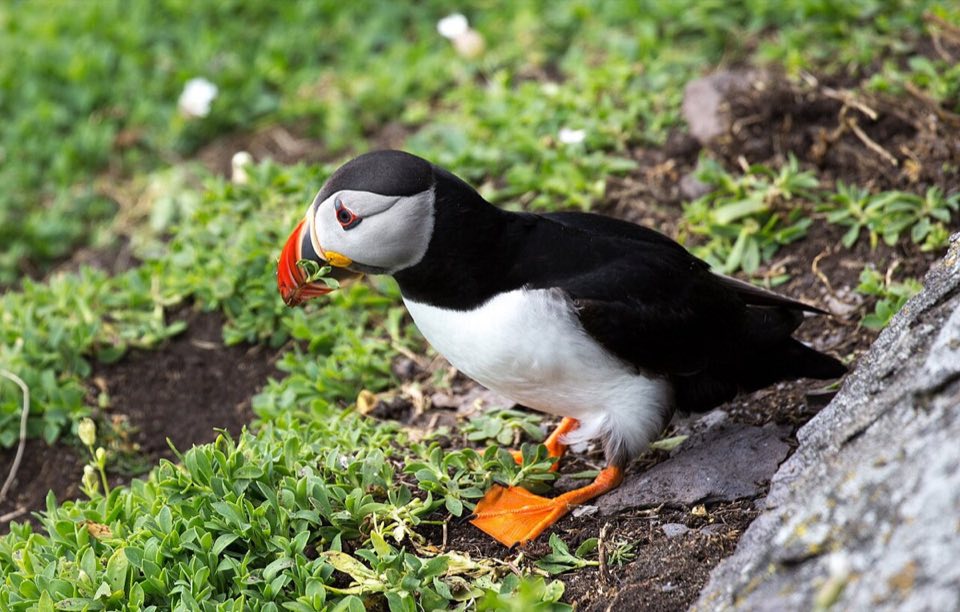
Guillemot (c. 20,000 at Moher), razorbill, kittiwake (7,700 nests at Moher), fulmar, puffin (Moher's Goat Island; Skellig Michael), gannet (Little Skellig c. 35,000 pairs; Great Saltee), chough, peregrine. Cliffs of Moher (Clare), Saltee Islands (Wexford), Skellig Islands (Kerry), Ireland.
Best time: 10 May – 30 Jun (May to June). Where: Cliffs of Moher visitor area – O'Brien's Tower and the South platform (Goat Island puffins), Great Saltee, Kilmore Quay, Little Skellig (BirdWatch Ireland reserve) from the boat; Skellig Michael (Ireland). Time of day: Colonies are loudest in the morning and again from two hours before sunset.
- Partly on your own
- Entry fee
- Binoculars helpful
- Sound 4/5
Open it in the interactive calendarSunrise and sunset listening times for the day you pick, and the map.
When is the best time?
Peak: 10 May – 30 Jun. Mid May to end of June; puffins best May–June; by early August the auk ledges are empty
Active from 15 Apr to 31 Jul (April to July) in a typical year.
Time of day
Colonies are loudest in the morning and again from two hours before sunset; the Moher visitor area opens 08:00 (09:00 in winter), Saltee boats land late morning for ~3.5 h ashore, Skellig boats leave Portmagee mid-morning (landing season mid May–Sept).
- Morning colony activity: sunrise → 3 h after sunrise
- Evening return to the ledges: 2 h before sunset → sunset
What will you hear?
The roar of 20,000 guillemots on the Moher ledges with kittiwakes screaming 'kitti-wake' and fulmars cackling; the Atlantic 200 m below; on Little Skellig the deafening, continuous growl of a gannet city heard over the engine; choughs' ringing calls on the cliff top.
Binoculars?
Binoculars helpful. Moher's ledges are 100–200 m below the path and Goat Island's puffins are close under the first viewing point — binoculars; Saltee puffins sit at your feet; Little Skellig is seen from the boat at 50 m.
Where to go
- Cliffs of Moher visitor area – O'Brien's Tower and the South platform (Goat Island puffins) — Ticketed visitor experience 08:00–19:00 Mar–Apr/Sept–Oct, 08:00–21:00 May–Aug (€15 adult at the gate, cheaper online, 2026); 800 m of paved cliff path. Map
- Great Saltee, Kilmore Quay — Private island; small passenger boats from Kilmore Quay 1 Apr–31 Aug, weather-dependent; gannet colony at the south end, puffins on the east cliffs. Map
- Little Skellig (BirdWatch Ireland reserve) from the boat; Skellig Michael — No landing on Little Skellig; eco-cruises and Skellig Michael landing boats from Portmagee, Valentia, Ballinskelligs or Derrynane circle it; Skellig Michael landing 12 May–Sept, free entry, under-12s not permitted. Map
How to go on your own, and what it costs
Cliffs of Moher: drive or bus (Doolin/Ennis) to the visitor centre, buy a ticket (online cheaper) and walk to O'Brien's Tower and the south platform; the free coastal walk from Doolin reaches Surfers' Path but not the centre (2026 closure). Great Saltee: boat from Kilmore Quay (free public car park behind the harbour wall), April–August only, book ahead. Skelligs: boats from Portmagee or Valentia, landing on Skellig Michael mid May–September subject to weather; eco-cruises circle Little Skellig without landing.
Cost: Cliffs of Moher €15 adult / €12 student & senior / €30 family at the gate, online cheaper (2026); Saltee and Skellig boats: check current prices; Skellig Michael site entry free.
Free or no-guide alternative: Free seabird colony sound without a ticket or boat: the Doolin end of the Cliffs of Moher coastal walk (open to Surfers' Path in 2026) runs above fulmar and kittiwake ledges, and Kilmore Quay harbour gives gannets fishing offshore. For the full colony roar there is no free substitute for the boats.
Field-recording notes
Moher inside the ticketed area is crowded and paved; the colony sound is best from the path early (08:00) before the coaches, or from the coastal walk outside the centre, which in 2026 is only open 1 km north and south of the centre (the Liscannor section is closed). Saltee: 3.5 hours on a private island whose owners allow day visits — stay on paths, the gannetry is a 40-min walk. Skelligs: only from a boat; engine noise rules out anything but a close-pass impression of the gannet roar. No drones at any site; wind is relentless on the Clare coast.
Sources
- Cliffs of Moher – bird watching (species, Goat Island, months)
- Cliffs of Moher – admission rates and hours
- Discover Ireland – Birdwatching at the Cliffs of Moher (counts, coastal walk closures)
- BirdWatch Ireland – Little Skellig reserve site guide (35,000 gannet pairs, boats)
Similar spectacles
 Hornøya and Gjesværstappan: Arctic seabird cliffsA guillemot wall at arm's length: massed growling and trumpeting, kittiwake screaming, puffin grunts, Brünnich's guillemots' lower calls; Arctic surf; at Gjesværstappan the gannet colony's grating and the constant wing-noise of puffins by the hundred thousand.
 Sept-Îles: gannets on Rouzic, puffins and auksFrance's only gannet colony (about 14,000 pairs on Rouzic) as a wall of grating calls from the boat, puffins and kittiwakes on the sea, and the Atlantic swell against the granite.
 Svalbard: Arctic summer cliffs, walrus and ternsLittle auk colonies — a shrill, laughing chorus from scree slopes by the hundred thousand; Brünnich's guillemot walls (Alkefjellet) with birds pouring off 100 m dolerite cliffs; arctic terns in a screaming defensive cloud in Adventdalen; walrus grunts and snorts on a haul-out; calving glaciers.
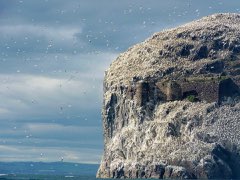 Seabird citiesA wall of seabird calls: gannet grating, kittiwakes calling their name, guillemot growls, puffin burrow moans, sea and wind below.
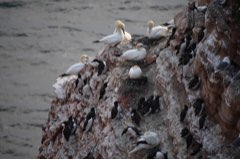 Helgoland Lummenfelsen: guillemots, gannets and the 'Lummensprung'Germany's only seabird cliff: guillemot growls, kittiwake screaming, gannet colony grating, fulmar cackles; at the jump, chicks peeping and adults calling them down to the sea 40 m below.
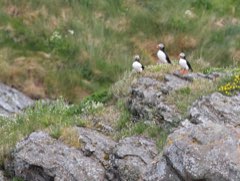 Puffin arrival day on Lovund and the Røst coloniesThe wing-roar and growling of a puffin colony wheeling over the slope, kittiwakes, eagles; on Røst, Leach's and storm petrels at night; the Atlantic.
More: all spectacles in Ireland · puffins · guillemots · seabird colonies · Ireland in May · June