
Hornøya and Gjesværstappan: Arctic seabird cliffs
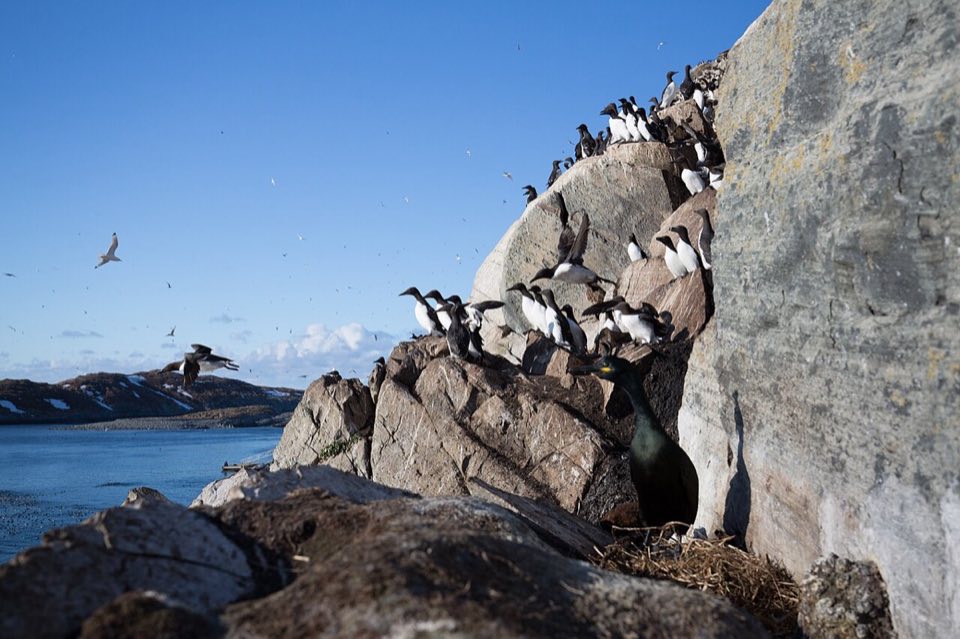
Common and Brünnich's guillemot, puffin (Hornøya 7,800 pairs; Gjesværstappan several hundred thousand), kittiwake, razorbill, shag, gannet (Gjesværstappan), white-tailed eagle. Vardø (Varanger) and Nordkapp, Finnmark, Norway.
Best time: 20 May – 15 Jul (May to July). Where: Hornøya (boat from Vardø harbour), Gjesværstappan (boat from Gjesvær, Nordkapp), Ekkerøy kittiwake cliff (Vadsø) (Norway). Time of day: Midnight sun — no dawn or dusk.
- Partly on your own
- Entry fee
- No binoculars needed
- Sound 5/5
Open it in the interactive calendarSunrise and sunset listening times for the day you pick, and the map.
When is the best time?
Peak: 20 May – 15 Jul. 20 May to mid July; Hornøya boats run 1 March–1 September, Gjesværstappan safaris May–August
Active from 1 Mar to 31 Aug (March to August) in a typical year.
Time of day
Midnight sun — no dawn or dusk. Colony noise peaks in the 'night' hours 22:00–02:00 and again 05:00–08:00, when the fishing boats are quiet; the Vardø–Hornøya boat runs by booking (returns around 10:10, 12:10, 14:40 and 17:00), so ask for the earliest sailing.
- Night peak (midnight sun): 22:00 → 02:00
- Early morning: 05:00 → 08:00
What will you hear?
A guillemot wall at arm's length: massed growling and trumpeting, kittiwake screaming, puffin grunts, Brünnich's guillemots' lower calls; Arctic surf; at Gjesværstappan the gannet colony's grating and the constant wing-noise of puffins by the hundred thousand.
Binoculars?
No binoculars needed. Hornøya's guillemots are a metre from the path and Ekkerøy's kittiwakes are at arm's length; binoculars only at Gjesværstappan from the boat.
Where to go
- Hornøya (boat from Vardø harbour) — Nature reserve; coconut-mat paths within a metre of nesting guillemots and puffins; 10-minute boat, several hours ashore. Map
- Gjesværstappan (boat from Gjesvær, Nordkapp) — Nature reserve islands; no landing — recorded from the boat 15 km west of the North Cape. Map
- Ekkerøy kittiwake cliff (Vadsø) — Walk-in colony on a cliff on the Varanger fjord; free, with a hide; excellent for close kittiwake sound. Map
- Syltefjord (Syltefjordstauran) — Finnmark's largest kittiwake colony and a gannet colony; boat from Syltefjord or Båtsfjord. Map
How to go on your own, and what it costs
Hornøya: daily boat from Vardø harbour 1 March–1 September (book through Destination Vardø; several returns a day), then the marked coconut-mat paths only. Gjesværstappan: boat safaris from Gjesvær, no landing. Ekkerøy: free walk-in kittiwake cliff with a hide, from the E75 east of Vadsø. Syltefjord: boat from Båtsfjord or Syltefjord.
Cost: Hornøya boat ticket (check current price via Destination Vardø); Ekkerøy free.
Free or no-guide alternative: Ekkerøy is the free, walk-in Arctic colony: park by the E75 at Ekkerøy and follow the path to the kittiwake cliff and hide — close sound, no boat.
Field-recording notes
Hornøya is the most intimate seabird-recording site in Europe — the reserve allows the marked paths only, and the birds ignore you, so a close pair on the path rail with the colony 1 m away works with no directional gear at all. Wind and the Vardø airport (small planes) and harbour are the noise; the far side of the island faces open sea. Gjesværstappan is boat-only: idle engine, hydrophone for the underwater puffin traffic. Polar bears are not an issue on the mainland; skuas are, in June. Temperatures 3–8 °C in June with wind — bring winter kit.
Sources
- SEAPOP – Hornøya key site
- Destination Vardø – Hornøya
- Visit Norway – Arctic birdwatching in Varanger
- Nordnorge.com – Gjesværstappan
Similar spectacles
 Sept-Îles: gannets on Rouzic, puffins and auksFrance's only gannet colony (about 14,000 pairs on Rouzic) as a wall of grating calls from the boat, puffins and kittiwakes on the sea, and the Atlantic swell against the granite.
 Irish seabird cities: Cliffs of Moher, Great Saltee and the SkelligsThe roar of 20,000 guillemots on the Moher ledges with kittiwakes screaming 'kitti-wake' and fulmars cackling; the Atlantic 200 m below; on Little Skellig the deafening, continuous growl of a gannet city heard over the engine; choughs' ringing calls on the cliff top.
 Seabird citiesA wall of seabird calls: gannet grating, kittiwakes calling their name, guillemot growls, puffin burrow moans, sea and wind below.
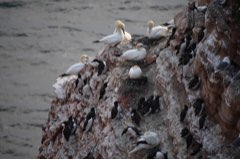 Helgoland Lummenfelsen: guillemots, gannets and the 'Lummensprung'Germany's only seabird cliff: guillemot growls, kittiwake screaming, gannet colony grating, fulmar cackles; at the jump, chicks peeping and adults calling them down to the sea 40 m below.
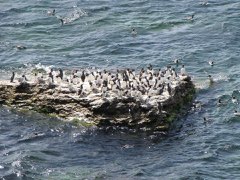 Stora Karlsö: Baltic auk cliffs and the guillemot jumpThe growling, gurgling roar of a packed guillemot colony on limestone ledges, razorbill rasps, kittiwake-free Baltic quiet behind it; in late June the thin whistles of chicks calling to parents as they leap into the sea.
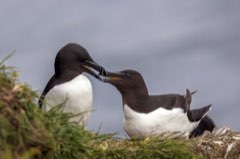 Ertholmene: Denmark's only guillemot and razorbill colonyGuillemots' growling and razorbills' rattle from Græsholm's rocks 100 m across the sound, eider crooning, gull colonies, the Baltic; at night on Christiansø, migrants and the fortress silence.
More: all spectacles in Norway · puffins · guillemots · seabird colonies · Norway in May · Norway in June · Norway in July