
Light-bellied brent geese arriving in Dublin Bay
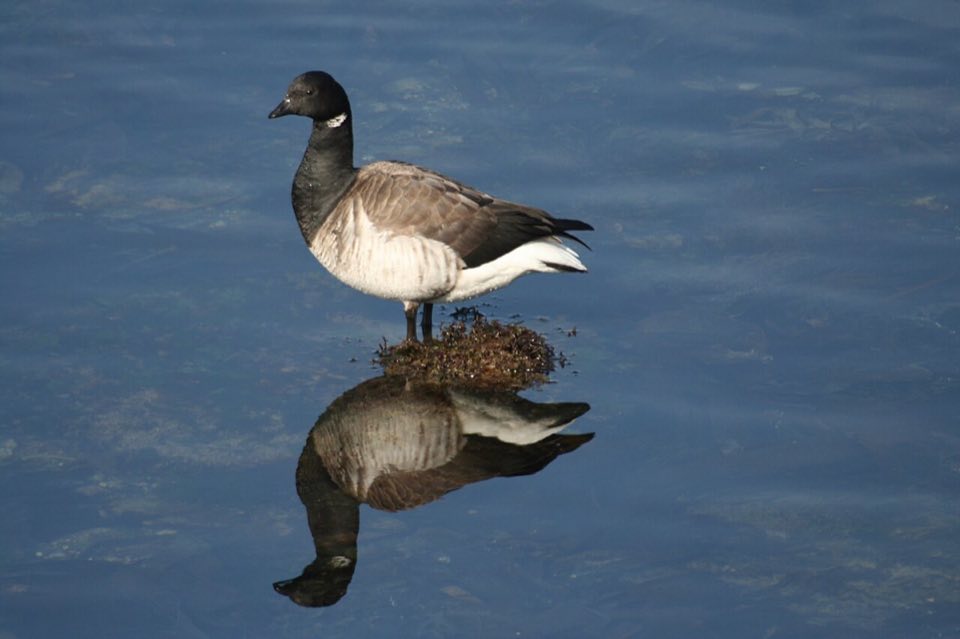
Light-bellied brent goose (Branta bernicla hrota, Canadian High Arctic population — Bull Island internationally important, 1,500+ mean peak; Dublin Bay holds thousands), black-tailed and bar-tailed godwits, knot, dunlin, oystercatcher, short-eared owl. North Bull Island and Sandymount Strand, Dublin, Ireland.
Best time: 15 Oct – 15 Mar (October to March). Where: North Bull Island – causeway and interpretive centre, Sutton (south side of Howth) – Sutton creek and the north lagoon, Sandymount Strand (South Dublin Bay) (Ireland). Time of day: Brent feed on the lagoons at low tide and move to the salt marsh and the city's playing fields at high tide.
- You can go on your own
- Free
- Binoculars helpful
- Sound 3/5
Open it in the interactive calendarSunrise and sunset listening times for the day you pick, and the map.
When is the best time?
Peak: 15 Oct – 15 Mar. Mid October to mid March; the geese arrive in October (via Strangford Lough) and leave in April
Active from 1 Oct to 10 Apr (October to April) in a typical year.
Time of day
Brent feed on the lagoons at low tide and move to the salt marsh and the city's playing fields at high tide; dawn and dusk flights along the Clontarf front and across Sutton; wader roosts peak in the 2 h around high tide.
- Dawn flights and feeding: 30 min before sunrise → 90 min after sunrise
- Evening return to the lagoons: 1 h before sunset → last light
Depends on the tide: best around high tide. Check local tide tables.
What will you hear?
The soft, rolling 'rrronk' chorus of brent flocks on the lagoon and the salt marsh, godwits and knot calling at the roost, curlews over the mudflats — all against the hum of Dublin port, the DART and the city.
Binoculars?
Binoculars helpful. Geese graze within 30–100 m of the causeway and the Clontarf promenade; waders on the lagoon need a scope at low tide.
Where to go
- North Bull Island – causeway and interpretive centre — Nature reserve open 24 h; drive or walk the causeway from the Clontarf road; salt marsh and northern tip are wildlife-only (no access). Map
- Sutton (south side of Howth) – Sutton creek and the north lagoon — DART to Sutton; geese and waders on the inner lagoon at high tide. Map
- Sandymount Strand (South Dublin Bay) — DART to Sandymount; brent feeding on the strand at low tide and on the Irishtown/Sean Moore Park grass at high tide. Map
How to go on your own, and what it costs
Bus or cycle from the city centre along the Clontarf Road; walk or drive onto the causeway (reserve open 24 h, free parking along the causeway); DART to Sutton or Sandymount for the other two sites. Respect the signed zones and keep dogs on leads in the dunes.
Cost: Free.
Field-recording notes
An urban soundscape: Dublin Port cranes and ferries, the DART on the north shore, planes into Dublin Airport. The quietest spot is the far end of the causeway facing the lagoon at dawn on a Sunday. Zones are colour-coded: red (salt marsh, northern tip) no entry, blue dunes dogs on leads. Disturbing the geese is an offence under the Wildlife Acts — record from the causeway and the wooden bridge, not the marsh. Brent also feed on suburban playing fields in late winter and are remarkably tame there.
Sources
- Dublin City Council – North Bull Island (species, zones, 24 h)
- NPWS – North Bull Island SPA site synopsis (brent and wader numbers)
- Dublin Bay Biosphere – A welcome return to the bay (arrival timing)
Similar spectacles
 Wadden Sea autumn: geese, waders and whooper swans in the marshBarnacle goose yapping in flocks of tens of thousands over the Ballum marsh, brent geese growling on the flats, golden plover flocks whistling, whooper swan families bugling on the polders at night, curlew; the tide.
 Pink-footed goose dawn flightsTens of thousands of geese lifting off the mudflats at first light in a wall of 'wink-wink' calls, wave after wave overhead.
 Whooper swans & barnacle geeseBugling whoopers and yapping barnacle flocks like a huge crowd; the whole Svalbard barnacle population is on one estuary.
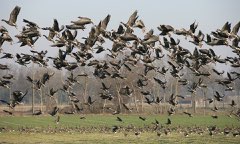 Arctic geese on the Lower RhineWhite-fronted geese's high yelping in skeins of thousands, bean geese's deeper 'kayak', the roar of a roost lifting off the Rhine at first light, whooper swans on the Bislicher Altrhein; barges and the A57 underneath.
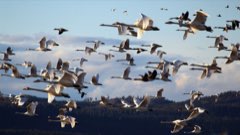 Lower Oder Valley: whooper swans, geese and the flooded poldersWhooper swan bugling in chorus over the polder ice-edge, geese lifting at dawn by the thousand, smew and goldeneye wing-whistle, eagle yelps; in October, cranes; in May, corncrakes at night.
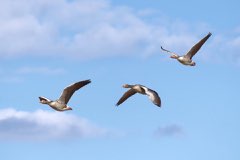 Goose autumn at the Lange Lacke, SeewinkelGeese in skeins of thousands crossing the pastures at dusk, greylag chatter on the soda lake roost through the night, cranes trumpeting overhead in late October, eagle calls; the salt-steppe silence in between.
More: all spectacles in Ireland · wild geese · winter geese, swans and ducks · Ireland in January · February · March · October · Ireland in November · Ireland in December