
Cacheu mangroves — West Africa's largest continuous mangrove block
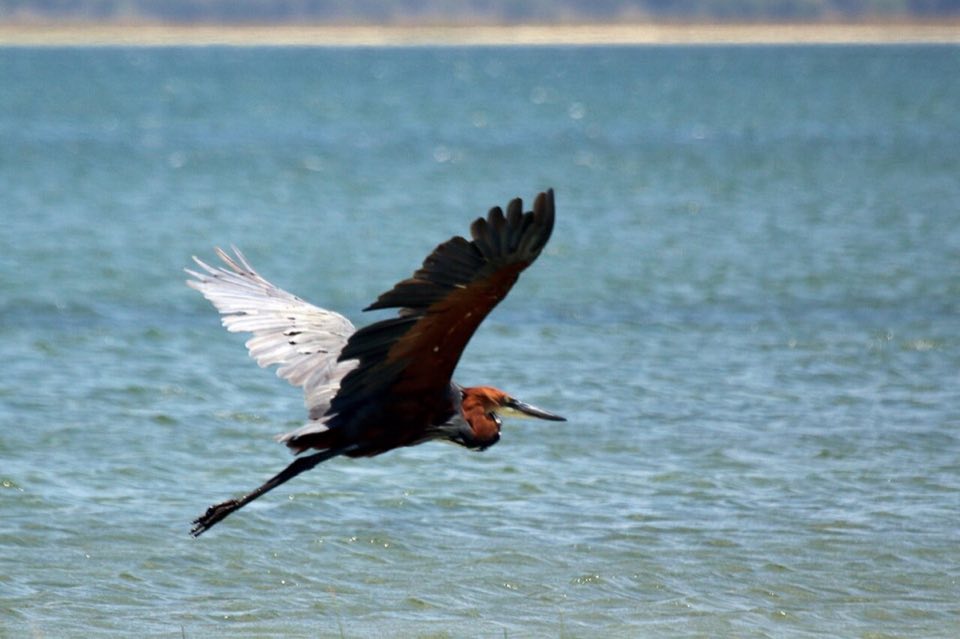
African spoonbill, pelicans, goliath heron, wintering waders and ospreys, black crowned crane; West African manatee, Nile crocodile, hippo. Parque Natural dos Tarrafes do Rio Cacheu, north-west, Guinea-Bissau.
Best time: 15 Nov – 28 Feb (November to February). Where: Cacheu town – park post and pirogues, São Domingos – northern channels (Guinea-Bissau). Time of day: Dawn pirogue on a rising tide into the mangrove channels.
- Partly on your own
- Low cost
- Binoculars helpful
- Sound 4/5
Open it in the interactive calendarSunrise and sunset listening times for the day you pick, and the map.
When is the best time?
Peak: 15 Nov – 28 Feb. Mid November to end of February
Active from 15 Oct to 30 Apr (October to April) in a typical year.
Time of day
Dawn pirogue on a rising tide into the mangrove channels; the roosts fill in the last hour before dark
- Mangrove dawn: first light → 150 min after sunrise
- Evening roost: 1 h before sunset → last light
Depends on the tide: best around high tide. Check local tide tables.
What will you hear?
The full mangrove soundscape — fiddler crabs, mudskippers, snapping shrimp under water, herons and kingfishers above — in channels wide enough that no village sound reaches, with crowned cranes on the rice edges.
Binoculars?
Binoculars helpful. Herons and kingfishers at close range from the pirogue; binoculars for spoonbills and cranes on the rice edges.
Where to go
- Cacheu town – park post and pirogues — Old Portuguese fort town on the Cacheu river; IBAP post arranges pirogues and guides. Map
- São Domingos – northern channels — Border town with Senegal; access to the northern mangrove blocks. Map
How to go on your own, and what it costs
Bush taxi Bissau–Canchungo–Cacheu; the riverfront and the fort are free, the channels are by pirogue hired at the IBAP post or from fishermen, with a park fee and a local guide inside the park.
Cost: Park fee small; pirogue and guide — check current prices at the Cacheu post.
Free or no-guide alternative: Cacheu's riverfront and the fort walls overlook the river and the nearest mangrove: roosting herons, pelicans and waders at dusk for free, no boat.
Who runs access
- IBAP – Cacheu park post (park authority) — Pirogues and guides.
Field-recording notes
Hydrophone territory: drop it from a paddled pirogue in a channel at slack water. Outboards are the noise; local pirogues will paddle if asked. Humidity high, salt everywhere; the harmattan brings haze but not much dust here. Ramsar site (2015); park fee and guide via the IBAP post.
Sources
Similar spectacles
 Wadden Sea autumn: geese, waders and whooper swans in the marshBarnacle goose yapping in flocks of tens of thousands over the Ballum marsh, brent geese growling on the flats, golden plover flocks whistling, whooper swan families bugling on the polders at night, curlew; the tide.
 Pink-footed goose dawn flightsTens of thousands of geese lifting off the mudflats at first light in a wall of 'wink-wink' calls, wave after wave overhead.
 Whooper swans & barnacle geeseBugling whoopers and yapping barnacle flocks like a huge crowd; the whole Svalbard barnacle population is on one estuary.
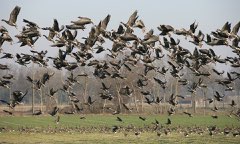 Arctic geese on the Lower RhineWhite-fronted geese's high yelping in skeins of thousands, bean geese's deeper 'kayak', the roar of a roost lifting off the Rhine at first light, whooper swans on the Bislicher Altrhein; barges and the A57 underneath.
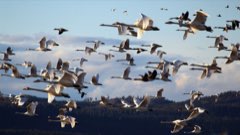 Lower Oder Valley: whooper swans, geese and the flooded poldersWhooper swan bugling in chorus over the polder ice-edge, geese lifting at dawn by the thousand, smew and goldeneye wing-whistle, eagle yelps; in October, cranes; in May, corncrakes at night.
 Wintering cranes at ArjuzanxWaves of cranes dropping into the flooded roost after dark, a continuous rolling chorus that carries for kilometres over the pine plantations.
More: all spectacles in Guinea-Bissau · winter geese, swans and ducks · Guinea-Bissau in January · Guinea-Bissau in February · November · Guinea-Bissau in December