
Bijagós intertidal flats — the flyway's second great wader wintering ground
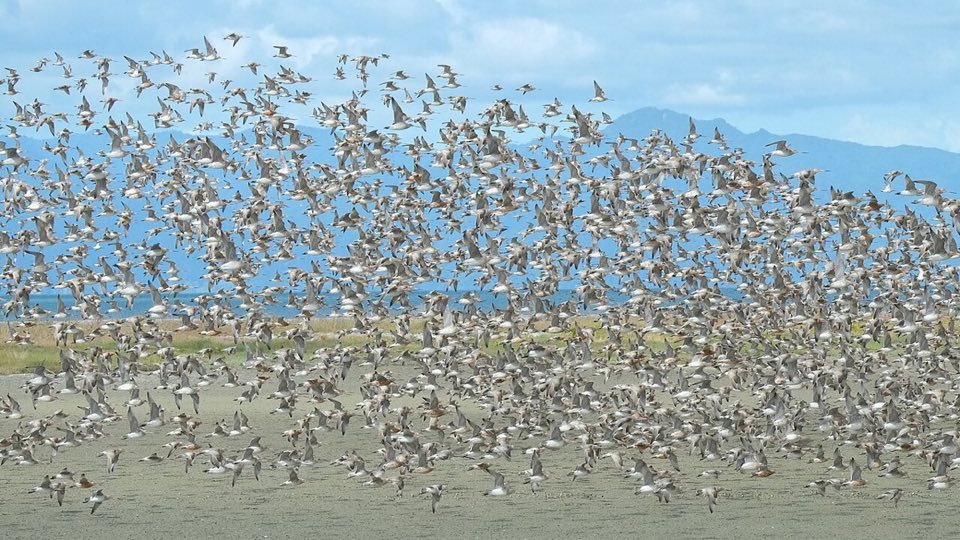
Bar-tailed godwit, whimbrel, red knot, curlew sandpiper, grey plover, ringed plover, sanderling, turnstone; royal & Caspian terns, African spoonbill, pelicans, flamingos. Bijagós archipelago (Bubaque, Orango, Formosa, Urok), Guinea-Bissau.
Best time: 1 Nov – 28 Feb (November to February). Where: Bubaque – town and the southern flats, Orango National Park – Eticoga, Urok islands (Formosa, Nago, Chediã) – community MPA (Guinea-Bissau). Time of day: The 2 hours around high water as the flats flood and roosts pack the sandbanks.
- Partly on your own
- Entry fee
- Telescope recommended
- Sound 4/5
Open it in the interactive calendarSunrise and sunset listening times for the day you pick, and the map.
When is the best time?
Peak: 1 Nov – 28 Feb. November to February; counts of the archipelago have exceeded 700,000 Palearctic waders (Wetlands International)
Active from 15 Sep to 30 Apr (September to April) in a typical year.
Time of day
The 2 hours around high water as the flats flood and roosts pack the sandbanks; dawn and dusk flights between mangrove and flats
- Dawn flight: 30 min before sunrise → 90 min after sunrise
- Evening roost: 90 min before sunset → sunset
Depends on the tide: best around high tide. Check local tide tables.
What will you hear?
Whimbrel and godwit flocks calling over enormous intertidal flats with no engine noise for kilometres, tern roosts on the sandbanks, mangrove crackle at low tide, and the islands' own forest and village sounds behind.
Binoculars?
Telescope recommended. Roosts pack sandbanks 200 m+ from the beach or pirogue; scope recommended, binoculars minimum.
Where to go
- Bubaque – town and the southern flats — The archipelago's hub: ferry/boat from Bissau, lodgings, and pirogues to the other islands. Map
- Orango National Park – Eticoga — Park HQ village and the base for the island; flats and lagoons on the north shore. Map
- Urok islands (Formosa, Nago, Chediã) – community MPA — Community-managed marine protected area with huge flats; village stays arranged through IBAP/Tiniguena. Map
How to go on your own, and what it costs
Public boat or ferry Bissau–Bubaque (irregular; a few times a week, 4–6 h) and Bubaque's own flats and beaches are free to walk; beyond that every island is a chartered pirogue from Bubaque or a park boat from Eticoga, and inside Orango NP a park fee and a local guide apply (IBAP rule).
Cost: Bubaque free once there; Orango NP entry fee and guide, and pirogue charters — check current prices with IBAP.
Free or no-guide alternative: Bubaque's southern beaches and flats (walk south from town towards Bruce beach) hold the same wader roosts and tern flocks, free and without a boat or guide.
Who runs access
- IBAP – ecotourism office (park authority) — Park fees, permits and village-stay contacts.
Field-recording notes
Recognised as a World Heritage Site in 2025 and a Biosphere Reserve since 1996: park entry fees apply on Orango and João Vieira-Poilão, and villages expect to be asked. Almost no anthropogenic noise beyond pirogue outboards and village life; wind is moderate in the dry season and calm at dawn. Humidity stays high even in the dry season; salt and sand in everything. Getting around is the constraint: boats are chartered per day, and weather cancels crossings. Tides are large (up to 5 m) — the flats are dangerous to walk without a local.
Sources
- Wikipedia – Bijagós Archipelago (UNESCO 2025, Ramsar, IBA)
- IBAP – Instituto da Biodiversidade e das Áreas Protegidas
- Wetlands International
Similar spectacles
 Wadden Sea autumn: geese, waders and whooper swans in the marshBarnacle goose yapping in flocks of tens of thousands over the Ballum marsh, brent geese growling on the flats, golden plover flocks whistling, whooper swan families bugling on the polders at night, curlew; the tide.
 Pink-footed goose dawn flightsTens of thousands of geese lifting off the mudflats at first light in a wall of 'wink-wink' calls, wave after wave overhead.
 Whooper swans & barnacle geeseBugling whoopers and yapping barnacle flocks like a huge crowd; the whole Svalbard barnacle population is on one estuary.
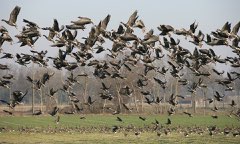 Arctic geese on the Lower RhineWhite-fronted geese's high yelping in skeins of thousands, bean geese's deeper 'kayak', the roar of a roost lifting off the Rhine at first light, whooper swans on the Bislicher Altrhein; barges and the A57 underneath.
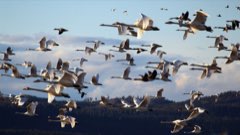 Lower Oder Valley: whooper swans, geese and the flooded poldersWhooper swan bugling in chorus over the polder ice-edge, geese lifting at dawn by the thousand, smew and goldeneye wing-whistle, eagle yelps; in October, cranes; in May, corncrakes at night.
 Wintering cranes at ArjuzanxWaves of cranes dropping into the flooded roost after dark, a continuous rolling chorus that carries for kilometres over the pine plantations.
More: all spectacles in Guinea-Bissau · winter geese, swans and ducks · Guinea-Bissau in January · Guinea-Bissau in February · November · Guinea-Bissau in December