
Tristão islands and the Rio Nunez estuary — waders, terns and mangrove
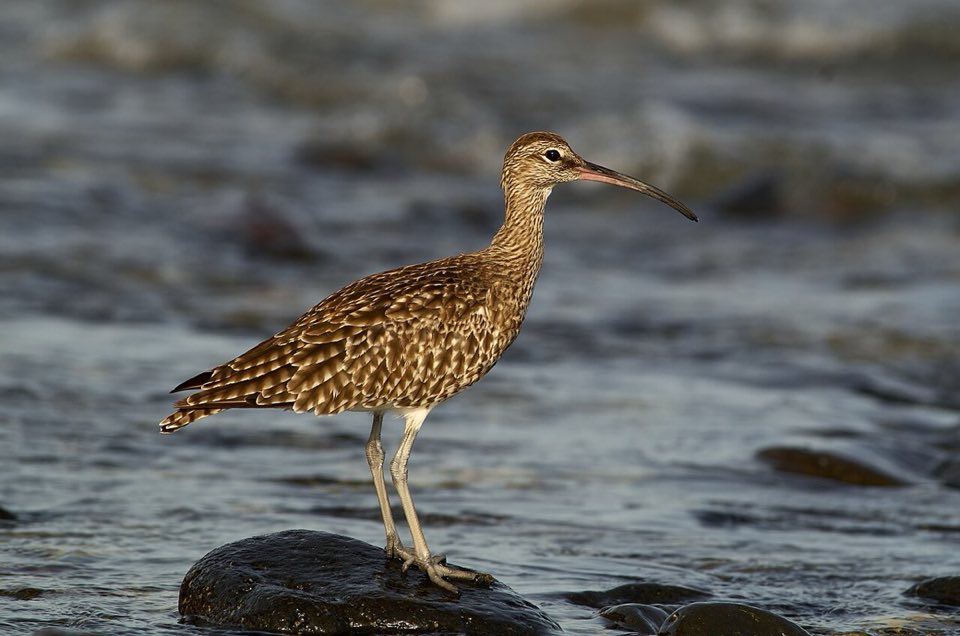
Palearctic waders (whimbrel, godwits, sanderling), royal & Caspian terns, pelicans, African spoonbill; green turtles nest on the outer beaches; manatees in the channels. Îles Tristão, Boké prefecture (north-west coast), Guinea.
Best time: 15 Nov – 28 Feb (November to February). Where: Konkouré delta (Baie de Sangaréya), Dubréka, Tristão main island (Katfoura / Kanof), Kamsar (Guinea). Time of day: High-tide roosts in the 2 hours around high water.
- Partly on your own
- Low cost
- Binoculars essential
- Sound 3/5
Open it in the interactive calendarSunrise and sunset listening times for the day you pick, and the map.
When is the best time?
Peak: 15 Nov – 28 Feb. Mid November to end of February
Active from 15 Oct to 15 Apr (October to April) in a typical year.
Time of day
High-tide roosts in the 2 hours around high water; dawn and dusk pirogue in the mangrove channels
- Mangrove dawn: first light → 2 h after sunrise
- Evening roost: 90 min before sunset → sunset
Depends on the tide: best around high tide. Check local tide tables.
What will you hear?
Wader and tern roosts on mangrove-fringed sandbanks at the southern end of the Bijagós system, with the mangrove's own crackle and the villages' fishing pirogues.
Binoculars?
Binoculars essential. Wader and tern roosts on sandbanks 100–300 m from the pirogue; binoculars needed, scope better.
Where to go
- Konkouré delta (Baie de Sangaréya), Dubréka — 90,000 ha Ramsar mangrove delta immediately north of Conakry: wintering Palearctic waders on the mudflats, goliath heron, hamerkop and woolly-necked stork nesting in the mangroves, bottlenose dolphins and manatee. Pirogues from Dubréka; the closest big wader site to the capital. Map
- Tristão main island (Katfoura / Kanof) — Ramsar site (1992); reached by pirogue from Kamsar or Boké. Coordinates approximate. Map
- Kamsar — Bauxite port and the departure point; loud with the mine and shipping. Map
How to go on your own, and what it costs
Bush taxi to Kamsar, then hire a pirogue (a full day) and ask village permission to stay; no park fee, but the marine protected area's community committee may ask a contribution.
Cost: Pirogue charter and village contribution — check current prices locally.
Free or no-guide alternative: The Rio Nunez estuary shore at Kamsar and Boké holds wader roosts and terns visible free from the public waterfront, without the crossing.
Field-recording notes
Thin information: the islands are a Ramsar site with a community-managed protected area but no tourism; you go with a hired pirogue and stay in a village with permission. Bauxite shipping noise near Kamsar; the outer islands are quiet. Green turtle nesting on the ocean beaches in the rains is documented but unmonitored.
Sources
- Source for Konkouré delta (Baie de Sangaréya), Dubréka
- Guinée Ecologie – BirdLife partner
- PRCM – West African coastal conservation
Similar spectacles
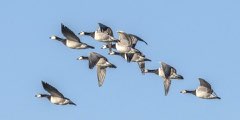 Wadden Sea autumn: geese, waders and whooper swans in the marshBarnacle goose yapping in flocks of tens of thousands over the Ballum marsh, brent geese growling on the flats, golden plover flocks whistling, whooper swan families bugling on the polders at night, curlew; the tide.
 Pink-footed goose dawn flightsTens of thousands of geese lifting off the mudflats at first light in a wall of 'wink-wink' calls, wave after wave overhead.
 Whooper swans & barnacle geeseBugling whoopers and yapping barnacle flocks like a huge crowd; the whole Svalbard barnacle population is on one estuary.
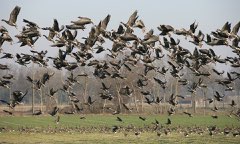 Arctic geese on the Lower RhineWhite-fronted geese's high yelping in skeins of thousands, bean geese's deeper 'kayak', the roar of a roost lifting off the Rhine at first light, whooper swans on the Bislicher Altrhein; barges and the A57 underneath.
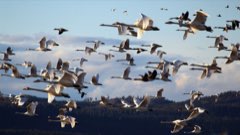 Lower Oder Valley: whooper swans, geese and the flooded poldersWhooper swan bugling in chorus over the polder ice-edge, geese lifting at dawn by the thousand, smew and goldeneye wing-whistle, eagle yelps; in October, cranes; in May, corncrakes at night.
 Wintering cranes at ArjuzanxWaves of cranes dropping into the flooded roost after dark, a continuous rolling chorus that carries for kilometres over the pine plantations.
More: all spectacles in Guinea · winter geese, swans and ducks · Guinea in January · Guinea in February · November · Guinea in December