
Midwife toad piping in the villages
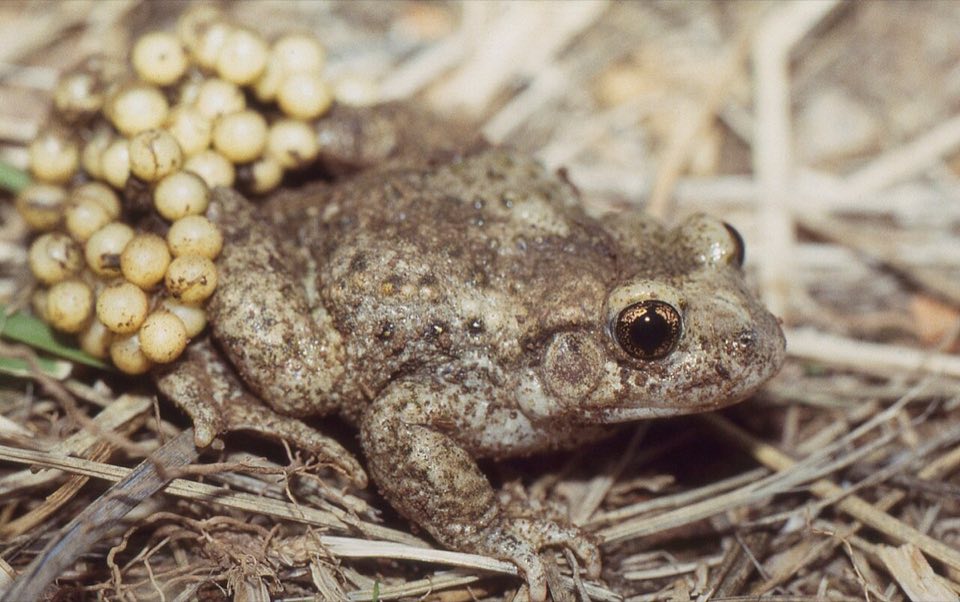
Common midwife toad (Alytes obstetricans). Massif Central, Cévennes, Burgundy, Pyrenean foothills, France.
Best time: 15 Apr – 30 Jun (April to June). Where: Florac and the Tarnon valley, Cévennes, Morvan (Saint-Brisson), Basque foothills (Sare / Ainhoa) (France). Time of day: Piping starts at dusk, fills the village walls 1–2 h after dark and continues to about midnight on mild evenings.
- You can go on your own
- Free
- No binoculars needed
- Sound 4/5
Open it in the interactive calendarSunrise and sunset listening times for the day you pick, and the map.
When is the best time?
Peak: 15 Apr – 30 Jun. Mid April to end of June
Active from 20 Mar to 31 Aug (March to August) in a typical year.
Time of day
Piping starts at dusk, fills the village walls 1–2 h after dark and continues to about midnight on mild evenings; a few call by day in warm rain.
- Evening piping: 30 min after sunset → 00:00
What will you hear?
Pure, bell-like single notes at about 1.2 kHz from dozens of males in dry-stone walls and rubble, like an out-of-tune carillon across a whole valley.
Binoculars?
No binoculars needed. Piping from the village walls at arm's length; a torch, not binoculars.
Where to go
- Florac and the Tarnon valley, Cévennes — Terraced villages with dry-stone walls; the sound is everywhere in spring. Map
- Morvan (Saint-Brisson) — Regional park with old stone villages and ponds. Map
- Basque foothills (Sare / Ainhoa) — Dense populations in the walls and farm ponds. Map
How to go on your own, and what it costs
Stand in any stone village lane after dark — Florac's back streets, the Morvan hamlets around Saint-Brisson, the Basque villages. Public streets, no permits.
Cost: Free.
Field-recording notes
The males call from under stones, not from water, so the chorus is spatially spread — a wide stereo pair in a village lane catches the antiphony. Village noise (dogs, bells, a bar) is the trade-off; hamlets at the end of a road are cleanest. Protected species: no handling or turning stones.
Sources
Similar spectacles
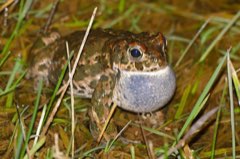 Natterjack toad chorusThe loudest amphibian in Britain — a rolling, ratcheting chorus audible up to 2 km away across dunes.
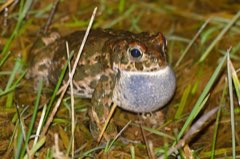 Natterjack toad chorus on the Kerry dunesA loud, ratcheting 'rrrrRup, rrrrRup' chorus from dozens of males in shallow dune pools — the loudest amphibian in these islands — with the Atlantic surf behind the dunes and snipe overhead.
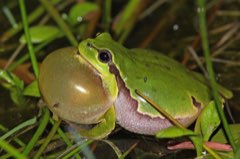 Tree frog choruses of Zeeuws-VlaanderenA rattling, surprisingly loud 'kè-kè-kè-kè' chorus from hundreds of tree frogs around the old fortress moats and pools — audible across the polder — with marsh frogs and nightingales behind; the ramparts of Retranchement alone hold a few hundred.
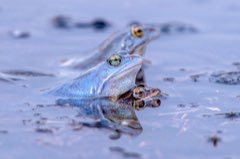 Fire-bellied toads, natterjacks and blue moor frogsFire-bellied toad's melancholy 'uh...uh' by the hundred over shallow pasture ponds, moor frog's bubbling 'waug-waug' underwater chorus, natterjack's ratcheting trill carrying 2 km across dune slacks, tree frogs at full volume, bittern and crane in the background.
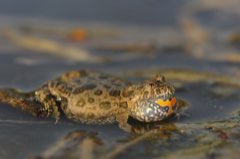 Frog nights in the Danube floodplain forestTree frog volleys and fire-bellied toads' soft hooting from the oxbows (Altarme), marsh frog laughter, night herons croaking overhead, nightingale and beaver tail-slaps; Danube barges as a slow low bed.
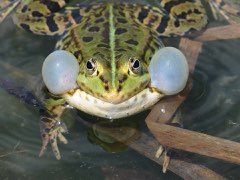 Amphibian chorus of the intermittent lakeWall-to-wall Pelophylax chorus with tree frog 'krak-krak' on top, toad trills, yellow-bellied toad's soft 'poop-poop' from karst puddles, Savi's warbler and bittern in the mix.
More: all spectacles in France · frog and toad choruses · France in April · France in May · France in June