
La Crau steppe: little bustard, sandgrouse & stone-curlew
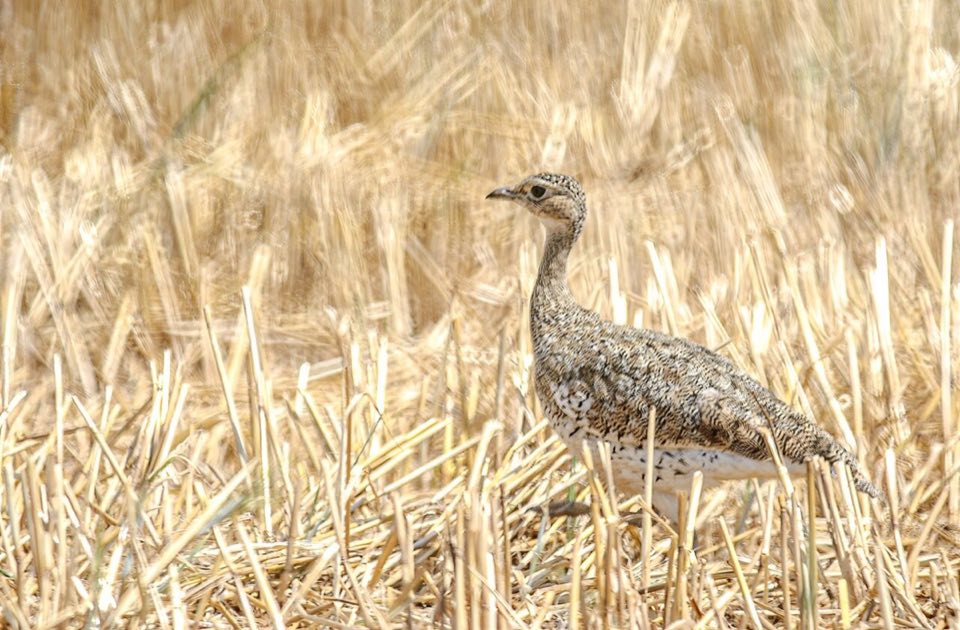
Little bustard (Tetrax tetrax), pin-tailed sandgrouse (Pterocles alchata), stone-curlew, calandra lark, lesser kestrel. Plaine de la Crau, Bouches-du-Rhône, France.
Best time: 20 Apr – 31 May (April to May). Where: Sentier de Peau de Meau (Réserve des Coussouls de Crau), Écomusée de la Crau, Saint-Martin-de-Crau (France). Time of day: Little bustard displays and lark song from first light to about 2 h after sunrise (before Istres flying starts).
- Partly on your own
- Low cost
- Telescope recommended
- Sound 4/5
Open it in the interactive calendarSunrise and sunset listening times for the day you pick, and the map.
When is the best time?
Peak: 20 Apr – 31 May. Late April to May (little bustard display)
Active from 1 Apr to 30 Jun (April to June) in a typical year.
Time of day
Little bustard displays and lark song from first light to about 2 h after sunrise (before Istres flying starts); sandgrouse fly to drink mid morning; stone-curlews and a second bustard bout in the hour before sunset. Trail access is daytime, by permit.
- Dawn display: 30 min before sunrise → 2 h after sunrise
- Evening display: 1 h before sunset → sunset
What will you hear?
Little bustards' dry 'prrrt' with a foot-stamp and wing-whirr jump, sandgrouse 'catar-catar' flights to drinking pools, calandra larks in continuous song-flight, stone-curlews at dusk.
Binoculars?
Telescope recommended. Bustards and sandgrouse are 200–500 m out on the open coussoul; a scope from the sheepfold observatory, binoculars minimum.
Where to go
- Sentier de Peau de Meau (Réserve des Coussouls de Crau) — 4.7 km trail with an observatory in the old sheepfold; permit required from the Écomusée de la Crau in Saint-Martin-de-Crau. Map
- Écomusée de la Crau, Saint-Martin-de-Crau — Permit desk and information; reserve maps. Map
How to go on your own, and what it costs
The only public access to the reserve is the Sentier de Peau de Meau: buy the permit (valid two days) at the Écomusée de la Crau shop in Saint-Martin-de-Crau, then drive the D24/D5 to the trail car park and walk the 4.7 km loop to the sheepfold observatory in daylight, no dogs. Night access is not allowed.
Cost: Peau de Meau permit from the Écomusée: €3 adult, €1.50 child (2026); Écomusée itself €5 adult / €3.50 reduced.
Free or no-guide alternative: The public roads across the Crau are free at any hour: pull in on the D568 or D24 verges east of Saint-Martin-de-Crau at dawn for calandra larks, little bustards and, at dusk, stone-curlews — from the roadside only.
Field-recording notes
The steppe is fenced grazing land and a national nature reserve: the only public access is the Peau de Meau trail, by permit, daytime. The Istres military airbase and the Fos industrial zone put jets and low-frequency hum into the background — mornings before flying starts are best. France's only sandgrouse; keep to the trail and no playback.
Sources
Similar spectacles
 Great snipe lek at FokstumyraThe great snipe's extraordinary accelerating clicks, rattles and whistles from a group of males displaying on the bog, ruff males in silent lek nearby, whimbrel bubbling, bluethroat song, cranes bugling, snipe drumming everywhere, willow grouse cackling.
 Capercaillie and black grouse leks in the eastern forestsCapercaillie's clicking, cork-pop and grinding song from pine bog edges, wing-beats of cocks flying in, black grouse bubbling on the open bogs; cranes, whooper swans and Tengmalm's owl in the same nights.
 Black grouse leksBubbling 'rookooing' from displaying males, hissing 'tchu-wee' sneezes and flutter jumps; curlew and snipe often in the same soundscape.
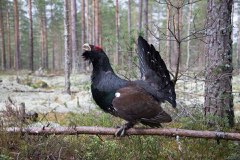 Capercaillie and black grouse — the ones you do not visitThe capercaillie's accelerating clicks, 'cork-pop' and grinding — a very quiet song (audible to ~200 m) that is almost never recorded in Germany without a permit. Black grouse bubbling in the Alps.
 Black grouse leks in the Alps and JuraBubbling 'rookooing' rolling across a snow-patched alpine meadow from several cocks, sneezing 'tchu-shwee' hisses, wing-flutter jumps; ring ouzel and water pipit around them; cowbells not yet arrived.
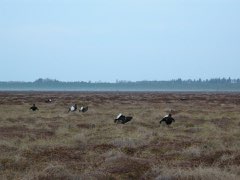 Black grouse leks above the treelineBubbling 'rookooing' and explosive hisses from several cocks on a snow-patched clearing, wing-flutter jumps, ring ouzel and ptarmigan croaks; cowbells arrive later in the season.
More: all spectacles in France · leks · France in April · France in May