
Vultures
9 places to see and hear vultures in the wild, in 8 countries from France to The Gambia: when each one peaks, where to go on your own, what it costs and what you will hear. Wild animals only, no zoos.
Best time, place by place
| Spectacle | Country | Peak | On your own? |
|---|---|---|---|
| Vulture cliffs of the Jonte, Verdon and Ossau | France | 1 Mar – 31 Jul | You can go on your own |
| Bearded vultures and golden eagles of the Engadin | Switzerland | 15 Jun – 30 Sep | You can go on your own |
| Marmots, ibex and vultures, Hohe Tauern | Austria | 20 Jun – 31 Aug and 1 Dec – 31 Dec | You can go on your own |
| Griffon vultures on the sea cliffs of Cres | Croatia | 15 May – 15 Aug | You can go on your own |
| Griffon vultures of the Bosa coast, Sardinia | Italy | 1 Feb – 30 Jun | You can go on your own |
| Griffon cliffs: Hoces del Duratón, Hoces del Riaza and Monfragüe | Spain | 1 Feb – 30 Jun | You can go on your own |
| Douro Internacional: griffon and Egyptian vultures on the canyon walls | Portugal | 15 Mar – 15 Jul | You can go on your own |
| Sagres: the south-west corner — raptor passage and seabirds off Cape St Vincent | Portugal | 20 Sep – 25 Oct | You can go on your own |
| Hooded vultures of the Kombo coast — Africa's densest population at the fish beaches and abattoirs | The Gambia | 1 Nov – 28 Feb | You can go on your own |
Where to go, north to south
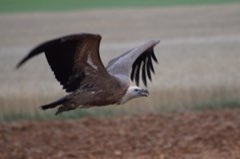 Vulture cliffs of the Jonte, Verdon and OssauWing-rush of griffons passing a few metres over the rim, hissing and grunting from the colony ledges, chough flocks and the river below; more a sight than a sound.
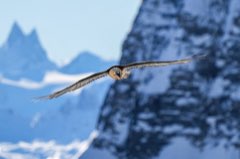 Bearded vultures and golden eagles of the EngadinSilence and wind — the recording is of the alpine air, chough flocks, marmots and the occasional whoosh of a 2.8 m wingspan overhead; the visual spectacle is the point.
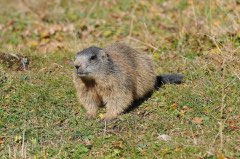 Marmots, ibex and vultures, Hohe TauernMarmot alarm whistles bouncing between glacier-polished walls, chough flocks, ibex hoof-clatter, the wing-rush of a griffon passing at 20 m, ptarmigan; glacier streams and cowbells below.
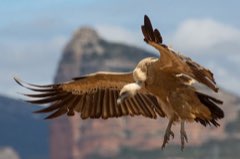 Griffon vultures on the sea cliffs of CresHissing and grunting at the ledges, the wind-rip of 2.7 m wings passing low over a boat, chick begging; shags and yellow-legged gulls beneath, cicadas and scops owl in the maquis behind.
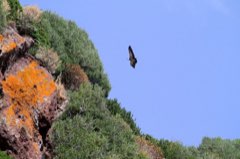 Griffon vultures of the Bosa coast, SardiniaMostly visual: Italy's largest griffon colony riding the updraughts of volcanic sea cliffs. Sound is the Mediterranean swell under the cliffs, the wing-rush of birds passing close, hissing at the ledges, blue rock thrush and, in summer, Eleonora's falcons chattering along the coast.
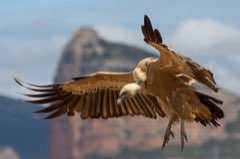 Griffon cliffs: Hoces del Duratón, Hoces del Riaza and MonfragüeA griffon colony settling at dusk is a surprisingly loud thing: hisses, grunts and cackles from hundreds of birds squabbling over ledges, the rush of wings passing at head height, choughs and alpine swifts along the wall and, after dark in winter, eagle owls hooting across the gorge.
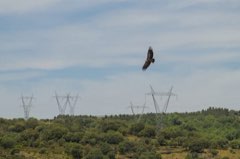 Douro Internacional: griffon and Egyptian vultures on the canyon wallsMostly visual, but the canyon is a natural reverb chamber: griffon wing-rush as they pass the viewpoint at eye level, hissing and grunting at the nests carrying across the gorge, alpine swifts screaming along the walls, blue rock thrush and the river far below.
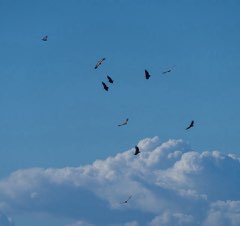 Sagres: the south-west corner — raptor passage and seabirds off Cape St VincentMostly a sky spectacle, but the Sagres plateau has its own soundtrack: red-billed chough flocks (one of Portugal's few colonies) calling over the fields, bee-eaters passing in September, and the Atlantic swell under the Cape St Vincent cliffs. The raptors themselves are silent.
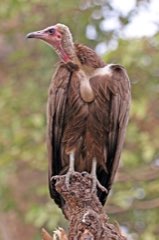 Hooded vultures of the Kombo coast — Africa's densest population at the fish beaches and abattoirsMostly silent birds in enormous numbers: the hiss and thin squealing at a carcass or fish-gut pile, the clatter of 200 pairs of wings lifting at once when a dog runs through, the thud of landings in the kapok roost at dusk. The real soundscape is the fish beach itself — pirogue crews, drying racks, gulls, kites and the vultures' shuffle. A phenomenon that no longer exists anywhere else in the species' range.