
Tern and gull colonies of the Langue de Barbarie
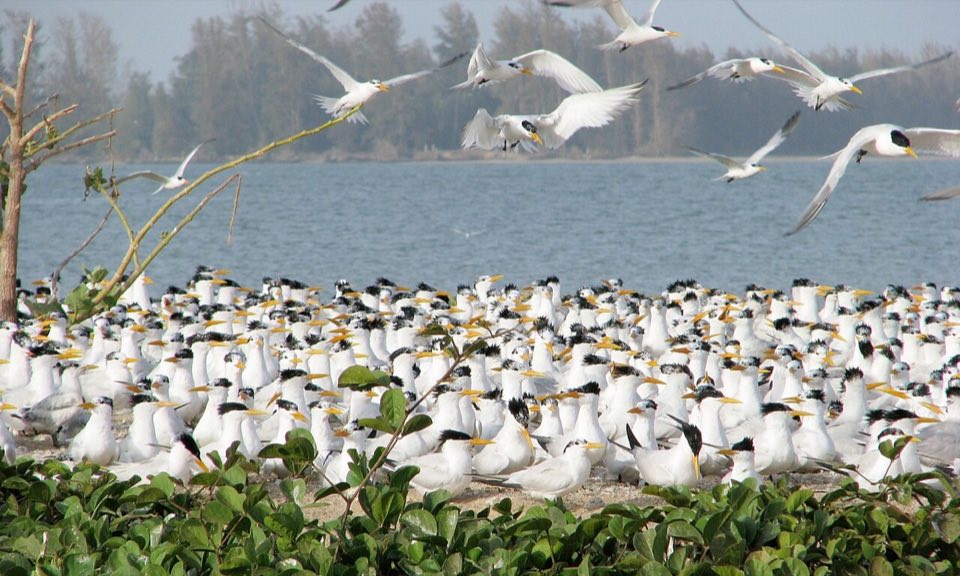
Royal tern (Thalasseus maximus albididorsalis), Caspian tern, slender-billed gull, grey-headed gull, lesser black-backed gull (wintering), pelicans. Parc National de la Langue de Barbarie, south of Saint-Louis, Senegal.
Best time: 1 Apr – 31 May (April to May). Where: Bird island, Senegal river mouth, Park HQ, Mouit (Gandiol), Guembeul special reserve (Senegal). Time of day: Park pirogue trips in the morning (about 08:00–11:00) and late afternoon.
- Guide, ranger or boat needed
- Entry fee
- Binoculars helpful
- Sound 4/5
Open it in the interactive calendarSunrise and sunset listening times for the day you pick, and the map.
When is the best time?
Peak: 1 Apr – 31 May. April–May: species take turns on the bird island, ending in late May; slender-billed and grey-headed gulls first, then royal and Caspian terns
Active from 15 Feb to 15 Jul (February to July) in a typical year.
Time of day
Park pirogue trips in the morning (about 08:00–11:00) and late afternoon; the colony is loudest as fishing adults return from the sea in the late afternoon
- Morning pirogue: 1 h after sunrise → 11:00
- Afternoon return: 150 min before sunset → sunset
What will you hear?
A packed royal and Caspian tern colony screaming on a sand islet in the Senegal river mouth, gull colonies underneath, and the Atlantic surf on the spit a few hundred metres away.
Binoculars?
Binoculars helpful. The pirogue holds a set distance from the colony islet; binoculars fill the gap the ranger sets.
Where to go
- Bird island, Senegal river mouth — The colony islet; boats keep a set distance and no landing. The river mouth has moved since the 2003 breach — ask at the park which islet holds this year's colony. Map
- Park HQ, Mouit (Gandiol) — Entry post and pirogue base 20 km south of Saint-Louis; village campements nearby. Map
- Guembeul special reserve — Neighbouring lagoon reserve: Dama gazelles (captive breeding), waders and flamingos, cheap entry. Map
How to go on your own, and what it costs
The colony is on an islet: the park pirogue from Mouit with a park guide is the only legal approach (park rule). Taxi or sept-place from Saint-Louis to Mouit/Gandiol, pay entry and the boat at the HQ.
Cost: Entry about 2,000 CFA per person plus pirogue (recent reports) — check current prices.
Free or no-guide alternative: The Gandiol/Mouit riverbank and the ocean beach at the spit's end are public: terns and pelicans fish and commute past all day and the colony is audible across the channel on still evenings — free, no boat.
Who runs access
- Langue de Barbarie park pirogues (DPN, Mouit) (park authority) — Park-run boats with guide.
Field-recording notes
The park is a sand spit between river and ocean: wind and surf all day, calmest in the first hours. Fishing pirogues with big outboards use the river mouth constantly — the Gandiol fishermen's fleet is the main noise. Pirogue-based recording with the engine cut on the lee of the colony islet; ranger sets the distance. Hurricane-season storms (Aug–Sep) rework the islets. No landing, no drones; nests are on open sand and trampled easily.
Sources
Similar spectacles
 Hornøya and Gjesværstappan: Arctic seabird cliffsA guillemot wall at arm's length: massed growling and trumpeting, kittiwake screaming, puffin grunts, Brünnich's guillemots' lower calls; Arctic surf; at Gjesværstappan the gannet colony's grating and the constant wing-noise of puffins by the hundred thousand.
 Seabird citiesA wall of seabird calls: gannet grating, kittiwakes calling their name, guillemot growls, puffin burrow moans, sea and wind below.
 Helgoland Lummenfelsen: guillemots, gannets and the 'Lummensprung'Germany's only seabird cliff: guillemot growls, kittiwake screaming, gannet colony grating, fulmar cackles; at the jump, chicks peeping and adults calling them down to the sea 40 m below.
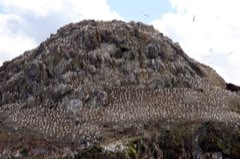 Sept-Îles: gannets on Rouzic, puffins and auksFrance's only gannet colony (about 14,000 pairs on Rouzic) as a wall of grating calls from the boat, puffins and kittiwakes on the sea, and the Atlantic swell against the granite.
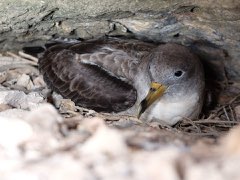 Shearwater colonies at night, Lastovo archipelagoScopoli's shearwaters wailing and cackling overhead and from burrows — the 'crying baby' chorus of Mediterranean islets; Yelkouan's higher nasal calls; waves on rock, cicadas fading at dusk.
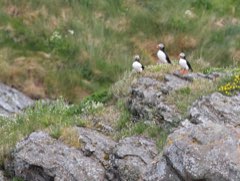 Puffin arrival day on Lovund and the Røst coloniesThe wing-roar and growling of a puffin colony wheeling over the slope, kittiwakes, eagles; on Røst, Leach's and storm petrels at night; the Atlantic.
More: all spectacles in Senegal · seabird colonies · April · May