
Seabird passage at Estaca de Bares
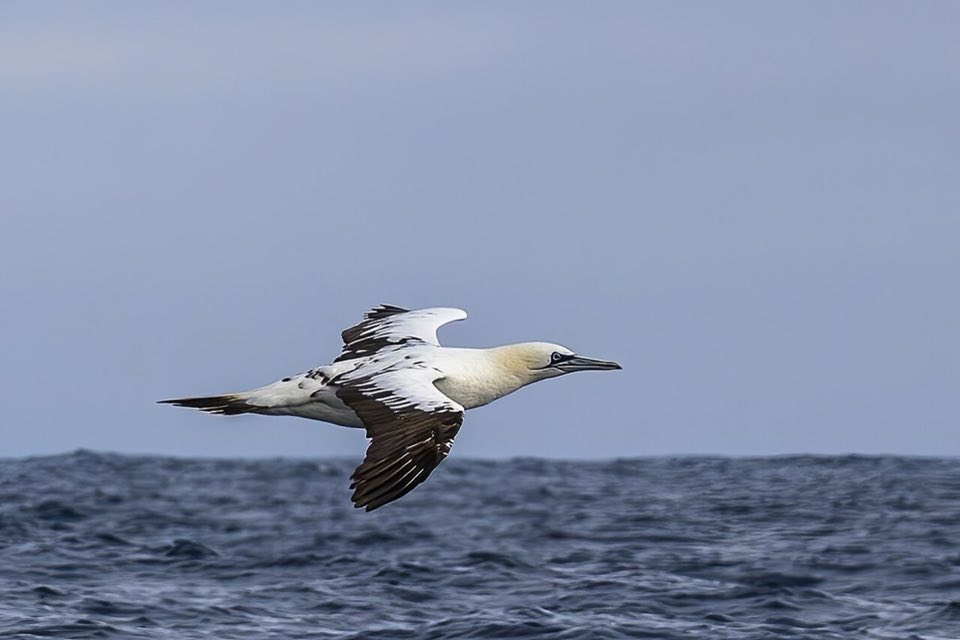
Gannet, Manx, Balearic, sooty and great shearwaters, skuas, Sabine's gull, phalaropes, auks. Galicia, A Coruña; also Cabo Peñas (Asturias), Spain.
Best time: 1 Sep – 31 Oct (September to October). Where: Estación Ornitolóxica de Estaca de Bares, Cabo Peñas (Asturias), Punta da Candieira / Cabo Ortegal (Spain). Time of day: Passage is heaviest from first light to about 10:00, especially the morning after a westerly gale.
- You can go on your own
- Free
- Telescope recommended
- Sound 2/5
Open it in the interactive calendarSunrise and sunset listening times for the day you pick, and the map.
When is the best time?
Peak: 1 Sep – 31 Oct. September–October, on north-westerly gales
Active from 15 Aug to 5 Dec (August to December) in a typical year.
Time of day
Passage is heaviest from first light to about 10:00, especially the morning after a westerly gale; a lesser movement in the 2 h before sunset.
- Morning passage: 15 min before sunrise → 10:00
- Evening passage: 2 h before sunset → sunset
What will you hear?
Mostly a scope spectacle — over a million seabirds a year round Spain's northernmost point — but the gale, the surf on the rocks and passing gannet flocks make a raw Atlantic ambience.
Binoculars?
Telescope recommended. Seabirds pass 200 m to 2 km out in a gale; a scope is the whole point, binoculars catch only the nearest.
Where to go
- Estación Ornitolóxica de Estaca de Bares — Observation hut and lighthouse headland; the counting station has volunteers in autumn. Map
- Cabo Peñas (Asturias) — Second Cantabrian headland with a visitor centre and seawatching point. Map
- Punta da Candieira / Cabo Ortegal — Wilder cliffs to the west; no facilities. Map
How to go on your own, and what it costs
Drive to the Estaca de Bares lighthouse car park (free) and use the observation hut on the headland; Cabo Peñas has a free car park and visitor centre; Cabo Ortegal is a road-end with a car park.
Cost: Free.
Field-recording notes
Wind is the point and the problem — 40-knot gales bring the birds. Heavy wind protection, a sheltered nook below the ridge, and treat it as a storm-ambience session with birds passing through. The lighthouse foghorn may sound in poor visibility.
Sources
Similar spectacles
 Cap Gris-Nez: seabird passage through the Dover StraitA visual passage — skuas harrying terns, gannet lines, scoter strings — above the one great sound of the place: the Channel breaking on the rocks 50 m below, with kittiwakes and the Gris-Nez foghorn in sea fog. Overland, meadow pipits and finches stream past calling on October mornings.
 Seabird citiesA wall of seabird calls: gannet grating, kittiwakes calling their name, guillemot growls, puffin burrow moans, sea and wind below.
 Crane autumn staging: Rügen-Bock, Linum, Diepholz, MüritzWaves of trumpeting families flying in at dusk, the roost's night-long murmur over shallow water, dawn's mass departure with tens of thousands calling at once; greylag and white-fronted geese in the same flights.
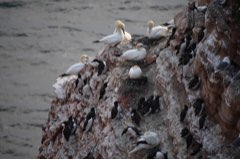 Helgoland Lummenfelsen: guillemots, gannets and the 'Lummensprung'Germany's only seabird cliff: guillemot growls, kittiwake screaming, gannet colony grating, fulmar cackles; at the jump, chicks peeping and adults calling them down to the sea 40 m below.
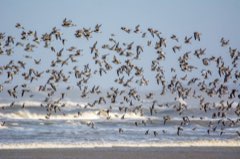 Wadden Sea autumn: millions of waders and geeseKnot and dunlin flocks in the tens of thousands wheeling with a rushing wing-roar, curlew and godwit calls at the roost, brent geese growling, barnacle geese yapping; wind, surf and the tide-edge trickle.
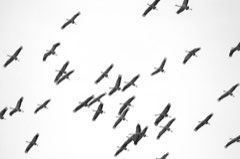 Cranes at Lac du DerTens of thousands of cranes bugling as they leave the lake at first light in wave after wave, then the evening return with the sky full of trumpeting skeins.
More: all spectacles in Spain · gannets · bird migration hotspots · Spain in September · Spain in October