
Helgoland migration falls and grey seal winter
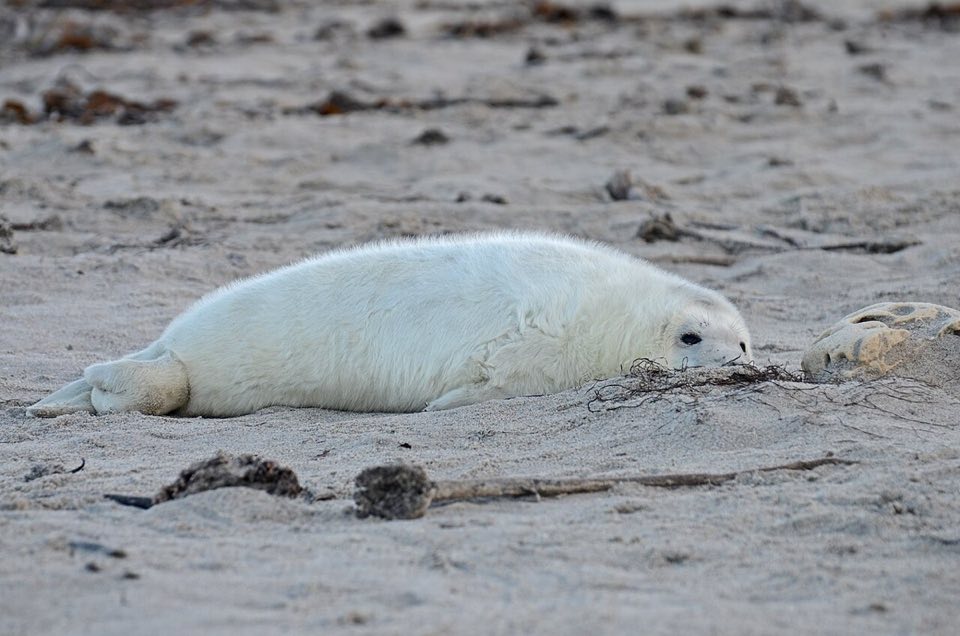
Thrushes, warblers, goldcrests, flycatchers and rarities in autumn falls; grey seal pups (Halichoerus grypus) Nov–Jan. Helgoland, North Sea, Germany.
Best time: 5 Oct – 5 Nov and 20 Nov – 10 Jan (October to January). Where: Vogelwarte Helgoland – Fanggarten (ringing station), Oberland fields and cliff path, Düne north beach (seals) (Germany). Time of day: Flight calls overhead from dusk all night, densest 2 h after dark to 03:00.
- You can go on your own
- Free
- Binoculars helpful
- Sound 4/5
Open it in the interactive calendarSunrise and sunset listening times for the day you pick, and the map.
When is the best time?
- Peak 1: 5 Oct – 5 Nov — October to early November: migration falls on easterlies
- Peak 2: 20 Nov – 10 Jan — Late November to early January: grey seal pupping on the Düne (600–800 pups a year, up to 38 a day)
Active from 15 Sep to 15 Jan (September to January) in a typical year.
Time of day
Flight calls overhead from dusk all night, densest 2 h after dark to 03:00; after a fall the island drips with birds from first light to mid morning. Seals on the Düne at any hour (30 m rule).
- Nocturnal migration: last light → first light
- Dawn fall: 30 min before sunrise → 3 h after sunrise
What will you hear?
Nocturnal flight calls of thrushes (redwing 'seep', song thrush, blackbird) in the thousands over the island, goldcrests in every bush at dawn; on the Düne, grey seal pups wailing and bulls roaring in December.
Binoculars?
Binoculars helpful. Nocmig is ears only; binoculars for the dawn fall in every bush and seals 30 m off on the Düne.
Where to go
- Vogelwarte Helgoland – Fanggarten (ringing station) — Institute for Avian Research; the ringing garden is closed but the station posts daily counts. Map
- Oberland fields and cliff path — Dawn after an easterly night: the island 'drips' with birds. Map
- Düne north beach (seals) — Winter pupping; pups can be within 30 m of the path, keep the legal distance; boat access weather-dependent. Map
How to go on your own, and what it costs
Same ferries; the Oberland fields and cliff path are public at all hours — set a rig on the Oberland facing up. The Düne is a separate small ferry from the harbour; stay on the marked path, 30 m from seals. Winter ferries are cancelled in storms.
Cost: Free; ferry fares apply: Cassen Eils from Cuxhaven €66–68 adult day return (2026); other boats (check current prices).
Field-recording notes
Nocturnal flight-call recording here is exceptional: a small island 50 km offshore with a lighthouse and almost no ground noise once the ferry is gone. Put an omni pair or a single high-gain omni on the Oberland facing up, all night, in October with an east wind and cloud; the lighthouse attracts birds (and, in fog, causes collisions). Winter ferries can be cancelled for days. The Düne seal colony is a Jordsand-warden zone: stay on the marked path, 30 m minimum, and never between a seal and the water.
Sources
Similar spectacles
 Grey seal puppingEerie wailing 'singing' of cows, bawling pups and bull snarls, with the surf.
 Iroise: grey seals of Molène and Sein dolphinsSeal moans and pup calls from the reef islets, a resident bottlenose pod around Sein and Molène, and the Iroise swell — France's most oceanic soundscape.
 Seals at Hvide Sande and on the Wadden Sea sandbanksHarbour seals are quiet — snorts, splashes, pups bleating on a haul-out; grey seal bulls moaning and roaring in winter; with a hydrophone, seal vocalisations and the tide; oystercatchers and the surf.
 Mediterranean monk seal colony, Cap BlancThe world's largest monk seal colony (around 300 animals) in a few sea caves and cliff-foot beaches: barks, snorts and pup bleats over surf — but mostly heard from above, at a distance, on the viewing platforms.
 Cranes at Lac du DerTens of thousands of cranes bugling as they leave the lake at first light in wave after wave, then the evening return with the sky full of trumpeting skeins.
 Cranes at Laguna de GallocantaUp to 100,000 cranes lifting off the salt lagoon at first light in a continuous trumpeting roar that lasts half an hour, then skeins bugling over the steppe villages.
More: all spectacles in Germany · seals · bird migration hotspots · Germany in January · Germany in October · Germany in November · Germany in December