
Castro Verde steppe: great bustard display and the calandra lark dawn
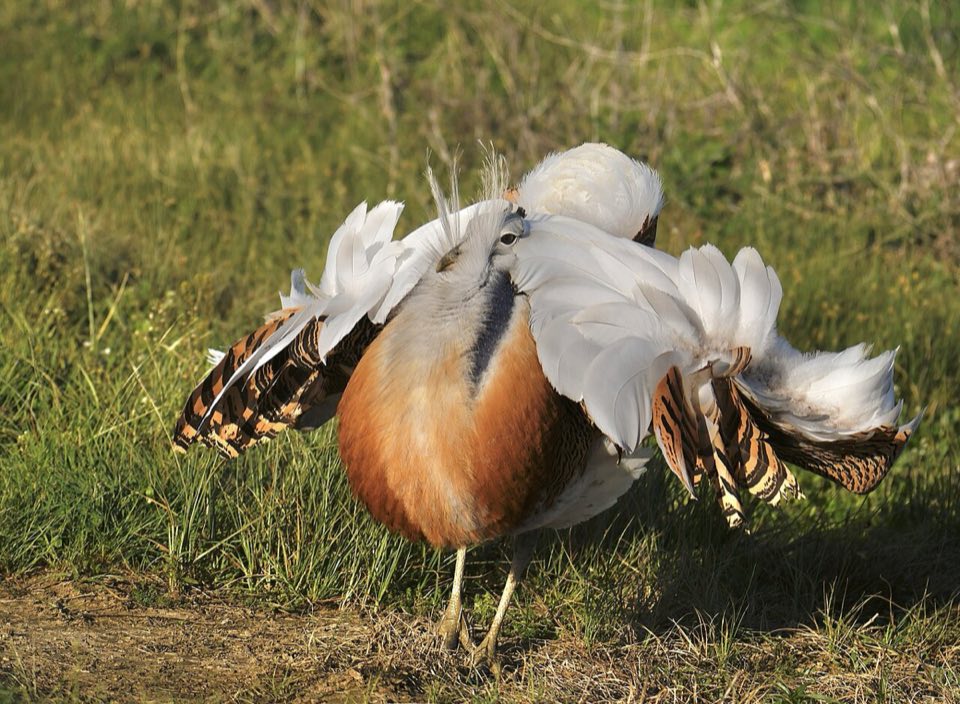
Great bustard (Otis tarda), little bustard (Tetrax tetrax), calandra lark, lesser kestrel, roller, black-bellied sandgrouse, Montagu's harrier, Spanish imperial eagle. Campo Branco, Castro Verde, Baixo Alentejo, Portugal.
Best time: 20 Mar – 30 Apr (March to April). Where: LPN – Centro de Educação Ambiental do Vale Gonçalinho, Entradas – Carregueiro road, São Marcos da Ataboeira (Portugal). Time of day: Males display from first light until about 2 h after sunrise and again in the last 2 h before sunset.
- You can go on your own
- Free
- Telescope recommended
- Sound 3/5
Open it in the interactive calendarSunrise and sunset listening times for the day you pick, and the map.
When is the best time?
Peak: 20 Mar – 30 Apr. Late March to end of April for the great bustard display; little bustard calling and the lark chorus run on into May
Active from 1 Mar to 31 May (March to May) in a typical year.
Time of day
Males display from first light until about 2 h after sunrise and again in the last 2 h before sunset; the calandra lark chorus is loudest in the first hour of daylight, little bustards call at dusk and on moonlit nights.
- Dawn display and lark chorus: 30 min before sunrise → 2 h after sunrise
- Evening display: 2 h before sunset → 30 min after sunset
What will you hear?
A wall of calandra lark song over the cereal steppe at dawn, the dry 'prrrt' snort of little bustards, lesser kestrel colonies chattering on the farm buildings and, with luck, the low booming grunt of a displaying great bustard — mostly this is a sight: white 'foam-bath' males on the ridge lines.
Binoculars?
Telescope recommended. Bustards are usually 300 m to 1 km from the roads and tracks — a scope is the norm; the larks and lesser kestrels need nothing.
Where to go
- LPN – Centro de Educação Ambiental do Vale Gonçalinho — LPN's reserve and visitor centre with a 3.5 km marked circular trail through the steppe; staff advise where the bustards are that week. Follow the old road from Castro Verde towards Entradas to the junction marked with a great bustard silhouette. Map
- Entradas – Carregueiro road — Minor roads north of Castro Verde through the core SPA; watch from the verges. Map
- São Marcos da Ataboeira — Eastern part of the steppe towards Mértola; sandgrouse and rollers on the tracks. Map
How to go on your own, and what it costs
Vale Gonçalinho: from Castro Verde take the old road parallel to the IP2 north towards Entradas and turn at the junction marked with a great bustard silhouette; park by the environmental centre and walk the marked 3.5 km loop (open access; the centre itself has office hours — check with LPN). Elsewhere drive the minor roads around Entradas, Carregueiro and São Marcos da Ataboeira and watch from the verges; free, no permits.
Cost: Free.
Field-recording notes
Private farmland throughout — stay on the marked trail at Vale Gonçalinho and on the public roads elsewhere, and close every gate. LPN warns that birdwatcher pressure has hurt breeding success: never walk towards displaying males, no playback for bustards or sandgrouse. The IP2 road hums across the plain; move a few kilometres east for quiet. Wind drops at dawn; by 10:00 in April it is already too warm and the larks thin out. Motorhomes may not overnight at the centre (Castro Verde has designated spots).
Sources
Similar spectacles
 Capercaillie and black grouse leks in the eastern forestsCapercaillie's clicking, cork-pop and grinding song from pine bog edges, wing-beats of cocks flying in, black grouse bubbling on the open bogs; cranes, whooper swans and Tengmalm's owl in the same nights.
 Black grouse leksBubbling 'rookooing' from displaying males, hissing 'tchu-wee' sneezes and flutter jumps; curlew and snipe often in the same soundscape.
 Capercaillie and black grouse — the ones you do not visitThe capercaillie's accelerating clicks, 'cork-pop' and grinding — a very quiet song (audible to ~200 m) that is almost never recorded in Germany without a permit. Black grouse bubbling in the Alps.
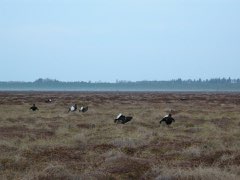 Black grouse leks in the AlpsBubbling 'rookooing' and hissing from males on snow patches at the treeline, ring ouzels, water pipits, and meltwater.
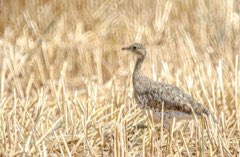 La Crau steppe: little bustard, sandgrouse & stone-curlewLittle bustards' dry 'prrrt' with a foot-stamp and wing-whirr jump, sandgrouse 'catar-catar' flights to drinking pools, calandra larks in continuous song-flight, stone-curlews at dusk.
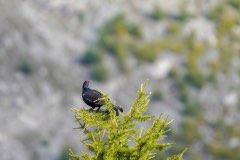 Black grouse leks in the Alps and JuraBubbling 'rookooing' rolling across a snow-patched alpine meadow from several cocks, sneezing 'tchu-shwee' hisses, wing-flutter jumps; ring ouzel and water pipit around them; cowbells not yet arrived.
More: all spectacles in Portugal · leks · March · April