
Fruit bat colony on the cliffs of Wli Falls
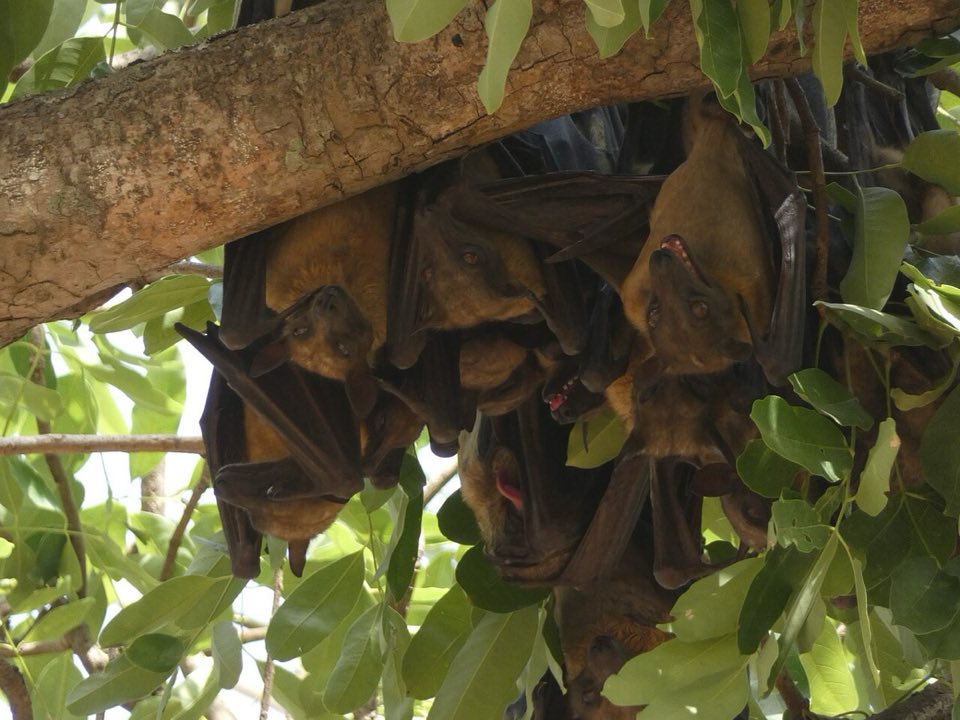
Straw-coloured fruit bat (Eidolon helvum), with other fruit bats on the cliffs. Agumatsa Wildlife Sanctuary, Hohoe, Volta Region, Ghana.
Best time: 1 Nov – 31 Mar (November to March). Where: Wli – lower falls and cliff colony, Wli Todzi / upper falls path (Ghana). Time of day: Bats chatter on the cliff all day.
- Guide, ranger or boat needed
- Entry fee
- Binoculars helpful
- Sound 4/5
Open it in the interactive calendarSunrise and sunset listening times for the day you pick, and the map.
When is the best time?
Peak: 1 Nov – 31 Mar. November to March: the falls are quieter, the path is dry and the colony is at its fullest
Active from 1 Jan to 31 Dec (all year) in a typical year.
Time of day
Bats chatter on the cliff all day; the emergence starts at sunset and pours off the cliff for about 40 minutes
- Evening emergence: 30 min before sunset → 1 h after sunset
What will you hear?
A high, ceaseless chattering from many thousands of bats hanging on the cliff face beside the upper cascade, then the rush of wings as the colony peels off at dusk over the pool, all against the falls.
Binoculars?
Binoculars helpful. The colony hangs on the cliff face 50–100 m above the pool; binoculars show the bats, the emergence is overhead.
Where to go
- Wli – lower falls and cliff colony — 45-minute guided walk from the Wli visitor centre; the cliff colony is above and to the side of the lower falls. Map
- Wli Todzi / upper falls path — Steep 2–3 h climb; closer to the cliff and higher above the water noise. Map
How to go on your own, and what it costs
The Agumatsa sanctuary requires a guide from the Wli visitor centre for the walk to the falls (community rule); tro-tro from Hohoe to Wli. Pay the entry and guide fee at the centre and ask for a late walk so you are at the cliff at sunset.
Cost: Lower falls entry GHS 25 Ghanaian / GHS 60 non-Ghanaian adult (GHS 7 / 25 child), guided upper-falls hike GHS 60–70 Ghanaian / GHS 80–90 non-Ghanaian (2025); guide included in the entry.
Free or no-guide alternative: The evening emergence is visible and audible for free from Wli village and the road below the falls; the bats stream out over the valley at dusk. Only the cliff itself needs the guide.
Who runs access
- Wli Waterfalls visitor centre – guided walks (community project) — Community/Wildlife Division; guide compulsory
Field-recording notes
The falls are the problem and the point: in the rains (May–Oct) the lower falls are a broadband roar and the bats are only a texture on top of it; in the dry season the flow drops enough for the colony to carry. A guide is compulsory and the sanctuary closes to visitors at dusk, so an evening emergence needs the guide's agreement to stay late (and to walk out in the dark). The pool is a bathing spot and a weekend picnic site; weekday afternoons are quieter. Guano falls from the cliff in the emergence.
Sources
Similar spectacles
 The Plateau fruit bats of Abidjan — a city-centre roost flying out to the Banco forestA shrieking, squabbling wall of sound from the big trees of the Plateau administrative district, wing-slaps and jostling, then the rush of the evening emergence over the avenues and the lagoon bridges. The return at first light is quieter and more musical — thousands of bats settling and arguing over branches above the empty Sunday streets.
 Straw-coloured fruit bats over FreetownThe squabbling, squeaking chorus of a straw-coloured fruit bat roost and the wing-rush of the dusk emergence over a city — one of the great urban wildlife sounds of West Africa, if the colony can be found.
 East Nimba Nature Reserve — the Liberian side of Mount NimbaBat emergences from the disused iron-mine adits below the Nimba ridge (a full-spectrum recorder finds far more than the ear), chimps and hornbills in the remnant forest, and the wind on the grassland summit.
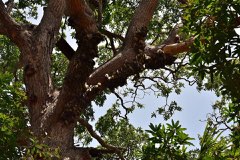 Îles Ehotilé: fruit bats, waterbirds and mangrove lagoonFruit bats chattering on the roost islands and rushing out over the water at dusk, egret colonies bickering as they settle, terns and whimbrel over the flats, and dugout paddles in a mangrove-lined lagoon.
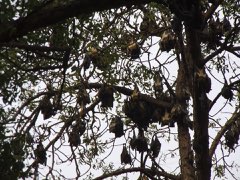 Straw-coloured fruit bat roost at 37 Military Hospital, AccraA continuous shrieking, chattering wall of sound from the roost trees over the hospital and the 37 lorry station, wing-slaps and squabbling as bats jostle, then the rushing of the evening emergence over Liberation Road. Pied crows and a few raptors work the edges.
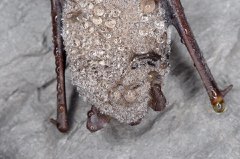 Bat hibernacula in the Mønsted and Daugbjerg limestone minesAudible squeaks and wing-flutter of hundreds of Myotis swarming at the entrances; on a detector, dense FM sweeps and social calls; tawny owls in the beech above; otherwise rural silence.
More: all spectacles in Ghana · bats · Ghana in January · Ghana in February · Ghana in March · November · Ghana in December