
The Plateau fruit bats of Abidjan — a city-centre roost flying out to the Banco forest
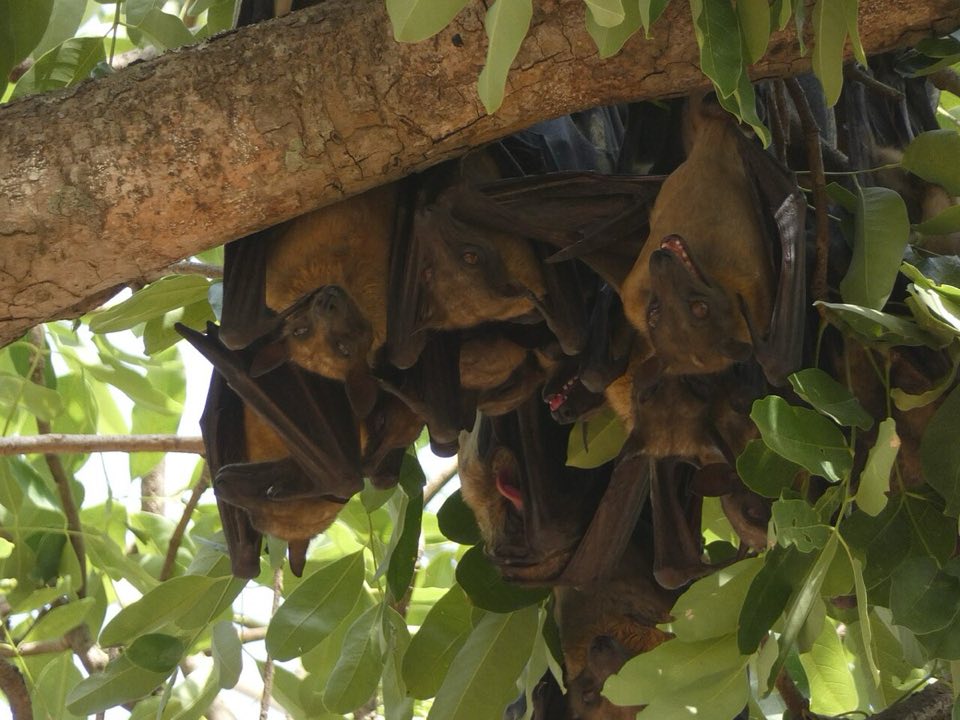
Straw-coloured fruit bat (Eidolon helvum). Le Plateau, central Abidjan, Côte d'Ivoire.
Best time: 1 Nov – 31 Mar (November to March). Where: Plateau – administrative district trees (Avenue Chardy / Boulevard de la République area), Pont Félix Houphouët-Boigny – lagoon edge and flight line, Banco National Park – main entrance (feeding forest) (Côte d'Ivoire). Time of day: Emergence begins 10–20 minutes after sunset and streams out for 30–45 minutes along two axes (west and east-north-east) towards the Banco forest and the lagoon shores.
- You can go on your own
- Free
- No binoculars needed
- Sound 5/5
Open it in the interactive calendarSunrise and sunset listening times for the day you pick, and the map.
When is the best time?
Peak: 1 Nov – 31 Mar. November to March, the dry season, when the roost is fullest — researchers counted just under 200,000 in 2005–06 and estimated up to a million by 2020 before a sharp decline; large 'migratory' movements through the city were recorded in February. No monthly counts are published; ask the Abidjan university team before planning a trip around it
Active from 1 Jan to 31 Dec (all year) in a typical year.
Time of day
Emergence begins 10–20 minutes after sunset and streams out for 30–45 minutes along two axes (west and east-north-east) towards the Banco forest and the lagoon shores; the return is in the last hour before sunrise; the roost chatters all day, loudest in the early-afternoon heat
- Return to roost: 1 h before sunrise → 20 min after sunrise
- Evening emergence: 10 min after sunset → 1 h after sunset
What will you hear?
A shrieking, squabbling wall of sound from the big trees of the Plateau administrative district, wing-slaps and jostling, then the rush of the evening emergence over the avenues and the lagoon bridges. The return at first light is quieter and more musical — thousands of bats settling and arguing over branches above the empty Sunday streets.
Binoculars?
No binoculars needed. The roost trees overhang the pavements and the emergence pours overhead; naked eye.
Where to go
- Plateau – administrative district trees (Avenue Chardy / Boulevard de la République area) — The daytime roost is in the big old trees of the ministries and banks quarter above the commercial district; several roost trees have been felled to drive the bats away, so the exact trees move from year to year. Map
- Pont Félix Houphouët-Boigny – lagoon edge and flight line — The southern flight line crosses the Ébrié lagoon; the bridge approaches and the lagoon front give an open sky for the emergence. Map
- Banco National Park – main entrance (feeding forest) — Where a large part of the colony feeds at night; see ci-banco-abidjan for the dawn chorus there. Map
How to go on your own, and what it costs
Any taxi or the Sotra bus to the Plateau; stand on the public pavements under the roost trees by day, or on the lagoon front near the Houphouët-Boigny bridge for the emergence. No ticket, no guide. Avoid the pavements in front of guarded ministries and the presidency.
Cost: Free (public streets); a taxi across the city is a couple of thousand CFA.
Field-recording notes
A roost in the government quarter: military and presidential buildings are close, and anyone with a rig on a tripod will be asked what they are doing — carry ID, stay on public pavements, never point at a guarded gate. The bats sit well above the traffic bed at the roost; the emergence is best taken from the lagoon front where the sky is open and the traffic is behind you. Guano and urine fall under the trees. The colony's size has crashed since 2020 with tree felling and hunting (smoked bats are sold as food) — confirm it is still there before flying in; the AFP piece quotes Magloire Niamien (University of Korhogo) and Blaise Kadjo (Université Félix Houphouët-Boigny) as the people who count it. Sundays and early mornings are the quiet times on the Plateau.
Sources
- AFP / ADF – Les chauves-souris d'Abidjan font face à un futur problématique (2022: up to a million bats in 2020, decline, hunting, tree felling)
- The bats of Abidjan — Plateau roost, Niamien et al. counts (blog summary of the 2005–06 fieldwork)
- Straw-coloured fruit bat (Wikipedia) — migration and colony ecology
Similar spectacles
 Straw-coloured fruit bat roost at 37 Military Hospital, AccraA continuous shrieking, chattering wall of sound from the roost trees over the hospital and the 37 lorry station, wing-slaps and squabbling as bats jostle, then the rushing of the evening emergence over Liberation Road. Pied crows and a few raptors work the edges.
 Straw-coloured fruit bats over FreetownThe squabbling, squeaking chorus of a straw-coloured fruit bat roost and the wing-rush of the dusk emergence over a city — one of the great urban wildlife sounds of West Africa, if the colony can be found.
 Fruit bat colony on the cliffs of Wli FallsA high, ceaseless chattering from many thousands of bats hanging on the cliff face beside the upper cascade, then the rush of wings as the colony peels off at dusk over the pool, all against the falls.
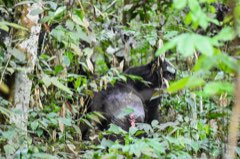 East Nimba Nature Reserve — the Liberian side of Mount NimbaBat emergences from the disused iron-mine adits below the Nimba ridge (a full-spectrum recorder finds far more than the ear), chimps and hornbills in the remnant forest, and the wind on the grassland summit.
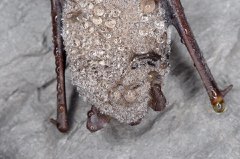 Bat hibernacula in the Mønsted and Daugbjerg limestone minesAudible squeaks and wing-flutter of hundreds of Myotis swarming at the entrances; on a detector, dense FM sweeps and social calls; tawny owls in the beech above; otherwise rural silence.
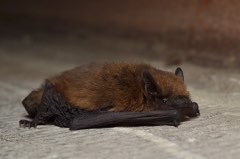 Bat emergence & autumn swarmingMostly ultrasonic: echolocation and feeding buzzes, social calls. Noctule social calls and some horseshoe calls are partly audible.
More: all spectacles in Côte d'Ivoire · bats · Côte d'Ivoire in January · Côte d'Ivoire in February · Côte d'Ivoire in March · Côte d'Ivoire in November · Côte d'Ivoire in December